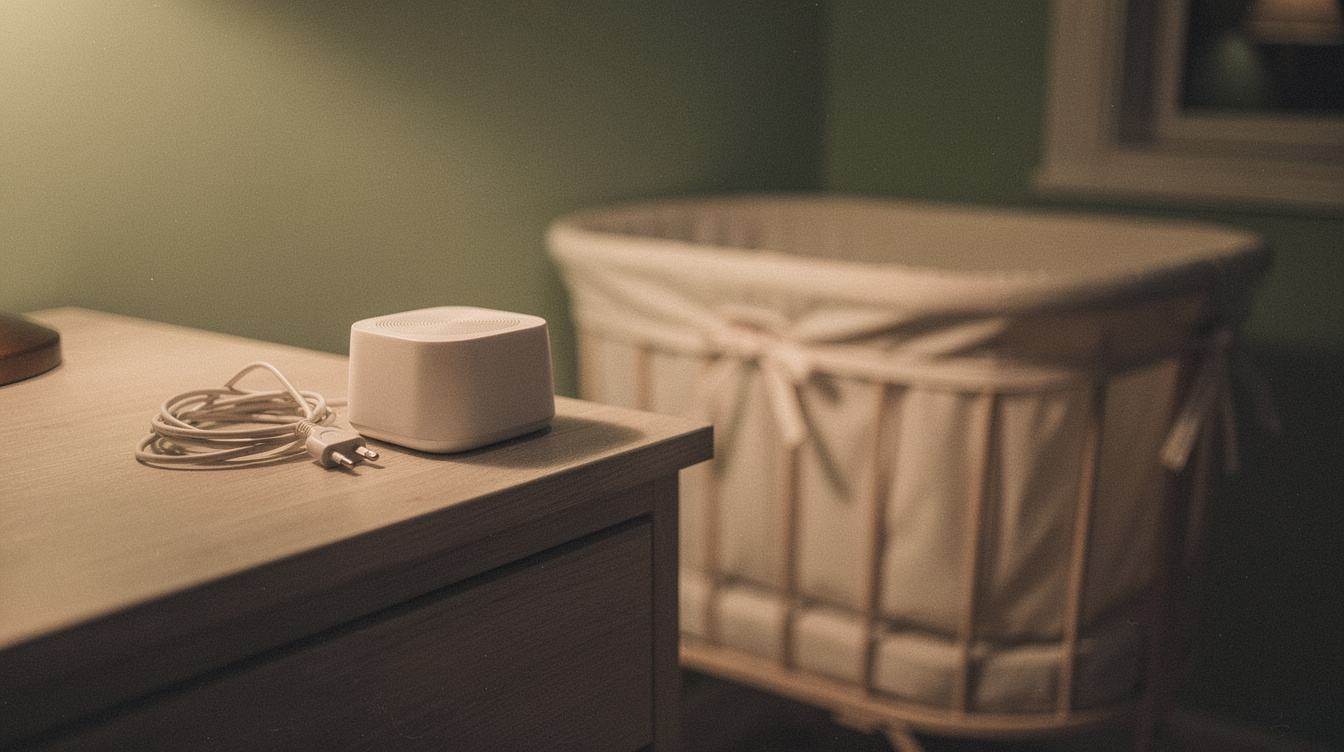
The journal · Sleep
White Noise for Babies: How Loud Is Too Loud, and How Far Away It Should Sit
In short
White noise does seem to help newborns settle — in one randomized trial, 80 percent of newborns fell asleep within five minutes with white noise versus 25 percent without it. The catch is volume. When researchers tested 14 infant sleep machines at full blast, the average output was 79 decibels at crib-rail distance, three were over 85 decibels, and all but one stayed above the 50-decibel limit used for infants even from across the room. So the machine goes far from your baby's head, the volume goes low, it runs for a short time rather than all night, and the cord stays at least three feet from the crib.
Somebody will hand you a sound machine at your baby shower, or you will end up running a phone app at 2 a.m. because it is the only thing that works. White noise has quietly become standard newborn equipment, and for good reason — there is real evidence it helps babies settle.
What almost nobody tells you is that the volume knob matters more than the machine. The one study that measured these devices found most of them, turned all the way up, were loud enough to worry the researchers. That is the part worth two minutes of your attention — because it is easy to fix, and because nobody fixes what they do not know about. Here is what the actual guidance and research say, and where the commonly repeated advice turns out to be fuzzier than it looks.
01Does white noise actually help babies sleep?
There is more than folklore behind this one. In a randomized trial published in Archives of Disease in Childhood, Spencer and colleagues studied "two groups of 20 neonates, between 2 and 7 days old." The result was striking: "Sixteen (80%) fell asleep within five minutes in response to white noise compared with only five (25%) who fell asleep spontaneously in the control group." The authors concluded that "white noise may help mothers settle difficult babies."
That is one small study on days-old newborns, not proof that a sound machine will fix every rough night. But it is a real randomized comparison, and the American Academy of Pediatrics acknowledges the same two-sided picture in its own write-up of its noise policy: "while some studies show potential benefits in the use of infant sleep machines, one study raised potential concern about sound levels from these devices" (HealthyChildren.org).
So: plausibly helpful, with a volume problem attached. Let's look at the study that raised the concern, because the numbers are specific and genuinely useful.
02The part nobody mentions: most machines are too loud
In 2014, a team published a study in Pediatrics that did the obvious thing nobody had done: they bought the machines and measured them. As NEJM Journal Watch summarized it, "Researchers purchased 14 ISMs that are commercially available in the U.S. and Canada and measured sound levels at maximum volume from three distances: 30 cm (placement on a crib rail), 100 cm (near a crib), and 200 cm."
What they found, at maximum volume:
- The average machine hit 79 decibels at crib-rail distance. "The mean maximum output of the ISMs was 79 dBA at 30 cm."
- Three of the 14 crossed into workplace-hazard territory. "Three ISMs produced noise >85 dBA at 30 cm, exceeding maximum work place noise levels for adults."
- Distance alone did not solve it. "All but one ISM produced noise levels >50 dBA — the maximum for infants — at all three distances." In other words, even from roughly seven feet away, thirteen of the fourteen machines were still above the 50-decibel ceiling used for infants, as long as the volume was maxed out.
That last point is the one that reframes everything. Moving the machine across the room is good practice, but it is not a substitute for turning the volume down. You need both.
03What those decibel numbers actually mean
Decibels are a confusing unit because they do not add up the way inches do. The practical thresholds, from the National Institute on Deafness and Other Communication Disorders at the NIH, are these: "Sounds at or below 70 A-weighted decibels (dBA), even after long exposure, are unlikely to cause hearing loss. However, long or repeated exposure to sounds at or above 85 dBA can cause hearing loss."
Set the study's findings against that. An average of 79 decibels at the crib rail sits above the 70-decibel "unlikely to cause harm" line, and three machines cleared 85. The NIH also notes two things worth holding onto: "The louder the sound, the shorter the amount of time it takes for NIHL to happen," and the damage is not the kind that heals — "Most NIHL is caused by the damage and eventual death of these hair cells. Unlike bird and amphibian hair cells, human hair cells don't grow back."
And a baby is not a small adult in this respect. The AAP points out that "children have smaller ear canals than adults, which intensifies higher frequency sounds," and stresses that the concern "involves not just volume but also duration and frequency of exposure." A machine that plays for ten hours a night, every night, for months is a duration question as much as a volume one.
Nothing here means you ruined anything
If you have been running a sound machine on the crib rail at full volume, the honest reading of the research is not that harm has happened — it is that the devices are capable of levels that concerned the people who measured them, which is why the guidance exists. Turn it down, move it back, and that is the whole fix. This is general information rather than medical advice, and if you have any worry at all about your baby's hearing, your pediatrician is the right person to ask.
04How to use a sound machine safely
Three of these come straight from the sources above. The fourth is about the cord, which has nothing to do with sound and everything to do with safety.
The four rules
- Put it as far from your baby's head as you can. The AAP is direct about this: if you use a sleep machine, "place it as far away from the baby's head as possible." Across the room, not on the crib rail — the crib rail was the loudest of the three distances tested.
- Turn the volume well down from maximum. Every number in the 2014 study was measured at maximum volume, and the study's own recommendation was to use "the lowest volume setting" (NEJM Journal Watch). A good instinct: if it is loud enough that you have to raise your voice over it, it is too loud.
- Run it for a short time, not all night. The AAP's wording is "use it for a short time only," and the study authors recommended operating machines "briefly until the child sleeps." If your machine has a sleep timer, that is the feature to use — the researchers actually asked manufacturers to add automatic timers.
- Keep the power cord at least three feet from the crib. This one is not about noise. The U.S. Consumer Product Safety Commission tells parents to "keep these cords and monitors at least 3 feet away from your baby's crib" — guidance written about baby monitors, and exactly as relevant to any other corded device near a sleep space. A dangling cord is a strangulation hazard, and it is the reason a sound machine never belongs inside or on the edge of a crib.
05About that "seven feet" number you keep seeing
Search for this topic and you will be told, confidently and everywhere, that the AAP says to place a sound machine at least seven feet (200 centimeters) from the crib and keep it under 50 decibels. We went looking for that sentence in the AAP's own materials and could not find it. What the AAP's parent-facing pages actually say is "as far away from the baby's head as possible" and "for a short time only" — no number attached.
The two figures do have real roots. The 200-centimeter distance is the farthest of the three distances the 2014 researchers measured, and 50 dBA is described in that study as "the maximum for infants." So the advice is sensible and traceable. We are just not going to put a specific number in the AAP's mouth that we could not verify in a page we actually read — and if you remember only one thing from this section, it should be the finding that at 200 centimeters, thirteen of fourteen machines were still over 50 decibels at full volume. The distance is the easy half. The volume knob is the half that does the work.
On the related question of when to stop using white noise altogether: we found no age or deadline in any of the sources we checked for this piece, so we are not going to invent one. The AAP's "short time only" framing applies whatever your baby's age.
06What white noise cannot do
A sound machine is a settling tool. It is not a sleep-safety measure, and it does not change anything about where or how your baby sleeps. The AAP's safe sleep guidance still governs that part: a firm, flat surface that "shouldn't indent when your baby is lying on it," and nothing soft or loose in the sleep space — "pillows and pillow-like toys, quilts, comforters, mattress toppers, non-fitted sheets, blankets, toys, bumper pads or related products that attach to crib slats or sides" — because those "can increase your baby's risk of entrapment, suffocation or strangulation." The AAP also recommends sharing a room, not a bed, "for at least the first 6 months of life."
Our full write-up of that guidance is in safe sleep for newborns, and it is the one page on this site we would ask you to read twice. If white noise is one of several things you are reaching for during a hard stretch of evening, our guide to soothing a crying newborn covers the rest of the toolkit.
07One quiet thing worth knowing
Your baby almost certainly had their hearing checked before you left the hospital — it is a routine newborn screening, and we cover what the result means in newborn hearing screening. That baseline is part of why the volume question is worth a moment now rather than later: hearing is one of the few things in newborn care where the damage, if it ever happened, would not announce itself and would not undo itself.
The fix costs nothing. Machine across the room, volume low, timer on, cord three feet clear of the crib. Then let it do its job. The rest of the newborn learning curve — feeding, sleep stretches, diapers, and when to pick up the phone and call the doctor — is laid out in our newborn basics guide, sourced the same way this page is.
Questions parents actually ask
Is white noise safe for babies?
Used carefully, the sources we reviewed do not say it is unsafe — but the devices themselves can be. A 2014 study in Pediatrics measured 14 infant sleep machines at maximum volume and found an average of 79 decibels at crib-rail distance, with three machines above 85 decibels. The AAP's guidance is to place a sleep machine as far from your baby's head as possible and use it for a short time only.
How loud should white noise be for a baby?
Low — well below maximum. The 2014 Pediatrics study describes 50 A-weighted decibels as the maximum for infants, and the study's own recommendation was to use the lowest volume setting. For context, the NIH says sounds at or below 70 dBA are unlikely to cause hearing loss even after long exposure, while long or repeated exposure at or above 85 dBA can cause it. A practical test: if you have to raise your voice over the machine, turn it down.
How far should a sound machine be from the crib?
As far as you reasonably can. The AAP says to place it as far from your baby's head as possible without naming a distance. The 2014 study measured machines at 30, 100 and 200 centimeters (roughly 1, 3 and 7 feet), and found that at all three distances all but one machine still exceeded 50 decibels at maximum volume — so distance helps but does not replace turning the volume down. Separately, the CPSC says to keep cords at least 3 feet from the crib.
Can I leave white noise on all night?
The guidance points the other way. The AAP says to use a sleep machine for a short time only, and the authors of the 2014 study recommended running machines briefly until the child falls asleep — they even asked manufacturers to build in automatic timers. The AAP also stresses that noise exposure is about duration and frequency, not volume alone, so all night every night is the pattern the advice is written to avoid.
Does white noise really help newborns fall asleep?
There is real evidence for it. In a randomized trial of 40 newborns aged 2 to 7 days published in Archives of Disease in Childhood, 16 of 20 babies (80 percent) fell asleep within five minutes with white noise, compared with 5 of 20 (25 percent) in the control group. The authors concluded white noise may help settle difficult babies. It is one small study, but it is a genuine randomized comparison.
Does a sound machine make sleep safer?
No — it has no bearing on sleep safety either way. Safe sleep is about the surface and the space: a firm, flat surface with nothing soft or loose in it, and sharing a room rather than a bed for at least the first six months, per the AAP. A sound machine is a settling tool that sits outside the crib, and the one safety rule attached to it is keeping its cord well clear of the sleep space.
Sources
- NEJM Journal Watch — Can Sleep Machines Damage Infant Hearing? (summary of Hugh et al., Pediatrics, 2014) — 14 commercially available infant sleep machines tested at maximum volume from 30 cm (crib rail), 100 cm and 200 cm; mean maximum output 79 dBA at 30 cm; three machines produced noise above 85 dBA at 30 cm, exceeding maximum workplace noise levels for adults; all but one machine exceeded 50 dBA — described as the maximum for infants — at all three distances; recommendations to place machines far from infants, use the lowest volume setting and run them briefly until the child sleeps; call for manufacturers to limit output, add warnings and add automatic timers.
- HealthyChildren.org (AAP) — How Noise Affects Children — Some infant sleep machines can produce hazardous noise levels; if you use one, place it as far away from the baby's head as possible and use it for a short time only.
- HealthyChildren.org (AAP) — AAP Sounds Alarm on Excessive Noise Risks to Children — Children have smaller ear canals than adults, which intensifies higher frequency sounds; noise above 70 decibels over prolonged periods may damage hearing and above 120 decibels can cause immediate harm; concern involves duration and frequency as well as volume; some studies show potential benefits of infant sleep machines while one study raised concern about their sound levels; pediatricians can counsel parents on safe use.
- NIDCD (National Institutes of Health) — Noise-Induced Hearing Loss — Sounds at or below 70 A-weighted decibels are unlikely to cause hearing loss even after long exposure; long or repeated exposure at or above 85 dBA can cause hearing loss; the louder the sound, the shorter the time it takes; most noise-induced hearing loss comes from damage and death of inner-ear hair cells, and human hair cells do not grow back.
- Spencer JAD, Moran DJ, Lee A, Talbert D (1990). White noise and sleep induction. Archives of Disease in Childhood 65(1):135-137 (full text via PubMed Central) — Randomized trial of two groups of 20 neonates aged 2 to 7 days; 16 of 20 (80%) fell asleep within five minutes in response to white noise compared with 5 of 20 (25%) who fell asleep spontaneously in the control group; authors concluded white noise may help mothers settle difficult babies.
- U.S. Consumer Product Safety Commission — OnSafety: Baby Movement Monitor Recall, A Cord Issue — CPSC guidance to keep cords and monitors at least 3 feet away from a baby's crib because of the strangulation hazard.
Newborn Weeks is planning help, not medical advice — always follow your own doctor, midwife, or pediatrician.
From the gear guide
- Acrabros Baby Wrap Carrier — our pick in baby carriers
- Boba Baby Wrap Carrier — our pick in baby carriers
- Koala Babycare Silver Nursing Cups — our pick in pumping & nursing bras
- Frida Mom Witch Hazel Perineal Healing Foam — our pick in postpartum recovery
Keep reading
 Sleep · 13 min read
Newborn Day-Night Confusion: Why Your Baby Is Up All Night (and What Actually Helps)
Newborn day-night confusion is a body clock that isn't built yet. What the AAP and sleep research say actually helps, and when it ends on its own.
Read the article Feeding · 14 min read
Baby Won't Take a Bottle? What Actually Helps, Step by Step
Baby won't take a bottle? The AAP-, La Leche League- and CDC-backed fixes that help: who offers it, when, how warm the milk is, and when to call the doctor.
Read the article Pregnancy · 13 min read
The Tdap Vaccine in Pregnancy: Why It's Given at 27 to 36 Weeks
The Tdap vaccine in pregnancy is given at 27 to 36 weeks so antibodies reach your baby before birth. What the CDC says about timing and safety.
Read the article