The journal · Pregnancy
Back Pain During Pregnancy: Why It Happens, What Helps, and When to Call
In short
Back pain is one of the most common complaints of pregnancy, and it usually shows up in the second and third trimesters as your ligaments loosen, your belly grows, and your posture shifts. The fixes are simple and mostly free: sleep on your side with a pillow between your knees, wear low-heeled supportive shoes, lift with your knees, use brief low-setting heat, stay gently active, and consider a support belt. Mild back pain is not usually a reason to worry, but sudden, severe, or cramping pain, or back pain with fever, bleeding, or pain when you pee, is a reason to call your provider. A low, dull backache that comes with tightening or pelvic pressure before 37 weeks can be a sign of preterm labor, so call or go in.
It starts as a twinge when you get out of the car. A few weeks later it is the reason you sit down to put on socks, and by the end of the day you are standing at the kitchen counter with both hands pressed into the small of your back like every pregnant person in every movie. Back pain sneaks up on a lot of people in pregnancy, and it can make the whole day feel heavier than it needs to.
The good news is that most of it is ordinary, and most of what helps is simple. The more important news is that a small slice of back pain is not ordinary at all, and it is worth knowing the difference before you need it. Here is what the medical sources actually say about why pregnancy back pain happens, what eases it, and exactly when to stop stretching and pick up the phone.
This is general information, not medical advice
Every pregnancy is different, and the person who knows yours is your own OB, midwife, or family doctor. Before you start a new exercise, medication, support garment, or therapy for back pain, run it past them. And if anything in the "when to call" section below sounds like what you are feeling, call rather than wait.
01How common is back pain in pregnancy?
Very. The Cleveland Clinic says it affects "about 40% of all pregnant women at some point." Scripps Health puts the number higher, saying research shows "up to 70% of pregnant women feel some pain, especially in the lower back." The figures differ depending on how pain is counted, but the takeaway is the same either way: if your back hurts, you have a lot of company.
As for timing, back pain "can strike at any point in pregnancy, but it's more common in the second and third trimesters," according to the Cleveland Clinic. That lines up with when your body is changing fastest.
02Why your back hurts
There is rarely a single cause. It is usually a few changes stacking on top of each other:
- Looser ligaments. "Ligaments in your body become softer and more flexible to prepare you for labor and delivery," says the Cleveland Clinic. Scripps notes this loosening happens "especially in the pelvic area." Looser joints are less stable, and the muscles around them work harder.
- More weight to carry. Scripps says weight gain, "typically 25 to 35 pounds, increases the load on your spine and pelvic joints."
- Stretched belly muscles and shifting posture. Per the Cleveland Clinic, "Your abdominal muscles stretch and weaken, which can lead to poor posture." Those muscles normally help hold your spine up, so your back picks up the slack.
- Everyday movement. "Standing for long periods of time or bending over can also trigger back pain," the Cleveland Clinic says.
- Your baby's position. Late in pregnancy, if the baby's head is against your tailbone or lower back, the Cleveland Clinic says "you could feel more back pain."
MedlinePlus, the National Library of Medicine's patient site, sums it up in five words: "Pregnancy strains your back and posture." It also notes that as the uterus grows, "it may press on the nerves in your legs," which is why some back pain comes with tingling or aching that travels down a leg. That kind of symptom has its own line in the warning-sign section below.
03What actually helps
None of these is a miracle on its own. Together they make a real difference, and almost all of them cost nothing. The sources we reviewed agree on most of this list.
Back pain relief, the sourced version
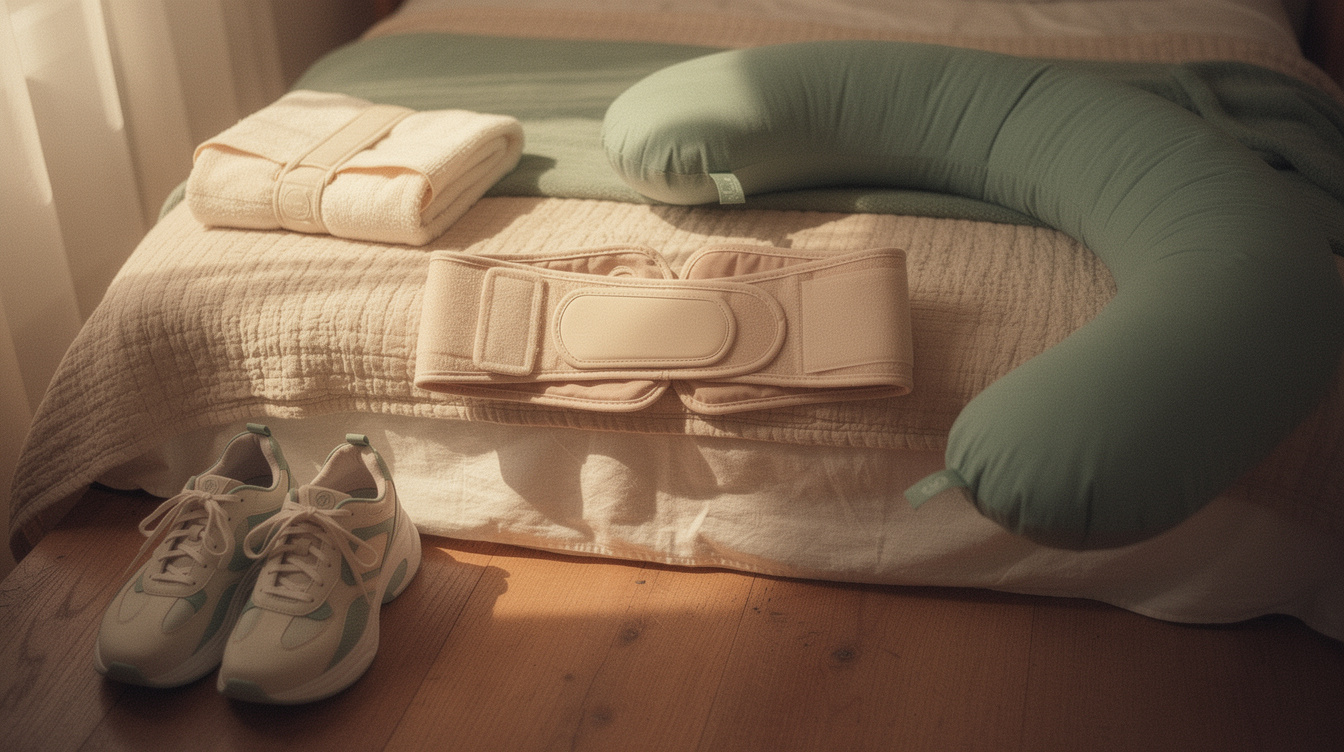
- Sleep on your side with a pillow between your knees. MedlinePlus says to "sleep on your side with a pillow between your legs," and Scripps explains the pillow "helps keep your hips aligned." The Cleveland Clinic adds that providers recommend the left side. Our guide to pregnancy sleep positions covers the rest of the setup.
- Wear low-heeled, supportive shoes. The Cleveland Clinic: "Low-heeled shoes or sneakers are best." Scripps suggests looking for "strong arch support" and to "stay away from high heels."
- Lift with your knees, not your waist. "When lifting objects, bend at your knees and not at your waist" (Cleveland Clinic). MedlinePlus also says to avoid lifting heavy objects, and Scripps puts it plainly: "If it's heavy, ask for help."
- Use heat or cold, briefly. MedlinePlus says to "use heat or cold on the sore part of your back." The Cleveland Clinic says to keep a heating pad "on a low setting and limit your time to about 15 minutes."
- Change position often. "Try not to stay in one position for too long, and shift if you're starting to feel uncomfortable," says the Cleveland Clinic, which also suggests avoiding long stretches of standing. Scripps adds: "Avoid crossing your legs when you sit."
- Support your lower back. The Cleveland Clinic suggests "a lumbar pillow behind your lower back" or a maternity belt. Scripps says a support belt "can help reduce pressure on your lower back and abdomen."
- Stay gently active. The Cleveland Clinic recommends regular exercise, noting "walking and swimming are great options," and suggests cat-cow as a gentle stretch. MedlinePlus says to do back exercises "that your provider suggests." Our guide to exercise during pregnancy covers what is generally considered safe.
- Ask for a back rub. MedlinePlus suggests having someone massage the sore spot. Scripps lists prenatal massage and acupuncture as options, with a caveat: "Always check with your doctor to make sure these options are safe for your stage of pregnancy."
Exercise helps, but go easy
The Cleveland Clinic adds a fair warning to its exercise advice: "Changes to your abdominal muscles can increase your risk of hurting your back during exercise." That is not a reason to stop moving. It is a reason to favor gentle activity like walking and swimming, skip anything that strains your back, and ask your provider which back exercises fit your pregnancy.
What about pain medicine?
This one belongs with your provider, not a blog. The Cleveland Clinic says that if none of the other approaches work, you should "ask your healthcare provider if medications that help with inflammation are safe to use." Scripps says the same thing more broadly: consult your doctor "before starting any new medications, exercises or treatments." Some common pain relievers are not recommended at certain points in pregnancy, so please do not start one on your own because it helped before.
04When back pain means call your provider
Here is the reassuring part first: "Mild back pain isn't typically a reason to worry or call your healthcare provider," says the Cleveland Clinic. The ache at the end of a long day is usually just that.
But some back pain is a signal, not a nuisance. The Cleveland Clinic says to contact your provider if any of these happen, "as they could be a sign of labor":
- "The pain is intense or severe and keeps you from completing normal everyday activities or chores."
- "The pain starts suddenly and sharply."
- "The pain feels more like cramping, and you feel it in your hips or abdomen."
It also says to contact your provider if back pain comes with "a fever, pain when you pee or vaginal bleeding." MedlinePlus says to see your provider right away for constant, severe abdominal pain, possible contractions, or pain with bleeding or fever, and to have any persistent numbness, tingling, or weakness in an arm or leg checked. Scripps adds pain lasting more than two weeks, and "numbness, tingling or radiating pain in your legs."
The backache that can mean preterm labor
This is the one worth memorizing. Preterm labor is "labor that happens too soon, before 37 weeks of pregnancy," per the CDC. The National Institute of Child Health and Human Development (NICHD), part of the NIH, lists its symptoms, and a backache is one of them:
Signs of preterm labor (NICHD)
- Contractions (tightening of stomach muscles, or birth pains) every 10 minutes or more often
- Change in vaginal discharge (leaking fluid or bleeding from the vagina)
- Feeling of pressure in the pelvis (hip) area
- Low, dull backache
- Cramps that feel like menstrual cramps
- Abdominal cramps with or without diarrhea
NICHD notes that "it is not normal to have frequent uterine contractions, such as six or more in one hour," and that anyone who thinks they might be in preterm labor "should call her doctor or go to the hospital to be evaluated." The CDC says the same: see a health care provider right away.
The simple rule
A sore back that eases when you rest, change position, or use a little heat is almost always ordinary. A backache that comes and goes in a rhythm, arrives with tightening, cramping, pelvic pressure, fluid, bleeding, or fever, or is sudden and severe, gets a phone call. Before 37 weeks, call or go in. Nobody at your provider's office will think you overreacted, and "it was nothing" is a perfectly good outcome. Our guides to signs of labor and Braxton Hicks contractions explain how practice contractions differ from the real thing.
05Plan around your back, not against it
Back pain tends to peak right when the to-do list does: the third trimester, when the crib needs assembling, the car seat needs installing, and the nursery needs everything carried in from the garage. That is the worst possible time to be bending, lifting, and standing for hours.
So do the physical jobs earlier, while your back is still cooperating, and hand off the heavy ones entirely. That is the whole idea behind our free week-by-week planner: enter your due date and it moves the lifting, building, and hauling into the middle of pregnancy, so the final weeks are for resting, side-sleeping with a pillow between your knees, and letting someone else carry the boxes.
Questions parents actually ask
Is back pain during pregnancy normal?
Yes, it is very common. The Cleveland Clinic says it affects about 40% of pregnant women at some point, and Scripps Health cites research showing up to 70% feel some pain, especially in the lower back. Mild back pain is not typically a reason to worry, but sudden, severe, or cramping pain, or pain with fever, bleeding, or pain when you pee, is a reason to call your provider.
When does back pain start in pregnancy?
It can start at any point, but the Cleveland Clinic says it is more common in the second and third trimesters, as ligaments loosen, weight increases, and posture changes.
Can back pain be a sign of labor?
It can. The NIH's NICHD lists a low, dull backache among the signs of preterm labor, along with regular contractions, pelvic pressure, menstrual-like cramps, and changes in vaginal discharge. The Cleveland Clinic says to contact your provider if back pain is severe, starts suddenly and sharply, or feels like cramping in your hips or abdomen. Before 37 weeks, call your provider or go to the hospital if you think you might be in labor.
What is the best sleeping position for back pain during pregnancy?
On your side with a pillow between your knees or legs. MedlinePlus recommends side sleeping with a pillow between your legs, Scripps says the pillow helps keep your hips aligned, and the Cleveland Clinic notes providers recommend the left side.
Do pregnancy support belts help with back pain?
They can. The Cleveland Clinic suggests a maternity belt or a lumbar pillow, MedlinePlus lists wearing a maternity girdle, and Scripps says a support belt can help reduce pressure on your lower back and abdomen. Ask your provider if one makes sense for you.
Can I take pain medicine for back pain while pregnant?
Ask your provider first. The Cleveland Clinic suggests asking whether anti-inflammatory medications are safe if other treatments do not work, and Scripps advises consulting your doctor before starting any new medication. Some common pain relievers are not recommended at certain points in pregnancy.
Sources
- Cleveland Clinic — Back Pain During Pregnancy: Lower, Causes & Treatment — Affects about 40% of pregnant women; more common in the second and third trimesters; ligaments soften, abdominal muscles stretch, standing and bending trigger pain, fetal position can add pain; walking, swimming, cat-cow stretch, lumbar pillow, maternity belt, low-heeled shoes, lifting with knees, heating pad on low for about 15 minutes, left-side sleeping, changing positions; exercise caution; ask provider about anti-inflammatory medication; mild pain usually not worrying; call for severe, sudden, or cramping pain, or pain with fever, pain when peeing, or vaginal bleeding.
- MedlinePlus (National Library of Medicine) — Aches and pains during pregnancy — Pregnancy strains the back and posture; side sleeping with a pillow between the legs; low-heeled shoes; bend the knees and avoid heavy lifting; heat or cold; massage; provider-suggested back exercises; maternity girdle; growing uterus may press on leg nerves; get persistent numbness, tingling, or weakness checked; see a provider right away for severe abdominal pain, possible contractions, bleeding, or fever.
- Scripps Health — How to Relieve Back Pain During Pregnancy: 8 Expert Tips — Up to 70% of pregnant women feel some pain; ligaments loosen especially in the pelvis; weight gain of 25 to 35 pounds loads the spine; side sleeping with a pillow between the knees; supportive low-heeled shoes; ask for help with heavy lifting; avoid crossing legs; support belts; prenatal massage and acupuncture with doctor approval; consult a doctor before new medications; see a provider for pain over two weeks, leg numbness or radiating pain, or pain with bleeding or fever.
- NICHD (NIH) — What are the symptoms of preterm labor? — List of preterm labor symptoms including a low, dull backache, contractions every 10 minutes or more often, pelvic pressure, menstrual-like cramps, and changes in vaginal discharge; six or more contractions in an hour is not normal; call a doctor or go to the hospital if preterm labor is suspected.
- CDC — Preterm Birth — Preterm labor is labor before 37 weeks of pregnancy; see a health care provider right away if you think you are experiencing signs of preterm labor.
Newborn Weeks is planning help, not medical advice — always follow your own doctor, midwife, or pediatrician.
From the gear guide
- Solly Baby Wrap Carrier — our pick in baby carriers
- Infantino Flip 4-in-1 Carrier — our pick in baby carriers
- Momcozy Muslin Swaddle Blankets — our pick in swaddle & receiving blankets
- Doona Car Seat & Stroller — our pick in convertible car seats
Keep reading
 Pregnancy · 12 min read
Stretch Marks During Pregnancy: What Causes Them, What Actually Helps, and What's Safe
Stretch marks during pregnancy affect 50-90% of women. What causes them, why creams don't prevent them, what helps, and what to avoid while pregnant.
Read the article Pregnancy · 11 min read
Dental Care During Pregnancy: Is the Dentist Safe, and What Changes in Your Mouth
Dental care during pregnancy is safe at any stage, per the CDC. What happens to your gums, X-rays and numbing, morning sickness, and when to call the dentist.
Read the article Pregnancy · 10 min read
Headaches During Pregnancy: What Helps, What's Safe to Take, and When to Call
Headaches during pregnancy are common and usually harmless. What helps, what medicine experts say is safe, and the warning signs that mean call right away.
Read the article