The journal · Pregnancy
Dental Care During Pregnancy: Is the Dentist Safe, and What Changes in Your Mouth
In short
Going to the dentist while you're pregnant is safe. The CDC says regular and emergency dental care is safe at any stage of pregnancy, and the American Dental Association says numbing medicine and dental X-rays are safe too. Pregnancy makes swollen, bleeding gums (pregnancy gingivitis) very common: the CDC puts it at about 60% to 75% of pregnant women. Brush twice a day with fluoride toothpaste, floss once a day, rinse with baking soda and water after morning sickness, and tell your dentist you're pregnant. Your own mouth matters for your baby, too, because cavity-causing bacteria can pass from parent to child.
You brush your teeth one morning and the sink turns pink. Your gums are puffy, a little sore, and bleeding in a way they never used to. Then you remember the cleaning appointment you booked six months ago, before the positive test, and wonder whether you're even supposed to go.
Yes, you should go. Of all the pregnancy rules you'll hear, this one is among the clearest: dental care is safe while you're pregnant, and putting it off can cause problems. Here's what public health and dental groups actually say about dentist visits, X-rays, and numbing, why pregnancy is hard on your gums, and what to do at home. Every claim links to the source it came from.
This is general information, not medical advice
Your OB, midwife, and dentist know your history, and a high-risk pregnancy can change the plan. The American Dental Association notes that if your pregnancy has been classified as high-risk, your dentist or doctor might recommend postponing certain treatments. Use this page to prepare for that conversation, not to replace it.
01Is it safe to go to the dentist while pregnant?
Yes. The CDC is direct about it: "Regular and emergency dental care is safe at any stage of pregnancy," and "women are encouraged to seek routine dental care during pregnancy." The American Academy of Pediatrics agrees on its parent site, HealthyChildren.org: "Seeing a dentist while pregnant is totally safe," adding that it's good to get it done "before your hands are full (literally) with your new baby."
The American Dental Association says the same, noting that experts at the ADA, the American College of Obstetricians and Gynecologists, and the AAP "all encourage you to see your dentist while you're expecting." It also suggests taking care of cleanings and any needed procedures, such as cavity fillings, before the baby arrives.
What about timing? March of Dimes says you can have dental treatment any time during pregnancy, and recommends seeing your dentist for a regular checkup every six months, "even during pregnancy." For treatment that's truly optional, it suggests trying to schedule it "in the second trimester or even after you deliver." Pain, swelling, or infection are not optional. Those need a call right away.
Dental X-rays during pregnancy
Dental X-rays are the part that worries people most. The ADA says that according to ACOG, "dental X-rays are safe during pregnancy." It explains that they "emit very low doses of radiation," and that your dental team will keep your exposure down by positioning you properly and aiming the beam only at the area they need to see. March of Dimes also states plainly: "Dental X-rays are safe during pregnancy."
Numbing medicine for fillings, root canals, and extractions
If you need a filling, a root canal, or a tooth pulled, the ADA says the numbing medications your dentist uses "are safe for both you and your baby." It points to a study of pregnant women who received local anesthetics such as lidocaine and found no difference in miscarriage, birth defects, premature birth, or birth weight compared with women who didn't. March of Dimes also calls local anesthesia safe during pregnancy.
One material question to ask about: March of Dimes advises that you should not get dental amalgam (silver, mercury-containing) fillings if you're pregnant, planning a pregnancy, or nursing. If you need a filling, ask your dentist what material they plan to use.
02What pregnancy does to your gums and teeth
If your gums have become a mess, you're in good company. The CDC's guidance for clinicians says "about 60% to 75% of pregnant women have gingivitis," the early stage of gum disease, in which gums become red and swollen from inflammation that "may be aggravated by changing hormones during pregnancy." March of Dimes gives the same 60% to 75% figure.
- Pregnancy gingivitis. March of Dimes lists the signs: redness and swelling, tender gums, shiny gums, and gums that bleed "even when you brush your teeth gently."
- Cavities. The CDC says women may be more prone to gum disease and cavities during pregnancy, and its clinician guidance points to changes in behavior, such as eating habits. The ADA notes that eating more carbohydrates than usual gives extra fuel to the bacteria that cause decay.
- Pregnancy tumors. They sound alarming, but March of Dimes says these red, raw-looking growths on the gums "are not cancer." They bleed easily, can be caused by too much plaque, and "usually go away on their own after giving birth." The ADA notes they usually appear in the second trimester.
- Loose teeth. Pregnancy hormones "can temporarily loosen the tissues and bones that keep your teeth in place," according to March of Dimes, and untreated gum disease can make teeth loose enough that they need to be pulled.
- Acid from morning sickness. Vomiting exposes your teeth to stomach acid, which March of Dimes says "can harm the enamel" (the hard outer surface of your teeth).
03Why your mouth matters for your baby
This is where dental care stops being only about you. The CDC explains that women with a lot of cavity-causing bacteria during and after pregnancy "could transmit these bacteria from their mouth to the mouth of their baby." Its fast facts put a number on it: children of mothers with high levels of untreated cavities or tooth loss "are more than 3 times as likely to have cavities." And it isn't rare: the CDC says one in four women of childbearing age has untreated cavities.
There is also a possible link to how pregnancy goes. March of Dimes says "some studies show a link between gum disease and preterm birth." Note the careful wording: a link found in some studies is not proof that gum disease causes early birth, and we found no source showing that treating your gums prevents it. Healthy gums are still worth the effort, but don't let this turn into one more thing to panic about.
04What to do at home
None of this needs special products. The routine is mostly the one you already know, done consistently, with one extra step if you're throwing up.
Your pregnancy mouth routine
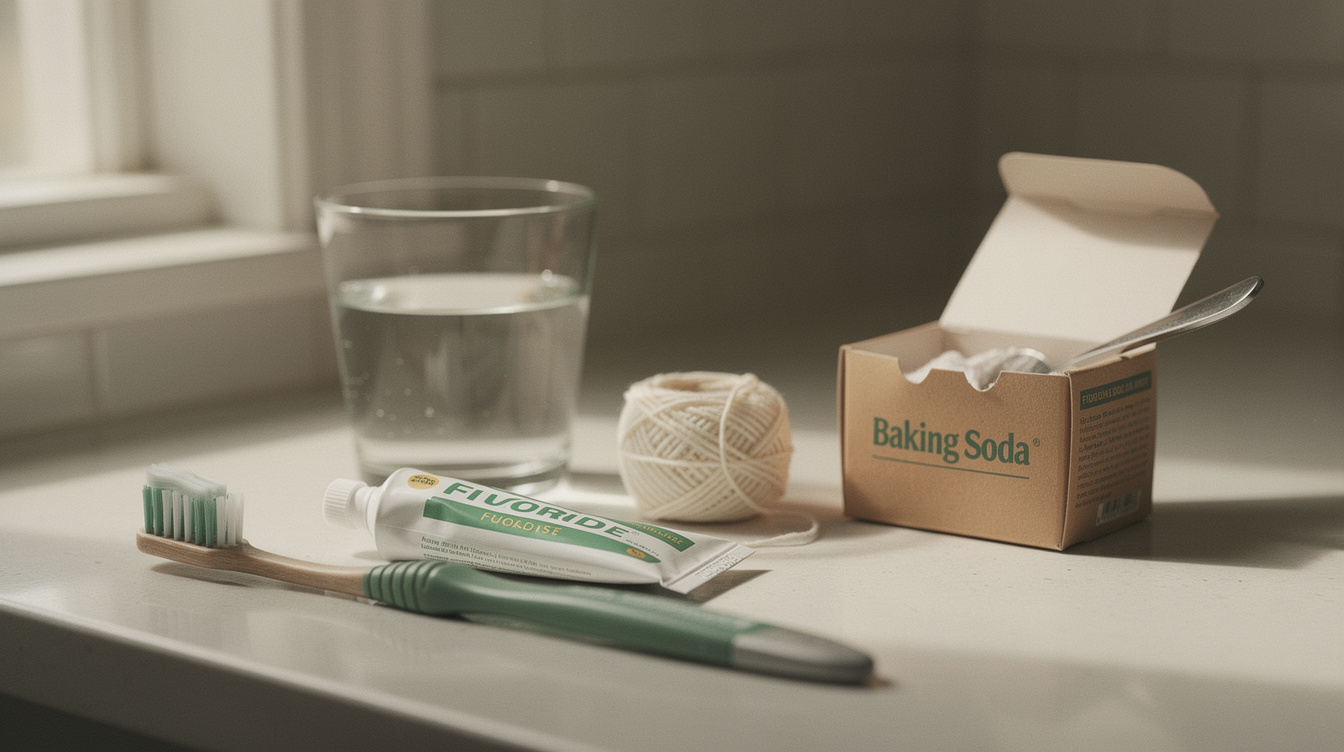
- Brush twice a day with fluoride toothpaste. March of Dimes recommends fluoride toothpaste twice a day and a toothbrush with soft bristles. The ADA adds: at least two minutes each time.
- Floss once a day. HealthyChildren.org calls brushing twice and flossing once "the best way" to keep down the bacteria you could later pass to your baby.
- Rinse after you're sick. HealthyChildren.org says to rinse your mouth "with 1 tsp of baking soda in a glass of water after you get sick." March of Dimes gives the same mix (1 teaspoon baking soda in 1 cup of water) and says rinsing helps reduce the acid in your mouth.
- Drink plain water between meals. The ADA recommends it, which helps when cravings mean more snacking.
- Keep your six-month checkup. March of Dimes says to keep it "even during pregnancy," and notes you can be referred for a dental checkup at your first prenatal visit.
- Tell your dentist you're pregnant. The ADA says to tell them "right away," even if you aren't sure yet, and to share how far along you are and your due date. Mention any medications and prenatal vitamins too, since that helps them choose antibiotics or pain relievers if you need them.
If morning sickness is making even brushing hard, our guide to morning sickness covers what helps and when nausea is worth a call to your provider.
When to call the dentist now, not at your next checkup
March of Dimes is clear: "If you have pain or swelling, call your dentist right away," and an infection needs quick treatment "to help prevent problems for your baby." A toothache, a swollen face or jaw, or a bad taste with pain is not something to wait out until after delivery. Emergency dental care is safe at any stage of pregnancy, according to the CDC.
05Looking ahead: your baby's teeth
The habits you build now carry straight into the newborn months. HealthyChildren.org recommends wiping your baby's gums twice a day with a soft, clean cloth. Once the first tooth comes in, brush twice a day with a rice-grain-sized smear of toothpaste, and take your baby to the dentist by their first birthday. If you don't have a dentist yet, it suggests asking your pediatrician to check your baby's mouth.
That's one reason a dental cleaning belongs on your pregnancy to-do list, not after it. Our pregnancy checklist lays out the appointments and tests trimester by trimester, and the first trimester checklist covers what to book first.
06Book it while you still have time
A dental visit is easy to push off now and hard to fit in once there's a newborn in the house. If it's been more than six months, book the cleaning this week, tell the front desk you're pregnant, and bring your due date. Our free week-by-week planner can hold it for you: enter your due date and it lays out the appointments and prep in the weeks where they fit best, so nothing important lands in the last exhausted stretch.
Questions parents actually ask
Is it safe to go to the dentist while pregnant?
Yes. The CDC says regular and emergency dental care is safe at any stage of pregnancy and encourages routine care. The American Dental Association, the American College of Obstetricians and Gynecologists, and the American Academy of Pediatrics all encourage seeing your dentist while you're expecting. Tell your dentist you're pregnant and share your due date.
Are dental X-rays safe during pregnancy?
Yes. The American Dental Association says that, according to ACOG, dental X-rays are safe during pregnancy. They use very low doses of radiation, and your dental team positions you and aims the beam only at the area they need to see to keep your exposure down. March of Dimes also says dental X-rays are safe during pregnancy.
Why are my gums bleeding during pregnancy?
Most likely pregnancy gingivitis. The CDC says about 60% to 75% of pregnant women have gingivitis, an early stage of gum disease in which gums become red and swollen from inflammation that changing hormones can make worse. Keep brushing twice a day with fluoride toothpaste and a soft brush, floss daily, and keep your dental checkups. Call your dentist if you have pain or swelling.
What should I do for my teeth after morning sickness?
Rinse. Stomach acid can harm tooth enamel, and the AAP's HealthyChildren.org recommends rinsing your mouth with 1 teaspoon of baking soda in a glass of water after you get sick. March of Dimes gives the same mix and says rinsing helps reduce the acid in your mouth.
Can I get a filling or root canal while pregnant?
Yes. The American Dental Association says the numbing medications dentists use for fillings, root canals, and extractions are safe for you and your baby. March of Dimes advises against dental amalgam (mercury-containing) fillings during pregnancy, so ask your dentist what material they plan to use. For purely elective work, March of Dimes suggests the second trimester or after delivery.
Can my teeth affect my baby?
They can. The CDC says cavity-causing bacteria can pass from a mother's mouth to her baby's, and children of mothers with high levels of untreated cavities or tooth loss are more than three times as likely to have cavities. March of Dimes also notes that some studies show a link between gum disease and preterm birth.
Sources
- CDC — Pregnancy and Oral Health Facts — Regular and emergency dental care is safe at any stage of pregnancy; women are encouraged to seek routine dental care; pregnant women may be more prone to gum disease and cavities; one in four women of childbearing age has untreated cavities; children of mothers with high levels of untreated cavities or tooth loss are more than 3 times as likely to have cavities.
- CDC — Talking to Pregnant Women about Oral Health — About 60% to 75% of pregnant women have gingivitis; inflammation may be aggravated by changing hormones; cavity risk from changes in behaviors such as eating habits; cavity-causing bacteria can be transmitted from mother's mouth to baby's.
- HealthyChildren.org (AAP) — Oral Health During Pregnancy & Infancy — Seeing a dentist while pregnant is safe; brush twice and floss once a day; rinse with 1 tsp baking soda in water after vomiting; wipe baby's gums twice a day; rice-grain smear of toothpaste once the first tooth appears; first dental visit by the first birthday.
- March of Dimes — Dental Health During Pregnancy — Dental treatment any time in pregnancy, elective work in the second trimester or after delivery; X-rays and local anesthesia safe; avoid amalgam fillings; 60-75% gingivitis and its symptoms; pregnancy tumors are not cancer and usually go away after birth; hormones can loosen teeth; vomiting acid harms enamel and the baking soda rinse; fluoride toothpaste and soft brush; checkups every 6 months; call right away for pain or swelling; some studies link gum disease and preterm birth.
- American Dental Association (MouthHealthy) — Pregnancy Dental Concerns — ADA, ACOG, and AAP encourage dental visits in pregnancy; dental X-rays are safe per ACOG and use very low radiation doses; local anesthetics are safe for mother and baby; tell your dentist right away, with how far along you are and your due date; share medications; high-risk pregnancies may postpone some treatment; brush two minutes twice daily, floss daily, drink plain water; more carbohydrates fuel decay; pregnancy tumors usually appear in the second trimester.
Newborn Weeks is planning help, not medical advice — always follow your own doctor, midwife, or pediatrician.
From the gear guide
- Mamazing Ultra Air Stroller — our pick in travel strollers
- Jeep Altitude Compact Travel Stroller — our pick in travel strollers
- Burt's Bees Baby Organic Cotton Crib Sheet — our pick in crib sheets & protectors
- Ingenuity Keep Cozy Bouncer & Rocker — our pick in activity centers & jumpers
Keep reading
 Pregnancy · 12 min read
Stretch Marks During Pregnancy: What Causes Them, What Actually Helps, and What's Safe
Stretch marks during pregnancy affect 50-90% of women. What causes them, why creams don't prevent them, what helps, and what to avoid while pregnant.
Read the article Pregnancy · 10 min read
Headaches During Pregnancy: What Helps, What's Safe to Take, and When to Call
Headaches during pregnancy are common and usually harmless. What helps, what medicine experts say is safe, and the warning signs that mean call right away.
Read the article Pregnancy · 10 min read
Constipation During Pregnancy: Why It Happens, What Helps, and When to Call
Constipation during pregnancy is common. Why hormones, iron, and a growing uterus slow things down, what actually helps, and when to call your provider.
Read the article