The journal · Pregnancy
How to Tell If Your Water Broke (and What to Do Next)
In short
Amniotic fluid is usually clear or pale, nearly odorless, and you cannot hold it back the way you can hold urine — it keeps leaking. Urine is darker, smells like urine, and stops once your bladder is empty. If you think your water broke, put on a clean pad, check it after a few minutes, and call your provider right away even if you are not sure — and tell them the time it happened and any color or smell. Most people have contractions within 24 hours. Green or brown fluid, a fever, a foul smell, bleeding, less movement from the baby, or any leaking before 37 weeks means call now, not later.
You stand up off the couch at 34 weeks and feel a small warm gush. Or you get up in the night and your underwear is damp, and you genuinely cannot tell whether that was your water or your bladder. It is one of the most common late-pregnancy phone calls, and nobody feels silly making it twice.
There is a short, practical way to tell the difference, and there is one rule that overrides everything else: if you think your water broke, call — even if you are not sure. Here is what the fluid actually looks and feels like, the check you can do in your own bathroom in five minutes, what happens next, and the handful of signs that mean this is not a wait-and-see situation.
This is general information, not medical advice
Every pregnancy is different, and whether your membranes have ruptured is something only your OB, midwife, or hospital can actually confirm — there are quick tests for it. Nothing on this page replaces calling them. The Office on Women's Health says plainly to "call your doctor if you think your water broke, but are not sure." That is the right move every time, at any hour.
01What your water breaking actually is
Your baby has spent the whole pregnancy inside a fluid-filled bag called the amniotic sac. When that sac tears, the fluid comes out. As the Cleveland Clinic describes it: "The amniotic sac tears, amniotic fluid comes out of your vagina. This is your 'water breaking,' and it's a sign that delivery is right around the corner."
What it feels like is wildly inconsistent, which is exactly why people second-guess themselves. The Cleveland Clinic notes that some people feel "a popping sensation followed by a gush of fluid," while "others feel nothing. Amniotic fluid can trickle into your underwear like a raindrop or rush down your legs like a waterfall." MedlinePlus, the National Library of Medicine's consumer health site, puts it the same way: "It may come out in a trickle or a gush."
So a dramatic movie-scene flood is one version of this. A slow, confusing dampness is an equally normal version.
02Amniotic fluid versus urine: the real differences
Leaking urine is extremely common in late pregnancy — the Office on Women's Health mentions it almost as an aside, because so many pregnant people do it. These are the things that actually separate the two.
- Color. "Pee is usually dark yellow and has a distinct odor. Amniotic fluid is mostly clear or light yellow," says the Cleveland Clinic.
- Smell. Amniotic fluid is described as odorless by the Cleveland Clinic, and MedlinePlus says it "usually has no color and has a much sweeter smell than urine." If it smells unmistakably like urine, it probably is.
- Whether you can stop it. This is the clearest tell. "You can't stop amniotic fluid. If your water breaks, you won't be able to 'hold it' like you can with pee" (Cleveland Clinic).
- Whether it keeps coming. Amniotic fluid "continues to leak (sometimes with a contraction) where urine doesn't" (Cleveland Clinic). A bladder empties and that is the end of it. A tear in the sac keeps producing fluid.
- How much there is. "There's usually more amniotic fluid than pee," per the Cleveland Clinic — and there is a lot of it to work with. At 36 weeks you can have up to about 4 cups of amniotic fluid, and around 2.5 cups at 40 weeks.
03The five-minute check you can do at home
This is not a substitute for the phone call — it is what to do while you are deciding how urgently to make it, and it gives your provider something concrete to work with. MedlinePlus recommends exactly this: "use a pad to absorb some of it. Look at it and smell it."
If you think your water might have broken
- Put on a clean pad and clean underwear. A pad, not a tampon — nothing goes inside once you suspect the sac has torn.
- Wait a few minutes, then stand up and move around. Amniotic fluid tends to keep coming when you change position; urine does not keep refilling.
- Look at the pad. Clear or pale and watery leans amniotic. Dark yellow leans urine. Green, brown, or bloody is a reason to call immediately, not to keep observing.
- Smell it. A sweeter or nearly odorless fluid leans amniotic. A clear urine smell leans urine.
- Note the exact time. The Office on Women's Health says to "let your doctor know the time your water breaks and any color or odor." Write it down — the clock genuinely matters for the decisions your team makes next.
- Call your provider, even if you are still unsure. They can confirm it with a quick exam and test. Guessing at home is the one option that is not on the list.
04How soon does labor start after your water breaks?
Usually soon. "For most women, contractions come within 24 hours after the bag of water breaks," says MedlinePlus, and the Cleveland Clinic agrees that contractions "will typically start within 24 hours of your water breaking."
Worth knowing: for most people the water does not break first at all. The Cleveland Clinic notes that for up to about 90% of people, labor starts before their water breaks. So contractions first and fluid later is the common order, not a sign something has gone sideways.
If labor does not start on its own, your provider may want to get things moving. The Office on Women's Health explains the reasoning: "Often a woman will go into labor soon after her water breaks. When this doesn't happen, her doctor may want to induce (bring about) labor. This is because once your water breaks, your risk of getting an infection goes up as labor is delayed." The sac was a barrier; once it is open, time starts counting.
05The signs that mean call right now
Most of the time, water breaking at term is simply the start of a normal birth story. A few things take it out of the wait-and-see category entirely.
- Green or brown fluid. That coloring can mean the baby has passed meconium — their first stool — into the fluid. MedlinePlus describes meconium-stained fluid as "stained with a greenish or brown substance," and babies commonly pass it in response to stress such as a decrease in blood and oxygen supply. Your team wants to know about this before delivery, not after.
- A fever or a foul smell. The Cleveland Clinic says to call immediately if the fluid is "accompanied by fever, foul-smelling odors, blood or a change in the fetus's movements." A bad smell or a temperature points toward infection.
- Blood. MedlinePlus lists "any vaginal bleeding other than light spotting" as a reason to contact your provider right away.
- The baby moving less. Decreased fetal movement is on that same call-right-away list. Do not wait it out to see if the baby perks up.
- Any leaking before 37 weeks. The Office on Women's Health is direct: "Call your doctor even if it's weeks before your due date — you might be going into preterm labor." And MedlinePlus is blunt about why: "The earlier your water breaks, the more serious it is for you and your baby."
If you want the fuller picture of what else is worth a phone call — contraction patterns, the bloody show, the difference between real labor and practice contractions — our guide to the signs of labor covers all of it, sourced the same way this page is.
06When the water breaks before labor
There is a name for this. The Cleveland Clinic defines premature rupture of membranes, or PROM, as "when you leak amniotic fluid before labor begins. It's commonly called your 'water breaking.'" It is not unusual: PROM affects up to 10% of all pregnancies. When it happens before 37 weeks it is called preterm PROM, or PPROM, which the Clinic puts at about 3% of pregnancies.
What happens next depends almost entirely on how far along you are. The Cleveland Clinic describes delivery typically happening within 24 hours when you are at term — 37 weeks or more. Before 34 weeks, the goal flips toward buying the baby more time safely, which can mean hospital bed rest along with corticosteroids, antibiotics, and other medications. The risks the team is watching for include infection of the membranes (chorioamnionitis), placental abruption, and umbilical cord compression or prolapse.
That list is not meant to frighten you. It is meant to explain why the answer to "should I call or wait until morning?" is always call — those are exactly the things a quick check rules in or out.
07What happens when you get there
Confirming ruptured membranes is quick and not mysterious. The Cleveland Clinic describes providers using a sterile speculum exam to look for pooling fluid and collect a sample, then checking it — one test reads the fluid's acidity on a strip of paper, another looks at how it crystallizes under a microscope in a fern-like pattern. The Office on Women's Health sums it up for parents: "An easy test can tell your doctor if the leaking fluid is urine (many pregnant women leak urine) or amniotic fluid."
They will also check where you are in labor. For reference, MedlinePlus describes true labor contractions as ones that "come regularly and get closer together (about 5 to 10 minutes apart), last from 30 to 70 seconds, and will get longer," and that do "not stop, no matter what you do." Practice contractions do not come at regular intervals and do not change the cervix.
And they will factor in anything already on your chart that changes the plan for labor — your group B strep swab result among them. Our group B strep guide covers that test and what a positive result actually changes, with its own sources.
08The part you can handle in advance
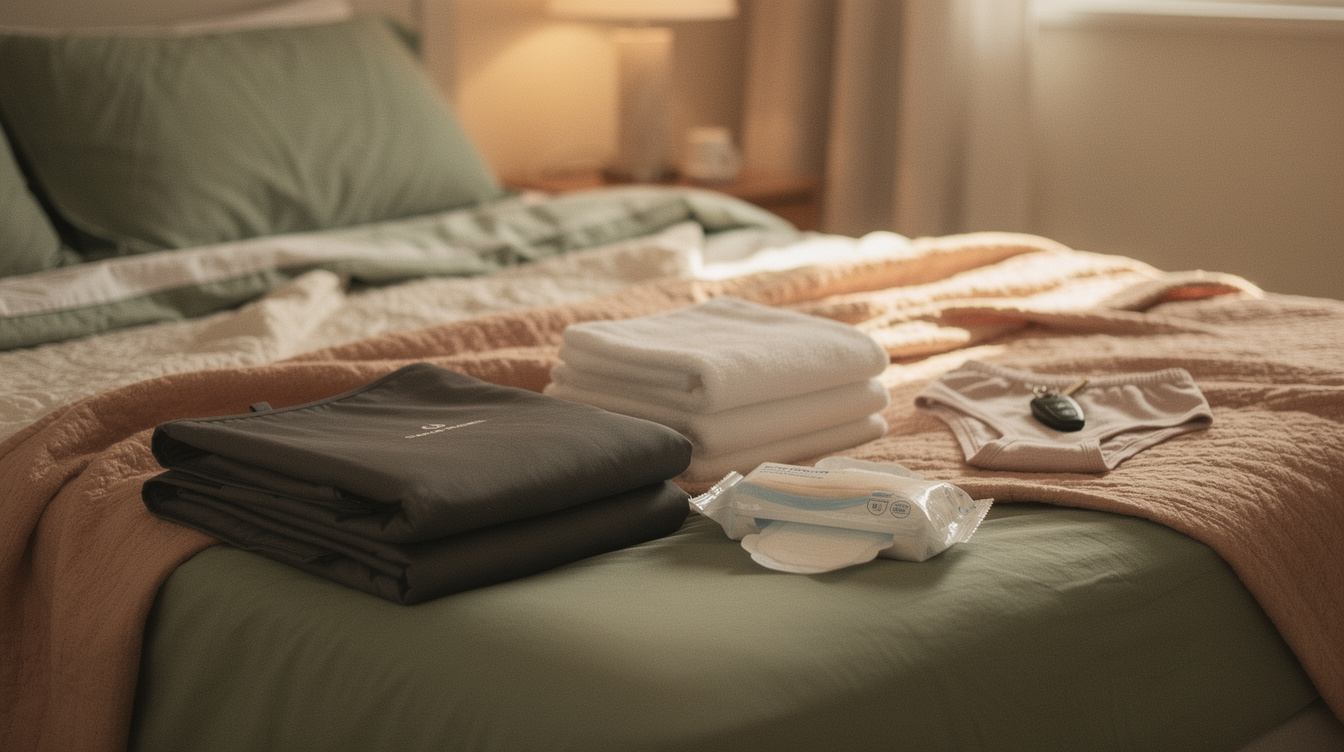
You cannot schedule this. You can make it a much smaller event. A bag already packed by the door, a towel and a dark waterproof pad on your side of the mattress, and your provider's after-hours number saved in your phone turn a 3 a.m. gush from a scramble into a short drive. Our hospital bag list covers what is genuinely worth bringing and what the hospital already has waiting for you.
And if you are reading this at 30 weeks because you felt something odd and went looking, that instinct is the useful one — front-load the preparation now, while bending over is still easy. Our free week-by-week planner takes your due date and turns the whole to-do list into one small task at a time, with the heavy items placed early instead of piled into the final weeks.
Questions parents actually ask
How can I tell if my water broke or if I just peed?
Amniotic fluid is mostly clear or light yellow and essentially odorless, while urine is usually dark yellow with a distinct smell, according to the Cleveland Clinic. The clearest difference is control: you cannot hold amniotic fluid back the way you can hold urine, and it keeps leaking rather than stopping once your bladder is empty. MedlinePlus suggests using a pad to absorb some of the fluid, then looking at it and smelling it — amniotic fluid usually has no color and a sweeter smell than urine.
Should I call my doctor if I'm not sure my water broke?
Yes. The Office on Women's Health says to call your doctor if you think your water broke but are not sure, and to tell them the time it happened along with any color or odor. There is a quick test that can tell whether the fluid is urine or amniotic fluid, so you do not have to work it out on your own.
How long after your water breaks does labor start?
Usually within a day. MedlinePlus says that for most women, contractions come within 24 hours after the bag of water breaks, and the Cleveland Clinic says the same. If labor does not start, your provider may suggest inducing it, because the Office on Women's Health notes that the risk of infection goes up the longer labor is delayed after the membranes rupture.
What does it mean if the fluid is green or brown?
It can mean the baby has passed meconium — their first stool — into the amniotic fluid. MedlinePlus describes meconium-stained fluid as stained with a greenish or brown substance, and notes babies often pass it in response to stress such as a decrease in blood and oxygen supply. Call your provider right away rather than waiting; this is information your birth team needs before delivery.
What is premature rupture of membranes?
The Cleveland Clinic defines premature rupture of membranes (PROM) as leaking amniotic fluid before labor begins, which affects up to 10% of pregnancies. When it happens before 37 weeks it is called preterm PROM (PPROM), which occurs in about 3% of pregnancies. Care at term often means delivering within about 24 hours, while before 34 weeks the focus shifts to safely extending the pregnancy in the hospital with medications such as corticosteroids and antibiotics.
Can I use a tampon or take a bath after my water breaks?
Do not put anything in the vagina once you think your membranes have ruptured — MedlinePlus advises using a pad when you check the fluid. Ask your own provider about bathing and anything else, because the Office on Women's Health notes that the risk of infection rises the longer things go after the water breaks, and your team will tell you what is safe in your situation.
Sources
- Cleveland Clinic — Water Breaking — Definition of water breaking as the amniotic sac tearing and fluid coming out; a popping sensation followed by a gush, or nothing at all; fluid can trickle like a raindrop or rush like a waterfall; urine is usually dark yellow with a distinct odor while amniotic fluid is mostly clear or light yellow and odorless; you cannot hold amniotic fluid back the way you can hold urine; amniotic fluid continues to leak while urine does not; there is usually more amniotic fluid than urine; up to about 4 cups of amniotic fluid at 36 weeks and about 2.5 cups at 40 weeks; labor starts before the water breaks for up to about 90% of people; contractions typically start within 24 hours; call immediately, especially with fever, foul-smelling odors, blood, or a change in the fetus's movements.
- MedlinePlus (National Library of Medicine) — Premature rupture of membranes — Fluid may leak slowly or gush out; use a pad to absorb some of it, then look at it and smell it; amniotic fluid usually has no color and a much sweeter smell than urine; contact your health care provider right away if you think your membranes have ruptured; the earlier your water breaks, the more serious it is for you and your baby.
- MedlinePlus (National Library of Medicine) — Am I in labor? — Fluid leaking from the vagina in a trickle or a gush when the amniotic sac breaks; for most women contractions come within 24 hours after the bag of water breaks; contact your provider right away for leaking amniotic fluid, decreased fetal movement, or any vaginal bleeding other than light spotting; true labor contractions come regularly about 5 to 10 minutes apart, last 30 to 70 seconds, get longer, and do not stop no matter what you do; false labor contractions do not come at regular intervals and do not produce cervical change.
- Office on Women's Health (U.S. Department of Health and Human Services) — Labor and birth — Water breaking can be a large gush or a continuous trickle; let your doctor know the time your water breaks and any color or odor; call your doctor if you think your water broke but are not sure; call even if it is weeks before your due date because it might be preterm labor; labor often starts soon after the water breaks and a doctor may induce if it does not, because the risk of infection goes up as labor is delayed; an easy test can tell whether leaking fluid is urine or amniotic fluid.
- Cleveland Clinic — Premature Rupture of Membranes (PROM) — PROM is leaking amniotic fluid before labor begins, commonly called your water breaking; PROM affects up to 10% of all pregnancies; PPROM happens before 37 weeks and occurs in about 3% of pregnancies; diagnosis uses a sterile speculum exam to see pooling fluid and collect samples, plus pH (nitrazine) paper and a fern test under the microscope; complications include chorioamnionitis, placental abruption, and umbilical cord compression or prolapse; at term, delivery typically occurs within 24 hours; before 34 weeks, hospital bed rest with corticosteroids, antibiotics and other medications to extend the pregnancy safely.
- MedlinePlus (National Library of Medicine) — Meconium aspiration syndrome — Amniotic fluid stained with a greenish or brown substance indicates meconium; babies may pass meconium in the womb in response to stress such as a decrease in blood and oxygen supply; other risk factors include maternal diabetes, high blood pressure, infection in the placenta, and a pregnancy that goes past the due date.
Newborn Weeks is planning help, not medical advice — always follow your own doctor, midwife, or pediatrician.
From the gear guide
- Infantino Flip Luxe 4-in-1 Carrier — our pick in baby carriers
- You+ME 4-in-1 Baby Carrier — our pick in baby carriers
- VTech VM819 Video Baby Monitor — our pick in baby monitors
- Angelcare Baby Bath Support — our pick in baby bathtubs
Keep reading
 Pregnancy · 12 min read
Stretch Marks During Pregnancy: What Causes Them, What Actually Helps, and What's Safe
Stretch marks during pregnancy affect 50-90% of women. What causes them, why creams don't prevent them, what helps, and what to avoid while pregnant.
Read the article Pregnancy · 11 min read
Dental Care During Pregnancy: Is the Dentist Safe, and What Changes in Your Mouth
Dental care during pregnancy is safe at any stage, per the CDC. What happens to your gums, X-rays and numbing, morning sickness, and when to call the dentist.
Read the article Pregnancy · 10 min read
Headaches During Pregnancy: What Helps, What's Safe to Take, and When to Call
Headaches during pregnancy are common and usually harmless. What helps, what medicine experts say is safe, and the warning signs that mean call right away.
Read the article