The journal · Newborn basics
The Newborn Startle Reflex: Why Their Arms Fly Out (and When It Stops)
In short
The startle reflex — doctors call it the Moro reflex — is an automatic reaction your baby has when they feel like they're falling or something startles them. Their arms shoot out, their fingers fan open, their head goes back, and they usually cry, then pull everything back in. It is present at birth, it is one of the things your pediatrician deliberately checks, and it is a sign the nervous system is working, not a sign anything is wrong. It peaks in the first month, starts fading after about two, and is usually gone by six. Until then, a correctly done swaddle and a slow, low crib transfer are the two things that actually help.
You spend twenty minutes getting your baby to sleep in your arms. You stand up. You lower them, very slowly, toward the bassinet. And about four inches from the mattress both arms shoot straight out like they've been dropped off a cliff, their eyes fly open, and you are back to minute one.
That is the startle reflex, and it has a medical name: the Moro reflex. It is not your baby being dramatic, it is not something you caused by moving too fast, and it is not a problem to be fixed. It is a hardwired reaction that every healthy newborn arrives with — and one your pediatrician actively looks for, because its absence would be the worrying thing, not its presence. Here is what it is, what the timeline actually looks like, and the two practical things that genuinely reduce how often it wakes your baby up.
01What the startle reflex actually is
A reflex, in the plainest terms, is "a muscle reaction that happens automatically in response to stimulation" (MedlinePlus). Your baby is not deciding to do it, and they cannot decide not to. The signal does not go through the thinking part of the brain at all.
The Cleveland Clinic describes the Moro reflex as "an automatic response they show when they feel like they're falling or something startles them." That phrase — feel like they're falling — is the whole explanation for the bassinet moment. The balance organs in your baby's inner ear register the change in position on the way down, and the reflex fires before anything else in the brain gets a vote. It is named after Ernst Moro, the German pediatrician who first described it in 1918.
It is genuinely deep wiring. A 2012 paper by Futagi, Toribe and Suzuki in the International Journal of Pediatrics measured the timing of the response and concluded that "the reflex is mediated in the brain stem, not at the level of the spinal cord," with its center "probably in the lower region of the pons to the medulla" — the oldest, most automatic part of the nervous system. Which is another way of saying: you are not going to talk your baby out of it.
02What it looks like, in order
The reflex happens fast enough that it can look like one motion, but it is really two, and knowing the second half is coming makes the first half less alarming. The AAP describes the trigger and the shape of it together: "If your baby's head shifts position abruptly or falls backward — or if he is startled by something loud or abrupt — he will extend his arms and legs and neck and then rapidly bring his arms together."
- Out. The arms spread and extend away from the body, the fingers and thumbs fan open, and the head goes back (Cleveland Clinic). The research paper describes the same first phase as "abduction of the upper limbs at the shoulders and extension of the forearms at the elbows" (Futagi et al.).
- Crying. Not always, but often, and it is part of the reflex rather than a separate complaint.
- Back in. The arms come back toward the body, the elbows bend, and your baby relaxes — what the paper calls an "arc-like movement" of the arms as they close. The Cleveland Clinic notes this settling happens "upon reassurance," which is the part you can actually help with: your hands on them, held still, is the reassurance.
The triggers are unglamorous. A door closing. A sneeze — yours. A dog barking two houses over. The moment their own head tips backward because your supporting hand shifted half an inch. And, frequently, nothing you can identify at all, which is normal and not a sign you missed something.
03When it starts, and when it goes away
It is there from the very beginning — before the beginning, in fact. The International Journal of Pediatrics paper reports the reflex is "seen in some preterm infants at 25 weeks of PCA and in the majority by 30 weeks of PCA" (postconceptional age, meaning weeks since conception). So it develops in the womb, and a full-term baby arrives with it fully installed.
Going away is more of a fade than a switch. The AAP says the Moro reflex "usually peaks during the first month and starts to disappear after about two months." The research puts numbers on the back half of that fade: the proportion of babies no longer showing the response "rapidly increases, reaching about 80% at 20 weeks of age," and the reflex "usually disappears by 6 months of age" (Futagi et al.). The Cleveland Clinic gives the same outer edge: it normally persists until around six months.
Put together, the honest version is: worst in month one, noticeably better after month two, gone for most babies somewhere between four and six months. If you are in the thick of it right now, the useful part of that sentence is that the peak is the very beginning — this is a problem that shrinks on its own while you do nothing.
Preterm babies are on a different clock
Because the reflex develops on a gestational schedule rather than a birthday schedule, a baby born early is working from a different starting point — the research found it present in only some babies at 25 weeks and in the majority by 30 weeks of postconceptional age. If your baby was born preterm, ask your own pediatrician what to expect on their timeline rather than comparing to a full-term friend's baby.
04Why your pediatrician is glad to see it
This is the part that reframes the whole thing. The startle reflex is not something your baby's doctor tolerates — it is something they check for on purpose. The Cleveland Clinic describes pediatricians assessing it during newborn exams as "a key indicator of how your baby's nervous system is working." A normal Moro reflex is evidence the wiring is intact.
There is one specific thing they are watching for that is worth knowing about, because it explains why the exam looks a little odd. The AAP notes that "the Moro and tonic neck reflexes should be present equally on both sides of the body." Symmetry is the signal. The Cleveland Clinic lists the patterns providers flag: a weak response, which may point to a disruption in the central nervous system; an asymmetrical one, where a single arm does less, which can suggest an injury or a nerve problem; and persistence well past six months.
On that last one, MedlinePlus states the general principle behind it: "A reflex that is still present after the age when it would normally disappear can be a sign of brain or nervous system damage." That is not a reason to start timing your baby's startles against a calendar — it is a reason to mention it at a well-baby visit if it is still going strong at seven months, which your pediatrician is already tracking anyway.
05The two things that actually help
You cannot switch the reflex off. You can absolutely reduce how often it wakes your baby, and there are only two moves worth your energy.
1. Swaddle, and do it correctly
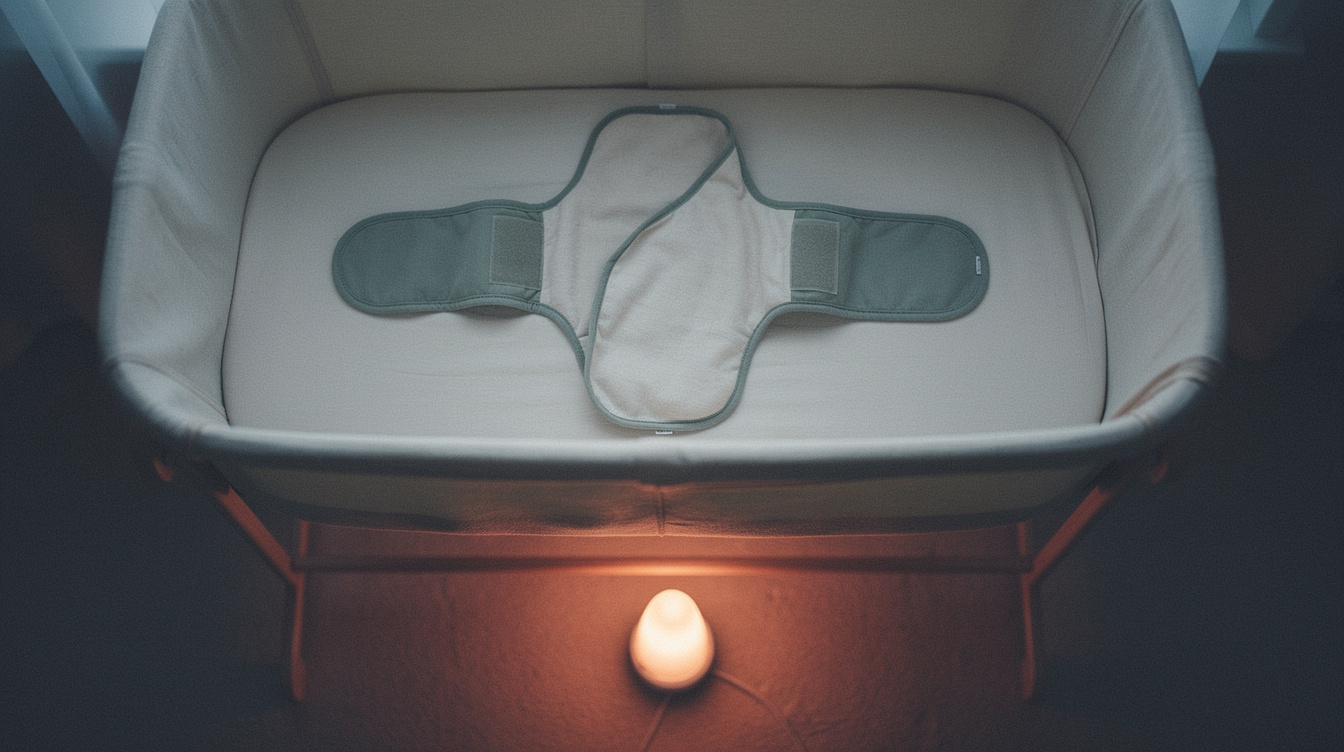
Swaddling works on the startle reflex because it removes the room the arms need to fly into. The AAP puts it this way: "A thin blanket wrapped snuggly around your baby's body can resemble the womb and help soothe your newborn. When done correctly, swaddling can be an effective technique to help calm infants and promote sleep." The "correctly" is doing real work in that sentence, and here is what it means.
Swaddling safely, per the AAP
- Stop at the first sign of rolling. "Stop swaddling as soon as your baby shows any signs of trying to roll over. Some babies start working on rolling as early as 2 months of age, but every baby is different" (AAP). This is the non-negotiable one — a swaddled baby who rolls to their stomach cannot push back up.
- Snug at the chest, loose at the hips. "Make sure their hips can move and that the blanket is not too tight. You want to be able to get at least two or three fingers between the baby's chest and the swaddle" (AAP).
- On the back, on a firm flat surface, every time. "Place your baby on their back to sleep on a firm, flat surface and monitor them to be sure they don't roll over while swaddled" (AAP).
- Watch for overheating. "Swaddling can increase the chance your baby will overheat, so avoid letting your baby get too hot." The AAP's list of signs: "sweating, damp hair, flushed cheeks, heat rash and rapid breathing."
- No weighted swaddles or weighted objects. The AAP's safe sleep guide says plainly: "don't use weighted swaddle blankets" or weighted objects inside a swaddle, because they increase suffocation risk.
Our step-by-step how to swaddle guide covers the actual folding, and safe sleep for newborns covers the rest of the sleep space — back for all naps and at night, a firm flat surface, nothing soft or loose in there, and room sharing without bed sharing for at least the first six months.
2. Change how you put them down
Since the trigger is the sensation of falling and the head shifting backward, the transfer itself is the thing to slow down. Keep your baby's head supported and their body curled rather than letting them unfold flat on the way down. Lower them feet and bottom first so their head stays the last thing to arrive. And leave your hands on them for a few seconds after they land — the Cleveland Clinic's observation that the arms come back in "upon reassurance" is essentially a description of steady pressure and stillness doing the job.
A lower start height helps too, which is a quiet argument for a bassinet with a high mattress over a full-size crib in the early weeks: less distance to travel is less falling sensation to register.
This is general information, not medical advice
Every baby is different, and a reflex is exactly the kind of thing that is easier to judge in person than from a page. If your baby's startle looks lopsided — one arm doing noticeably less than the other — if it seems absent, weak, or floppy, or if it is still happening strongly past about six months, call your pediatrician and describe what you're seeing. They check this reflex at well-baby visits for precisely this reason, and it is a completely ordinary thing to ask about.
06It is not the only reflex you'll notice
Once you know to look, your newborn is running a whole set of these. The AAP lists the ones you'll see most, each on its own schedule.
- Rooting — stroke your baby's cheek and they turn toward it looking for the feed. Present at birth, gone around four months.
- Sucking — present before birth, and automatic when a nipple reaches far enough into the mouth.
- Palmar grasp — stroke the palm and they grip, hard. Present at birth, fades around five to six months.
- Stepping — held upright with their feet touching a surface, a newborn makes walking motions. Present at birth, gone around two months.
None of these are things your baby learned. They arrived with all of them, and they will hand most of them back within half a year, swapped for movements they actually choose.
07The short version
The startle reflex is loud, it is inconvenient, it wrecks crib transfers, and it is a sign your baby's nervous system is doing exactly what it should. It peaks in the first month, starts easing after two, and is usually gone by six. A correct swaddle and a slower, lower put-down are the whole toolkit until then.
If you're still sorting out the rest of the newborn learning curve, our newborn basics guide covers feeding, sleep, diapers, and when to call the doctor, each one sourced the same way this page is. And if you're still pregnant, our free week-by-week planner puts the prep work — the bassinet, the swaddles, the safe sleep setup — in the middle of pregnancy instead of the exhausted final weeks.
Questions parents actually ask
What is the newborn startle reflex?
It's an automatic reaction, medically called the Moro reflex, that your baby has when they feel like they're falling or something startles them. The Cleveland Clinic describes the arms spreading and extending, the fingers and thumbs fanning out, the head going back, and crying — then the arms coming back in and the baby relaxing. The AAP describes the same thing as your baby extending their arms, legs and neck and then rapidly bringing the arms together. It is present in every healthy newborn.
When does the startle reflex go away?
It fades rather than stopping suddenly. The AAP says it usually peaks during the first month and starts to disappear after about two months. Research published in the International Journal of Pediatrics found about 80% of babies no longer show the response by 20 weeks of age, and that it usually disappears by six months — the same outer limit the Cleveland Clinic gives.
Is the startle reflex a sign something is wrong?
No — the opposite. The Cleveland Clinic notes that pediatricians assess the Moro reflex during newborn exams as a key indicator of how a baby's nervous system is working, and a normal reflex is a good sign. What providers watch for instead is a weak response, an asymmetrical one where one side does less than the other, or one that persists well beyond six months.
Does swaddling stop the startle reflex?
It doesn't stop the reflex itself, but it limits how far the arms can travel, which is why it helps babies stay asleep through one. The AAP says a thin blanket wrapped snugly can resemble the womb and, done correctly, is an effective way to calm a newborn and promote sleep. The critical safety rule: stop swaddling as soon as your baby shows any sign of trying to roll over, which can be as early as two months.
Why does my baby startle when nothing happened?
Often something did happen, just nothing you registered — a small shift of their head backward, a distant noise, a change in position as you moved. Because the reflex is triggered by the sensation of falling and by abrupt sounds or movements, the threshold is low. And because it is mediated in the brain stem rather than the thinking part of the brain, it fires before any judgment about whether the trigger mattered.
Do premature babies have the startle reflex?
Yes, though on a gestational timeline rather than a birth-date one. The International Journal of Pediatrics paper reports the reflex is seen in some preterm infants at 25 weeks postconceptional age and in the majority by 30 weeks. If your baby was born early, ask your own pediatrician what to expect for them specifically.
Sources
- HealthyChildren.org (AAP) — Newborn Reflexes — Description of the Moro reflex and its triggers (head shifting abruptly or falling backward, or a loud or abrupt sound: extends arms, legs and neck, then rapidly brings arms together); reflex is present at birth, usually peaks during the first month, and starts to disappear after about two months; the Moro and tonic neck reflexes should be present equally on both sides of the body; ages for the rooting (birth to ~4 months), sucking (present before birth), palmar grasp (birth to ~5-6 months) and stepping (birth to ~2 months) reflexes.
- Cleveland Clinic — What Is the Moro Reflex in Babies? — Definition of the Moro reflex as an automatic response when babies feel like they're falling or something startles them; named after Ernst Moro, who first described it in 1918; the stages of the response (arms spread and extend, fingers and thumbs fan out, head thrown back, crying; then arms come back in, elbows flex, baby relaxes upon reassurance); normally persists until around 6 months; pediatricians assess it during newborn exams as a key indicator of how the nervous system is working; concerning patterns are a weak reflex (possible central nervous system disruption), an asymmetrical response (possible injury or nerve disease), and persistence beyond 6 months.
- MedlinePlus (NIH) — Infant Reflexes — Definition of a reflex as a muscle reaction that happens automatically in response to stimulation; a reflex that is still present after the age when it would normally disappear can be a sign of brain or nervous system damage.
- Futagi Y, Toribe Y, Suzuki Y. The Grasp Reflex and Moro Reflex in Infants: Hierarchy of Primitive Reflex Responses. International Journal of Pediatrics (2012) — The Moro reflex is seen in some preterm infants at 25 weeks of postconceptional age and in the majority by 30 weeks; it usually disappears by 6 months of age, with the proportion of infants showing a negative response reaching about 80% at 20 weeks of age; the initial phase comprises abduction of the upper limbs at the shoulders and extension of the forearms at the elbows, followed by adduction and flexion in an arc-like movement; the reflex is mediated in the brain stem, not at the level of the spinal cord, with its center probably in the lower region of the pons to the medulla.
- HealthyChildren.org (AAP) — Swaddling: Is it Safe? — A thin blanket wrapped snugly can resemble the womb and soothe a newborn, and done correctly swaddling can calm infants and promote sleep; stop swaddling as soon as the baby shows any signs of trying to roll over, which some babies begin as early as 2 months; hips must be able to move and you should be able to fit two or three fingers between the baby's chest and the swaddle; place the baby on their back on a firm, flat surface and monitor for rolling; swaddling increases the chance of overheating, with signs including sweating, damp hair, flushed cheeks, heat rash and rapid breathing.
- HealthyChildren.org (AAP) — A Parent's Guide to Safe Sleep — Place the baby on their back for all naps and at night; use a firm, flat sleep surface; keep soft objects and loose bedding out of the sleep area; share a room with the baby for at least the first 6 months without bed sharing; stop swaddling when the baby looks like they're trying to roll over; do not use weighted swaddle blankets or weighted objects inside a swaddle, as they increase suffocation risk.
Newborn Weeks is planning help, not medical advice — always follow your own doctor, midwife, or pediatrician.
From the gear guide
- Munchkin Sparrow Travel Stroller — our pick in travel strollers
- Compact Travel Stroller with Canopy — our pick in travel strollers
- Kopi Baby Portable Changing Pad — our pick in diaper bags & changing pads
- Comfy Cubs Muslin Burp Cloths, 10-Pack — our pick in swaddle & receiving blankets
Keep reading
 Pregnancy · 12 min read
Braxton Hicks Contractions: What They Feel Like, and How to Tell Them From Labor
Braxton Hicks contractions are practice contractions, not labor. What they feel like, when they start, how to tell them from real labor, and when to call.
Read the article Feeding · 11 min read
Breast Engorgement: What Actually Relieves It When Your Milk Comes In
Breast engorgement peaks around day five. What actually relieves it: frequent feeding, softening before the latch, and cold between feeds. Source-cited.
Read the article Feeding · 14 min read
How to Increase Milk Supply: What Actually Works (and What Doesn't)
How to increase milk supply, per AAP, CDC, WIC and NIH sources: why frequent milk removal is the real lever — and which supplements to skip.
Read the article