The journal · Newborn basics
How to Trim Newborn Nails Without Nicking a Finger
In short
Newborn nails grow fast, and long ones scratch a baby's face within a day. The safest way to keep them short is a baby-sized clipper or a pair of baby nail scissors with rounded tips — or, for the softest first-week nails, an emery board. Trim while your baby is asleep or drowsy, use one hand to press the fingertip pad down and away from the nail edge so you're cutting nail and not skin, cut fingernails with a gentle curve and toenails straight across, and if you nick a finger, apply gentle pressure with a clean gauze pad — never a bandage. Do not bite or peel your baby's nails: mouth-to-finger contact is how babies pick up herpetic whitlow, a painful herpes infection of the fingertip.
Newborn nails are one of those things nobody warns you about. They are paper-thin, they grow faster than they have any right to, and within a day of birth your baby has laid a long red scratch down one cheek with a hand they cannot yet control. And there you are, holding a fingertip the size of a raisin, trying to work out how you are supposed to trim it without drawing blood.
The good news is that pediatric guidance on this is unusually consistent — from the AAP, Nemours KidsHealth, Kaiser Permanente and Ireland's HSE — and it all comes down to a small handful of moves: the right tool, a quiet moment, a specific little trick with the fingertip pad, and a rule about what not to reach for if you slip. Here is exactly how to do it, sourced end to end, with nothing invented in between.
01When to start and how often to do it
You can start as soon as the nails are long enough to catch on skin — which for most babies is within the first week. Baby nails grow noticeably faster than yours. Nemours KidsHealth says nails "tend to grow quickly from infancy to toddlerhood, so they might need to be trimmed as often as once or twice a week," and adds that "some newborns need their nails trimmed even more often during the first few weeks of life." The AAP puts the floor at "at least once a week."
Nails come out longer than a lot of parents expect. The AAP's plain reason for staying on top of it: "long nails on the hands of newborns with little to no control of them predictably result in stray scratches." A trim on day two is not overreacting — it is preventing the scratch across the bridge of the nose that shows up in the newborn photos.
02What to use — and what to leave in the drawer
You need one of three things, and they all cost a few dollars.
The three tools that work
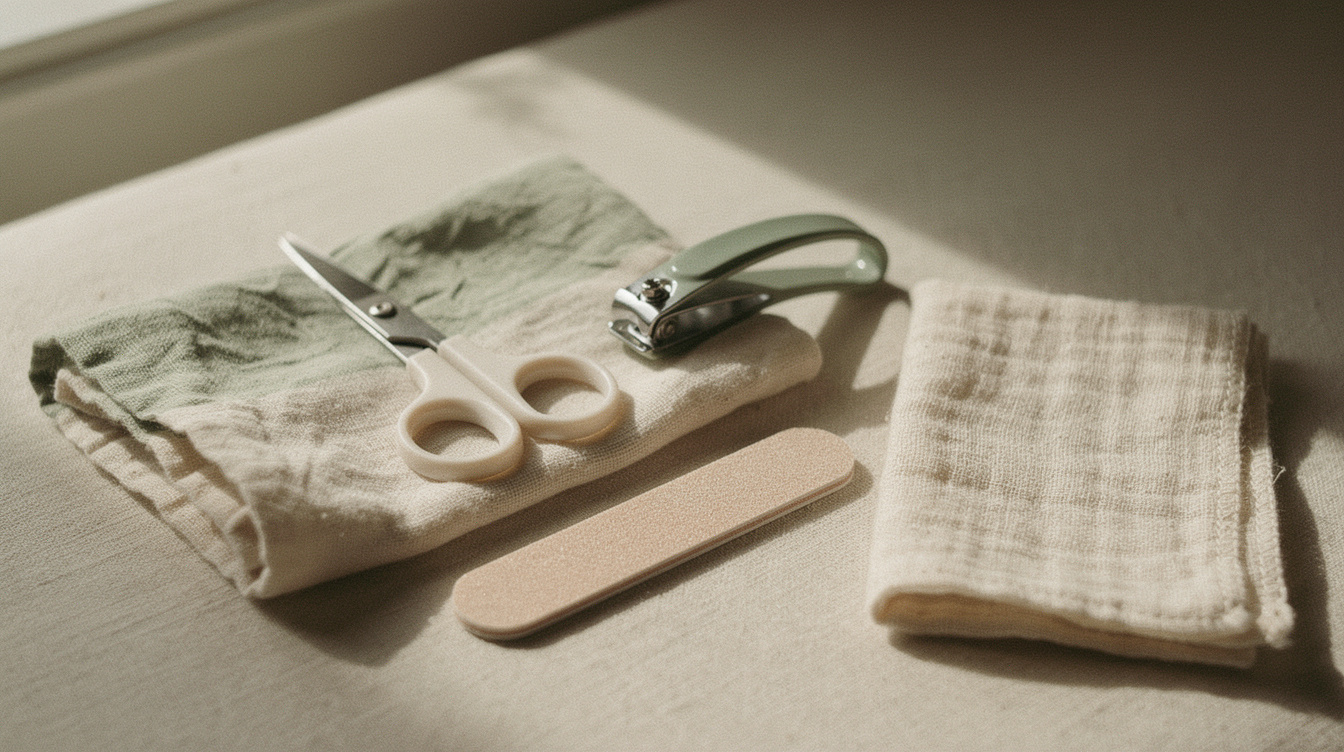
- Baby nail scissors. Small scissors with blunt, rounded tips. Nemours describes them as "baby nail scissors, which have rounded tips for safety." These are the easiest tool for most parents on tiny fingers because you can see exactly where each blade sits.
- Baby nail clippers. A miniature clipper sized for a baby's nail. Kaiser Permanente is specific: "Use a small clipper or scissor with a rounded cutting surface, specially designed for babies. Do not use adult nail clippers." A regular-sized clipper is too big to see around and takes off too much at once.
- An emery board. A plain nail file. It is slower than a clipper but almost impossible to draw blood with, which makes it the best option for the first few weeks. Nemours says that if you are nervous about scissors or clippers, "you can use an emery board to file the nails down without the risk of any nicks."
For the very first days, if the nails still feel soft and pliable, HSE points out an option most parents miss: "It is often possible to use your fingers to gently peel off the ends of their nails, instead of using scissors." Only the soft, whitish overhang — never further down than that. Once the nails firm up, switch to a real tool.
03The step-by-step method
Pediatric guidance converges on the same handful of moves. Do them in this order and the whole thing takes about two minutes.
How to trim, step by step
- Pick a quiet moment. The AAP says to "trim or file your baby's nails when she's asleep and her hands are less of a moving target." A drowsy baby after a feed works too. HSE agrees: try trimming "when they are asleep, drowsy or very calm."
- Sit down with good light. Kaiser Permanente's instruction is simply, "Work in an area with good lighting." You are looking at a nail edge one to two millimeters wide — a bright lamp or a window seat matters more than any tool you buy.
- Get a second pair of hands if you can. Nemours suggests placing your baby in your lap, in a rocker, or waiting until they are asleep. HSE adds: "Ask someone to hold your baby's hand while you cut their nails, if it helps." One person holds the hand still; the other cuts.
- Isolate one fingertip. Hold the finger between your forefinger and thumb, with the rest of your hand cupping the baby's hand so it cannot pull away (HSE).
- Do the fingertip-pad trick. This is the move that keeps you from cutting skin. Nemours: "Hold your baby's palm and finger steady with one hand and cut with the other." The AAP: "Push down on the fingertip skin so you can get the clipper or scissors around both sides of the nail and avoid cutting your baby's finger." Kaiser Permanente puts it as a safety check: "Pull down on your baby's finger or toe pad to be sure that you will not accidentally cut the skin." Same move, three ways of saying it — press the pad away from the nail edge so you can see the white overhang standing alone.
- Trim only the white overhang. Fingernails follow the natural curve of the fingertip; toenails go straight across. Take small cuts, not one big one.
- Smooth any rough edges. The AAP: "Finish off any sharp or rough edges with an emery board." A rough corner scratches almost as well as a long nail does.
04Fingernails and toenails are not the same job
One rule most parents forget until it is too late: fingernails and toenails are cut in different shapes. Kaiser Permanente is direct — "Cut the toenails straight across to prevent ingrown nails." A curved toenail, cut the way you would a fingernail, can grow into the corner of the toe and get sore and infected. Straight across every time on the toes.
Toenails also grow more slowly than fingernails, so you will trim them less often — typically every couple of weeks rather than every week.
05The oldest shortcut, and why to skip it
There is a very old parenting habit of biting a baby's nails to shorten them — it feels safer, because no blade is involved. It is not. The AAP is direct: biting or peeling nails "can potentially lead to infection."
The specific infection to know about is called herpetic whitlow. Cleveland Clinic describes it as "an infection of the skin around your fingernail. The herpes simplex virus causes the condition when the virus penetrates your skin through a break in your skin near your nail." It spreads "through physical contact," especially after contact with a cold sore. An adult who has ever had a cold sore — most adults have — carries the virus in their saliva and can pass it to a baby's tiny broken skin at the nail edge just by putting the fingertip in their mouth. It shows up as painful fluid-filled blisters on the fingertip a few days later.
Do not bite the nails — theirs or yours near theirs
The rule is not fussy. Do not bite your baby's nails to shorten them, and do not kiss or mouth their fingertips while you have any cold sore, cracked lip, or mouth ulcer. If someone else offers to trim the nails with their teeth because they "always did it that way," it is a fine time to say no thank you and hand them the emery board.
06If you nick the skin — and one day you will
Almost every parent draws a little blood at some point. A baby's fingertip pad is soft and the nail bed hides just behind it, so if you rush, the scissors close on skin instead of nail. It is not a disaster. HSE: "If it happens, try not to worry. Gently press a clean towel or gauze against the cut until the bleeding stops." A tiny fingertip cut bleeds a lot for a minute and then it stops.
Never put a bandage on a fingertip cut
This is the one part parents get wrong. Nemours is explicit: "Don't put a bandage around the tiny cut — babies love to put their fingers in their mouths, which can loosen the bandage and make it a choking risk." Use a sterile gauze pad and gentle pressure until the bleeding stops. That is it. No adhesive strip, no small round bandage, no piece of tape.
If the bleeding does not stop after ten minutes of steady pressure, if the fingertip looks red or swollen the next day, or if you see any little blisters appear on the fingertip in the days after the cut, call your pediatrician.
07The bath-time shortcut
One trick worth building into the routine: cut after the bath. Kaiser Permanente notes, "Clip your baby's nails after a bath when the nails are softer." A softer nail is a more forgiving cut — the scissors go through cleanly and the edges are less likely to leave a sharp corner. Warm, drowsy, soft-nailed and full of milk is roughly the ideal state for a manicure. Our guide to how to bathe a newborn covers the timing side of the bath itself.
08Mittens are not a substitute
The pair of newborn scratch mittens someone gave you at a shower is useful, but only within limits. The AAP suggests "limiting covered time to when your baby is sleeping" so your baby's hands are free to explore, touch, and get to the mouth for the rooting reflex during the day. Mittens are a bridge to a trim, not a replacement for one — a nail long enough to scratch will still be there once the mitten comes off.
This is general information, not medical advice
Every baby is different, and every fingertip nick or nail bed that looks red or swollen is worth running past your own pediatrician — they know your baby and you do not have to guess. If a fingertip becomes visibly swollen, painful, or forms blisters in the days after a trim, call them. That is exactly what they are there for.
09The tiny task that saves the tiny face
Trimming nails ends up on the very short list of newborn jobs that feel medical and are actually just chores — quick, cheap, and easy once you have done a few. Two minutes with the right tool once a week and the scratches stop, the fingertips stay smooth, and the newborn photos stop featuring a red line across the cheek.
The rest of the tiny-jobs-nobody-warned-you-about list is on our newborn basics guide — burping, bathing, umbilical care, diaper changes, and when to call the doctor, each one sourced the same way this page is. And if you are still pregnant, our free week-by-week planner puts the small prep that makes those first weeks easier right where it belongs: in the weeks before the baby arrives. If you are in the fog of the first seven days, our guide to what to expect the first week with a newborn walks through the rest of it hour by hour.
Questions parents actually ask
When can I first trim my newborn's nails?
As soon as the nails are long enough to catch on skin — often within the first week. The AAP notes that long, uncontrolled newborn nails predictably cause stray scratches, and Nemours KidsHealth says some newborns need their nails trimmed even more often than once a week during the first few weeks of life. If the nails still feel very soft in the first days, HSE says it is often possible to gently peel the white ends off with your fingers instead of using scissors.
Scissors, clippers, or a nail file — which should I use?
Any of the three, as long as they are made for babies. Nemours recommends baby nail scissors with rounded tips or baby clippers. Kaiser Permanente specifically warns not to use adult nail clippers — they are too big to see around. An emery board is the safest option because it cannot cut skin at all; use it if you are nervous, or on the softest first-week nails.
What is the trick to not cutting the skin?
Press the fingertip pad down and away from the nail edge before you cut. The AAP calls it pushing down on the fingertip skin so you can get the clipper or scissors around both sides of the nail. Kaiser Permanente frames it as a safety check: pull the fingertip pad down first to be sure you will not accidentally cut the skin. It is the single move that separates a clean trim from a nicked finger.
Should I cut fingernails and toenails the same way?
No. Fingernails follow the natural curve of the fingertip. Toenails should be cut straight across — Kaiser Permanente specifically recommends this to prevent ingrown nails on the toes.
Is it okay to bite my baby's nails to shorten them?
No. The AAP warns that biting or peeling baby nails can lead to infection. The specific risk is herpetic whitlow, which Cleveland Clinic describes as a herpes simplex infection of the skin around the fingernail that spreads through physical contact, especially from someone with a cold sore. Use scissors, clippers, or a file — never your teeth.
What do I do if I accidentally cut my baby's finger?
Do not put on a bandage. Nemours explicitly warns that a bandage around a tiny cut can loosen when the baby puts the finger in their mouth and become a choking risk. Instead, apply gentle pressure with a clean piece of sterile gauze or a clean towel until the bleeding stops. If it does not stop within about ten minutes, or the fingertip becomes swollen, painful, or develops blisters in the following days, call your pediatrician.
Sources
- HealthyChildren.org (AAP) — Nailing It: How to Trim Your Baby's Fingernails — Trim nails at least once a week; long nails on newborns with little control predictably cause stray scratches; trim while the baby is asleep so hands are less of a moving target; push down on the fingertip skin so the clipper or scissors can get around both sides of the nail and avoid cutting the finger; finish sharp edges with an emery board; clippers, scissors, or a nail file all work; biting or peeling nails can lead to infection; limit mittens to when the baby is sleeping so daytime hands stay free to explore.
- Nemours KidsHealth — Trimming Your Baby's Nails — Nails grow quickly and may need trimming once or twice a week; some newborns need trimming even more often in the first few weeks; use baby nail scissors with rounded tips or baby clippers; an emery board files nails down without the risk of nicks; positions include lap, rocker, or waiting until asleep; hold the palm and finger steady with one hand and cut with the other; never put a bandage around a tiny cut because babies put fingers in their mouths and the bandage becomes a choking risk; apply gentle pressure with a sterile gauze pad.
- Kaiser Permanente — Caring for a Baby's Nails — Use a small clipper or scissor with a rounded cutting surface designed for babies; do not use adult nail clippers; clip nails after a bath when they are softer; work in an area with good lighting; pull down on the fingertip or toe pad first to be sure you will not accidentally cut the skin; cut toenails straight across to prevent ingrown nails.
- HSE (Ireland) — How to Trim Your Baby's Nails — Use baby scissors, not blunt scissors; for very soft first-week nails, it is often possible to gently peel off the ends of the nails with your fingers instead of using scissors; hold the finger between forefinger and thumb and gently push back the fingertip below the nail to avoid nipping the skin; try trimming when the baby is asleep, drowsy, or very calm; ask someone to hold the baby's hand if it helps; if a nick happens, gently press a clean towel or gauze against the cut until the bleeding stops.
- Cleveland Clinic — Herpetic Whitlow — Herpetic whitlow is an infection of the skin around the fingernail; the herpes simplex virus causes it when the virus penetrates the skin through a break near the nail; it spreads through physical contact, especially after contact with a cold sore or fever blister; symptoms include blisters or fluid-filled bumps on the skin near the fingernail and a swollen finger.
Newborn Weeks is planning help, not medical advice — always follow your own doctor, midwife, or pediatrician.
From the gear guide
- Safety 1st OnBoard FLX — our pick in infant car seats
- Graco Modes Pramette Travel System — our pick in infant car seats
- A+D Original Diaper Rash Ointment — our pick in diaper rash cream
- Medela Soothing Hydrogel Pads — our pick in pumping & nursing bras
Keep reading
 Out the door · 11 min read
Newborn Sun Safety: Shade, Hats, and When Babies Can Wear Sunscreen
Newborn sun safety, sourced: why babies under 6 months stay out of direct sun, when sunscreen is okay, the right hat, and the stroller-blanket mistake.
Read the article Feeding · 13 min read
How to Clean Baby Bottles (and When You Actually Need to Sanitize)
How to clean baby bottles the way the CDC and FDA describe: wash after every feeding, the sink mistake almost everyone makes, and when sanitizing matters.
Read the article Newborn basics · 12 min read
Newborn Breathing Patterns: The Pauses, Fast Breaths, and Grunts That Are Normal (and When to Call)
Newborn breathing patterns can look alarming. Learn which pauses, fast breaths, and noises are normal, and the warning signs that mean call now.
Read the article