The journal · Pregnancy
Foods to Avoid During Pregnancy: The Honest, Source-Cited List
In short
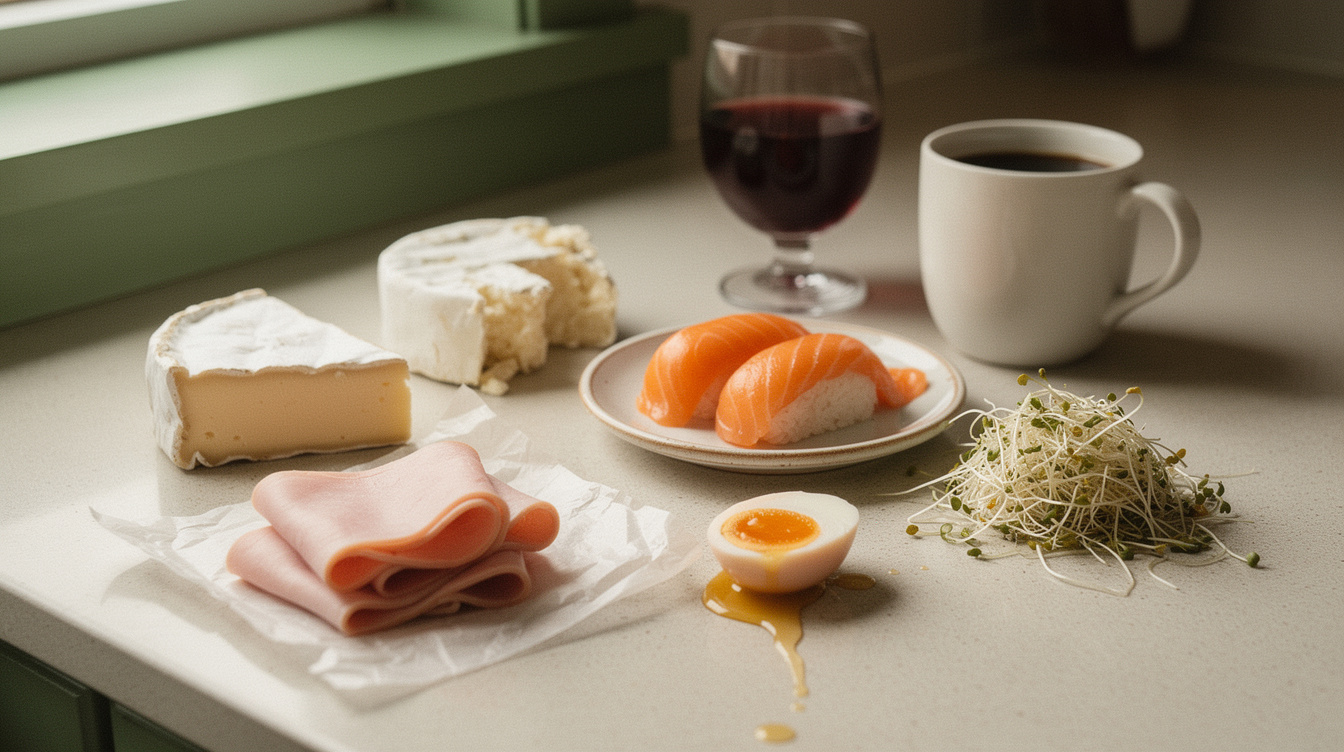
The list of foods to avoid during pregnancy is much shorter than the internet makes it look. It comes down to five things: seven high-mercury fish, anything raw or undercooked, anything unpasteurized, ready-to-eat chilled foods that can carry Listeria (deli meat, hot dogs, smoked fish, premade deli salads), and alcohol. Caffeine isn't banned — government health guidance puts the limit at under 200 mg a day. And several of the scariest-sounding items, deli meat included, are back on the table once they are heated until steaming.
Somewhere between the first positive test and the first prenatal visit, almost everyone goes down the same rabbit hole: a search for what you can't eat anymore, and then forty minutes of blog posts contradicting each other about turkey sandwiches. One says deli meat is fine. One says it's dangerous. Neither cites anybody.
So here is the actual list, built only from what the FDA, the CDC, and the National Library of Medicine say in writing — with a link on every claim so you can read the source yourself. It is shorter than you think, and a few of the items have a workaround nobody mentions.
This is general information, not medical advice
Food guidance is one of the places where your own history matters most — a previous pregnancy complication, a weakened immune system, or a condition like gestational diabetes can change what your provider wants on your plate. Bring this list to your next prenatal visit and ask what applies to you. Our pregnancy checklist covers what else belongs in that conversation.
01The whole list, in five groups
Every item on every pregnancy food-avoidance list traces back to one of five concerns. Learn the five and you can judge a food you've never seen on a list before.
- Mercury — seven specific fish, and a weekly cap on one more.
- Raw or undercooked animal foods — meat, poultry, eggs, seafood, and raw sprouts.
- Unpasteurized anything — milk, soft cheeses made from it, juice, and cider.
- Listeria risk in ready-to-eat chilled foods — deli meat, hot dogs, refrigerated smoked fish, premade deli salads, cut melon left out.
- Alcohol — the only item on the list with no safe amount at all.
02Fish: a short avoid list, and a reason to eat more of the rest
Fish is the most misunderstood item here, because the official advice is not "eat less." It's "eat more of the right ones." The FDA's joint advice with the EPA recommends "between 8 and 12 ounces per week of a variety of seafood from choices that are lower in mercury" during pregnancy and breastfeeding — that's 2 to 3 servings a week, where "1 serving is 4 ounces."
There are exactly seven fish on the FDA's "Choices to Avoid" list, the highest-mercury ones:
- Shark
- Swordfish
- King mackerel
- Marlin
- Orange roughy
- Bigeye tuna
- Tilefish (Gulf of Mexico)
Notice what isn't on it. Salmon, shrimp, cod, tilapia, sardines, scallops, catfish, crab, and canned light tuna (which includes skipjack) are all on the FDA's "Best Choices" list. Albacore — the "white" tuna — sits one tier down as a "Good Choice," and MedlinePlus, the National Library of Medicine's consumer health site, gives it a specific ceiling: "Limit white (albacore) tuna to 6 ounces per week."
The sushi question, answered honestly
Mercury and raw fish are two separate issues, and people mix them up constantly. The FDA's fish advice is about mercury and says nothing about raw fish at all. The raw-fish concern is foodborne illness, and MedlinePlus is plain about it: avoid "undercooked meat, poultry, eggs, and seafood" and "refrigerated smoked seafood." So a salmon roll is out on the raw-fish rule, not the mercury rule — while a cooked eel or shrimp tempura roll clears both. Cooked sushi is sushi.
03Deli meats and hot dogs: heat them, don't skip them
This is the one worth understanding properly, because the answer is not a flat no. The concern is Listeria, a bacterium that survives refrigeration — which is why it turns up in foods that are chilled and eaten without cooking. The CDC's prevention guidance lists what to be careful with: deli meat, cold cuts, hot dogs, fermented or dry sausages, refrigerated smoked fish, and "premade deli salads, such as coleslaw and potato, tuna, or chicken salad." It also names two easy-to-miss ones: "cut melon left out for more than 2 hours" and "raw or lightly cooked sprouts."
Here's the part that gets left out of the scary version. The CDC's own instruction for deli meat isn't "never" — it's heat. Deli meat, cold cuts, hot dogs, and dry sausages are safe to eat when "reheated to 165°F or until steaming hot." Heat kills it. A turkey sandwich microwaved until the meat steams, or a hot dog cooked through, is a different food from a cold one straight out of the package.
Is this worth the trouble? The honest numbers from the CDC: "Every year in the United States, about 1 in 25,000 pregnant women are infected with Listeria." So it is rare. But when it does happen it is severe — the CDC notes Listeria can reach the baby even when the pregnant person doesn't feel very sick, and that "1 in 4 pregnant women who get this illness lose their pregnancy or their baby shortly after birth." A rare risk with a serious outcome and a free fix is exactly the kind worth taking the free fix on.
04Cheese: softness isn't the problem, pasteurization is
The old shorthand — "no soft cheese" — is wrong, and it makes people throw out perfectly safe food. What matters is whether it was made with pasteurized milk and whether it's the fresh, soft, unheated kind.
The CDC specifically flags "any unheated queso fresco-type cheeses... such as queso fresco, or similar fresh, soft cheeses such as queso blanco and requesón." And it names the ones that are fine: "cottage cheese, cream cheese, string cheese, feta, and mozzarella, when made with pasteurized milk." MedlinePlus adds the unpasteurized versions to the avoid side — "unpasteurized soft cheeses, such as unpasteurized feta, Brie, queso blanco."
Put together, the rule is readable off a label in about four seconds: if the package says pasteurized and it isn't a fresh queso-style cheese, it's on the safe list. If it doesn't say pasteurized, skip it or heat it until steaming. Cheese on a hot pizza has already cleared that bar.
05Raw, undercooked, and unpasteurized
These two groups are the least controversial and the easiest to follow. MedlinePlus puts them in one place:
Skip these while you're pregnant
- Undercooked meat, poultry, eggs, and seafood. Cook them through. This is also the reason raw cookie dough and raw batter are on the list — MedlinePlus names "raw cookie dough" directly.
- Runny or raw eggs in anything uncooked: homemade mayonnaise, Caesar dressing, hollandaise, mousse, tiramisu. Store-bought versions are usually made with pasteurized egg — check the label.
- Unpasteurized or raw milk, and anything made from it. The CDC adds "raw (unpasteurized) milk, yogurt, and ice cream" to its Listeria avoid list.
- Unpasteurized juices or cider — the ones sold chilled at farm stands and juice bars are the ones to ask about.
- Raw sprouts of any kind, "including alfalfa, clover, radish, and mung bean" (MedlinePlus). The CDC says raw or lightly cooked sprouts, so a quick wilt in a stir-fry isn't enough.
- Refrigerated smoked seafood — the cold-smoked salmon and lox kind. Shelf-stable canned or pouched smoked fish is a different product.
06Alcohol: the one item with no safe amount
Most of this list is about probability and preparation. Alcohol isn't. The CDC is unambiguous on all three questions people ask: "There is no known safe amount of alcohol use during pregnancy." "All types of alcohol can be harmful, including red or white wine, beer, and liquor." And "there is no safe time during pregnancy to drink alcohol."
The CDC links alcohol use in pregnancy to "an increased risk of miscarriage, preterm birth, stillbirth, and sudden infant death syndrome (SIDS)," and to "a range of lifelong behavioral, intellectual, and physical disabilities known as fetal alcohol spectrum disorders (FASDs)." MedlinePlus says the same thing in one line: "There is no known amount of alcohol that is safe for a woman to drink during pregnancy."
If you drank before you knew you were pregnant — which is extremely common, since the first weeks happen before most people test — that is a conversation to have with your provider, not a verdict. Tell them honestly how much and when. They can only help with what they know.
07Caffeine: under 200 mg a day
Coffee is not on the banned list. MedlinePlus gives a number instead: "For most people, it's best to limit caffeine to less than 200 mg per day during pregnancy." The reason it's capped at all, from MedlinePlus's caffeine page, is that "caffeine passes through the placenta to your baby."
The hard part is knowing what 200 mg looks like, because coffee varies wildly. The same MedlinePlus page gives real ranges: "an 8-ounce cup of coffee: 95-200 mg," "an 8-ounce cup of tea: 14-60 mg," "a 12-ounce can of cola: 35-45 mg," and "an 8-ounce energy drink: 70-100 mg."
Read that coffee range again: a single strong 8-ounce cup can hit the whole daily limit by itself, and a large takeout coffee is two or three times that 8-ounce measure. That's the practical takeaway — the limit isn't really "one or two cups," it's "one modest cup, and check what you're actually buying." Tea has a lot of room in it by comparison.
08What this list isn't
It isn't a test you can fail retroactively. If you ate a cold sandwich last Tuesday, or had a bite of unpasteurized cheese at a wedding before you knew, the useful next step is to watch how you feel and call your provider if you develop a fever or flu-like symptoms — not to spend the night searching. The CDC's point about Listeria is that early treatment matters, which is a reason to make the phone call rather than a reason to panic quietly.
It also isn't a list of things that will make you feel better. If you're in the stretch where nothing stays down, the avoid-list is the least of your problems — eat what you can keep, and see our guide to morning sickness for what actually helps. Perfect eating is not the assignment. Not eating the seven fish is.
And it changes after delivery. Most of these restrictions exist because of what crosses the placenta or what a pregnancy-era immune system handles differently, so the postpartum list is a different and much shorter one — we covered it in foods to avoid while breastfeeding, and the surprise there is how little of this follows you.
09One list, handled once
The reason this question eats so much of people's time isn't that the list is long. It's that it arrives in forty pieces, from forty sources, over nine months. Read it once, learn the five groups, and you can stop re-litigating lunch.
That's the whole idea behind this site: get the preparation out of your head and onto a schedule. Enter your due date and you'll get a free, personalized week-by-week to-do list — the medical appointments, the real deadlines, and the setup that's easier to do now than in month nine, each placed in the week it belongs in.
Questions parents actually ask
Can I eat deli meat while pregnant?
Yes, if you heat it. The CDC's Listeria prevention guidance says deli meat, cold cuts, hot dogs, and fermented or dry sausages are safe when "reheated to 165°F or until steaming hot." The risk comes from eating them cold, straight from the package, because Listeria survives refrigeration. A microwaved turkey sandwich and a cold one are not the same food.
What fish should I avoid during pregnancy?
The FDA and EPA name seven on their "Choices to Avoid" list: shark, swordfish, king mackerel, marlin, orange roughy, bigeye tuna, and Gulf of Mexico tilefish. Everything else is a matter of amount — the FDA recommends 8 to 12 ounces a week of lower-mercury seafood during pregnancy, and MedlinePlus caps albacore (white) tuna at 6 ounces per week. Canned light tuna is on the FDA's "Best Choices" list.
Is sushi safe during pregnancy?
Cooked sushi is. The concern with raw fish is foodborne illness, not mercury — MedlinePlus says to avoid undercooked seafood and refrigerated smoked seafood, which rules out raw rolls, sashimi, and lox. Rolls made with cooked seafood, egg, or vegetables clear that rule, as long as any high-mercury fish from the FDA's avoid list stays out.
How much coffee can I have while pregnant?
MedlinePlus advises limiting caffeine to less than 200 mg per day during pregnancy, because caffeine passes through the placenta to the baby. Its own figures show why "two cups" is a bad unit of measure: an 8-ounce cup of coffee can carry 95 to 200 mg, so one strong cup can reach the limit on its own. Tea runs 14 to 60 mg per 8 ounces, and a 12-ounce cola 35 to 45 mg.
Can I eat soft cheese during pregnancy?
Often, yes. The rule is about pasteurization and freshness, not softness. The CDC says cottage cheese, cream cheese, string cheese, feta, and mozzarella are fine when made with pasteurized milk, and flags unheated fresh queso-style cheeses — queso fresco, queso blanco, requesón. MedlinePlus adds unpasteurized feta, Brie, and queso blanco to the avoid side. If the label doesn't say pasteurized, skip it or heat it until steaming.
I already ate something on this list. What should I do?
Don't panic, and don't stay silent. Tell your prenatal provider what you ate and when, and let them know right away if you develop a fever or flu-like symptoms. The CDC's guidance on Listeria stresses that treatment works best early, which is the case for making the call rather than waiting it out. One exposure is not a diagnosis, and your provider can only act on what they know.
Sources
- FDA / EPA — Advice About Eating Fish — 8 to 12 ounces per week of lower-mercury seafood during pregnancy and breastfeeding; 2 to 3 servings a week from "Best Choices"; one serving is 4 ounces; the seven "Choices to Avoid" fish (shark, swordfish, king mackerel, marlin, orange roughy, bigeye tuna, Gulf of Mexico tilefish); canned light tuna including skipjack is a "Best Choice" and albacore/white tuna is a "Good Choice"; the advice addresses mercury and contains no guidance on raw fish.
- MedlinePlus (NIH National Library of Medicine) — Pregnancy and Nutrition — No known safe amount of alcohol in pregnancy; limit caffeine to less than 200 mg per day; limit white (albacore) tuna to 6 ounces per week and do not eat tilefish, shark, swordfish, marlin, orange roughy, or king mackerel; avoid unpasteurized or raw milk, unpasteurized juices and cider, and unpasteurized soft cheeses such as feta, Brie, and queso blanco; avoid undercooked meat, poultry, eggs, and seafood, raw cookie dough, refrigerated smoked seafood, and raw sprouts of any kind including alfalfa, clover, radish, and mung bean.
- CDC — Preventing Listeria Infection — Deli meat, cold cuts, hot dogs, and fermented or dry sausages are safe when reheated to 165°F or until steaming hot; avoid unheated queso fresco-type cheeses such as queso fresco, queso blanco, and requesón; cottage cheese, cream cheese, string cheese, feta, and mozzarella are fine when made with pasteurized milk; avoid raw (unpasteurized) milk, yogurt, and ice cream, refrigerated smoked fish, premade deli salads such as coleslaw and potato, tuna, or chicken salad, cut melon left out more than 2 hours, and raw or lightly cooked sprouts.
- CDC — People at Increased Risk for Listeria Infection — About 1 in 25,000 pregnant women in the United States are infected with Listeria each year; Listeria can reach the baby even when the pregnant person does not feel very sick; 1 in 4 pregnant women who get the illness lose their pregnancy or their baby shortly after birth; early treatment matters.
- CDC — About Alcohol Use During Pregnancy — No known safe amount of alcohol use during pregnancy; all types of alcohol can be harmful including red or white wine, beer, and liquor; no safe time during pregnancy to drink; association with increased risk of miscarriage, preterm birth, stillbirth, and SIDS; alcohol can cause fetal alcohol spectrum disorders (FASDs).
- MedlinePlus (NIH National Library of Medicine) — Caffeine — Caffeine passes through the placenta to the baby; an 8-ounce cup of coffee contains 95-200 mg of caffeine, an 8-ounce cup of tea 14-60 mg, a 12-ounce can of cola 35-45 mg, and an 8-ounce energy drink 70-100 mg.
Newborn Weeks is planning help, not medical advice — always follow your own doctor, midwife, or pediatrician.
From the gear guide
- Munchkin Sparrow Travel Stroller — our pick in travel strollers
- Compact Travel Stroller with Canopy — our pick in travel strollers
- Ubbi Vertical Baby Bottle Drying Rack — our pick in sterilizers & drying racks
- GROWNSY Nasal Aspirator with Protection Mode — our pick in nasal aspirators
Keep reading
 Newborn basics · 14 min read
Newborn Constipation: What's Normal, What Isn't, and What Actually Helps
Newborn constipation is less common than it looks. What's normal, the straining that isn't constipation, and when to call your pediatrician.
Read the article Newborn basics · 14 min read
RSV in Babies: The Symptoms That Matter and When to Call
RSV in babies starts out looking like a cold. The AAP and CDC warning signs that mean call now, what helps at home, and the two ways to prevent it.
Read the article Pregnancy · 14 min read
Cord Blood Banking: What It Costs, What It Treats, and What the AAP Recommends
Cord blood banking, explained: what it treats, what private banks charge, and why the AAP recommends donating to a public bank unless a sibling needs it.
Read the article