The journal · Newborn basics
Baby Acne: Why Newborns Get Little Red Bumps (and What to Do About Them)
In short
Baby acne is small red or white bumps that show up on your newborn's cheeks, nose, or forehead around two weeks old — the AAD says about 20 percent of newborns get it. It is caused by leftover hormones from pregnancy, not anything you did or fed them, and it clears on its own in a few weeks to a few months without treatment. Wash the area gently with warm water, do not use oils or lotions, and do not scrub or squeeze. If bumps first appear after 6 weeks of age, that is a different condition called infantile acne and needs a dermatologist.
Your baby's face was smooth for a week or two, and now the cheeks are covered in small red bumps. It shows up in every third photo. It looks worse when they cry. And you have started to wonder whether it is something you ate, something in the laundry, or a reaction to the wipes.
It is almost certainly none of those. It is baby acne, it is extremely common, and it will go away on its own. The American Academy of Dermatology says about 20 percent of newborns get it, and the American Academy of Pediatrics puts the number at more than 30 percent — so if your baby has it, you are looking at something that a fifth to a third of newborns walk out of the hospital destined to develop. Here is what it is, why it happens, what to actually do about it, and — just as important — the small list of well-meaning things that make it worse.
01What baby acne actually is
Baby acne is a short-lived skin condition of the newborn weeks. Cleveland Clinic describes it as "a common and short-term skin condition that causes acne breakouts to form on your baby's face or chest." The AAP is more concrete about what it looks like: "small red bumps," sometimes with a white center.
It typically appears at 2 to 4 weeks of age, per the AAP, and the AAD adds that it can develop "any time before 6 weeks of age." You will usually see it on the cheeks and nose. The AAD notes it can also show up "on a baby's forehead, chin, scalp, neck, back, or chest" — but the face is by far the most common.
One useful thing to know before you Google an image: baby acne does not come with blackheads. Cleveland Clinic is explicit about it — a newborn with baby acne "won't have blackheads." If you are seeing blackheads on your baby, the bumps are something else and it is worth a call to the pediatrician.
02Why it happens (and why it is not your fault)
The short answer is hormones — yours, not theirs. The AAP puts it simply: "The cause appears to be the transfer of maternal hormones just prior to birth." Your baby spent nine months bathed in your hormones, some of those hormones stimulate the oil glands in their skin, and it takes a few weeks after birth for the effect to fade.
Cleveland Clinic adds a bit more nuance: the exact mechanism is not fully understood, but "hormones in the placenta can affect how your baby's skin produces sebum," which clogs the tiny pores on a newborn's face. Breastfeeding may transfer a small amount of maternal hormones and contribute at the margin, but this is not a reason to stop nursing — the acne is temporary and harmless, and the benefits of breastfeeding are not.
What baby acne is not caused by, based on every source we fetched: something you ate, your detergent, your body wash, your baby's formula, your baby's wipes, the room being too warm, or anything you did or didn't do. It is a normal physiological event of the newborn weeks.
03What to actually do about it
Almost nothing. That is the answer, and it is a hard one for the modern parent brain to accept. The AAP writes it in one sentence: "Since it goes away on its own, no treatment is needed."
But "do almost nothing" is not the same as "do literally nothing." A few gentle habits keep the skin comfortable while it clears.
The gentle-care checklist
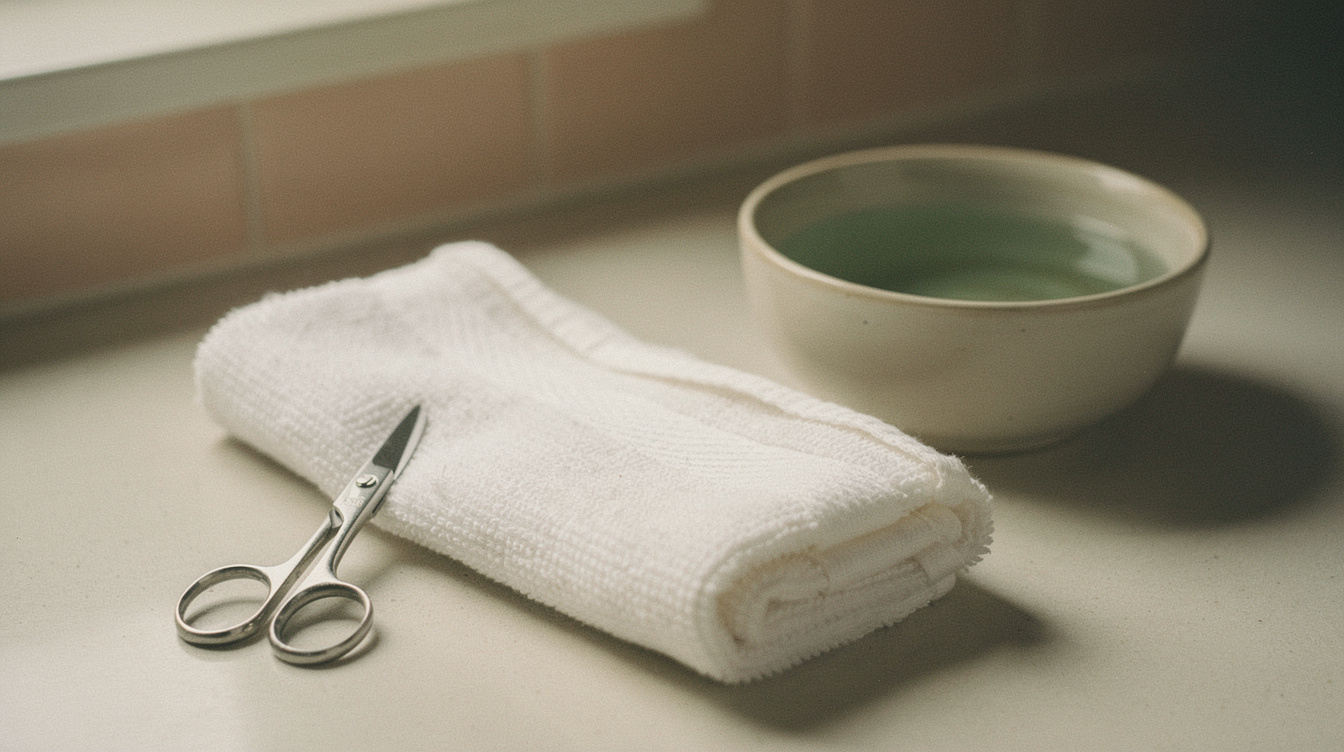
- Wash gently with warm water. Cleveland Clinic says to "gently wash your baby's skin with warm water." Nationwide Children's Hospital adds that "parents can simply clean the affected area with water and mild baby soap" — this does not need to be a whole face-wash routine.
- Pat dry, do not rub. Cleveland Clinic: "pat your baby's skin dry" and "do not scrub their skin." A soft cotton cloth beats a rough one.
- Keep their fingernails trimmed. Nationwide Children's specifically flags trimming baby's fingernails to prevent scratching, which can turn a bump into a scratch that can get infected.
- Give it time. The AAD says baby acne "tends to go away on its own in a few weeks to months." Cleveland Clinic sees most cases clear "within a few days to a couple of weeks," though "it could take up to a month." The AAP puts the outer end at 4 to 6 months of age.
The things that make it worse
Every source we fetched is unusually blunt on this: skip the oils and lotions. The AAP says "baby oil or ointments make it worse." Cleveland Clinic tells parents to avoid "lotions or oils." Nationwide Children's: "avoid using oils or lotions because these can make the acne worse." And do not squeeze or pop the bumps — Cleveland Clinic is explicit about it. A newborn's face is not adult skin; the same instincts that clear a teenager's breakout will inflame a baby's.
04Baby acne, milia, or eczema? How to tell them apart
Two other very common newborn bumps get mistaken for baby acne, because all three show up on the face in the first weeks. Being able to tell them apart saves you a worried Google spiral at 2 a.m.
- Milia are tiny white cysts, most often on the nose. Cleveland Clinic describes them as "small, white cysts on your skin" of "trapped dead skin cells," and notes that "about 40% to 50% of U.S. newborns have milia." Unlike baby acne, milia are "present at birth," not red, not inflamed, and also require no treatment — "in babies, milia usually last for a few weeks after they're born."
- Baby acne is red or purple bumps, sometimes with a pus-filled center, appearing around 2 weeks of age — not at birth. Cleveland Clinic: "small, red to purple bumps that are swollen," and "bumps that contain pus, surrounded by a red to purple or dark brown ring."
- Eczema is dry, flaky, itchy patches of skin, often on the cheeks, scalp, or in the creases of the elbows and knees. It looks and feels different — dry rather than pimply — and unlike baby acne, it usually needs treatment (a gentle moisturizer, and sometimes a prescription). If the bumps come with dry, scaly, or clearly itchy skin, mention it to your pediatrician.
05When it is not baby acne: the 6-week rule
The single most important thing to know about baby acne is a rule of timing. If the acne first appears after 6 weeks of age, it is a different condition, and the guidance changes.
The AAD calls this second condition infantile acne, and it usually shows up "between 3 and 6 months of age." It looks similar but behaves differently: "While newborn acne rarely causes a scar, infantile acne can cause permanent acne scars." It also lasts longer — "clearing usually takes about 6 months to 1 year," and sometimes more. For that reason the AAD recommends seeing a board-certified dermatologist or pediatric dermatologist, both to confirm what it is and to prevent scarring.
The rule of thumb is simple: bumps appearing before 6 weeks, on the face, that fit the description above — that is almost always baby acne, and it needs almost nothing. Bumps appearing after 6 weeks — call the pediatrician and ask about a dermatology referral.
06When to call the pediatrician about baby acne
Baby acne itself is not a reason to call. But the things that can go along with it, or that can look like it, sometimes are. Cleveland Clinic says to contact your provider if your baby's acne "doesn't clear up after a few weeks" or if you also see "blisters, peeling skin, fussiness, a fever or feeding difficulties." Nationwide Children's flags "increasing redness, swelling, tenderness or drainage" — signs a bump has become infected, usually from scratching.
In plain words: a call is warranted if the skin is getting worse instead of better, if it is spreading beyond the face and looks different from what we described, if your baby has a fever alongside it, or if a bump is oozing. And any newborn under 3 months old with a fever of 100.4°F (38°C) or higher gets called in — that is not about the acne, but it is worth knowing. Our fever guide covers the exact temperature rules.
This is general information, not medical advice
Baby acne is common, but every baby's skin is a little different, and your pediatrician knows your baby and you do not have to guess. If anything about the bumps, their spread, or how your baby is acting worries you, call — that is exactly what your pediatrician's phone line is there for. Do not use over-the-counter acne products meant for teens or adults on a newborn's skin.
07The photo you take anyway
The last thing worth saying is a gentle one. Baby acne peaks somewhere between three and eight weeks — right in the middle of the newborn-photo season, when family is visiting and everyone wants a picture. In a few weeks the skin will be smooth again and you will forget it happened. Take the photos anyway. It is a marker of the newborn weeks, not a flaw in the baby.
For the rest of the small, common, briefly worrying newborn things — the peeling skin, the sneezing, the crossed eyes, the sudden stuff on the scalp — our newborn basics guide walks through each one the same way this page does: what it is, what to do, and when to call. And if the bumps you are looking at seem more like scaly flakes on the scalp than pimples on the face, that is cradle cap, which is a different (and equally harmless) newborn thing.
Questions parents actually ask
What causes baby acne?
Leftover pregnancy hormones. The American Academy of Pediatrics says the cause "appears to be the transfer of maternal hormones just prior to birth" — those hormones stimulate the oil glands in a newborn's skin, and it takes a few weeks after birth for the effect to fade. It is not caused by anything you ate, your soap, your detergent, or anything you did or did not do.
How long does baby acne last?
Most cases clear in a few weeks to a few months on their own. Cleveland Clinic sees most cases resolve "within a few days to a couple of weeks," though "it could take up to a month." The American Academy of Dermatology says it "tends to go away on its own in a few weeks to months." The AAP puts the outer end at 4 to 6 months of age.
How do you treat baby acne at home?
Very lightly. Gently wash the area with warm water — Nationwide Children's Hospital says you can use "water and mild baby soap." Pat the skin dry, do not scrub, and keep your baby's fingernails trimmed so they don't scratch. Skip oils, lotions, and any adult acne product; the AAP is direct that "baby oil or ointments make it worse." Do not squeeze or pop the bumps.
How can I tell baby acne apart from milia?
Color and timing. Baby acne is red or purple bumps that show up around 2 weeks of age. Milia are tiny white cysts that are usually present at birth, most often on the nose. Cleveland Clinic describes milia as "small, white cysts" of "trapped dead skin cells" and says "about 40% to 50% of U.S. newborns have milia." Neither one needs treatment and both go away on their own.
When should I call the doctor about baby acne?
Call if the acne doesn't clear after a few weeks, if the bumps get red, swollen, tender, or start oozing (Nationwide Children's Hospital's signs of infection), or if your baby also has blisters, peeling skin, fever, or trouble feeding (Cleveland Clinic). And call your pediatrician about ANY fever of 100.4°F or higher in a baby under 3 months, regardless of the acne.
What if the acne shows up after 6 weeks?
Then it is not newborn baby acne — it is a different condition called infantile acne, and it does need attention. The American Academy of Dermatology says infantile acne "usually begin between 3 and 6 months of age," can cause permanent scars (which newborn acne rarely does), and "clearing usually takes about 6 months to 1 year." The AAD recommends seeing a board-certified dermatologist or pediatric dermatologist.
Sources
- American Academy of Dermatology — Is that acne on my baby's face? — About 20% of newborns have neonatal acne; it usually appears around 2 weeks, and can develop any time before 6 weeks of age; typically on cheeks and nose, but also forehead, chin, scalp, neck, back, or chest; rarely causes a scar; goes away on its own in a few weeks to months. After 6 weeks, it is infantile acne, which usually begins between 3 and 6 months; can cause permanent scars; clearing takes about 6 months to 1 year; recommends seeing a board-certified dermatologist or pediatric dermatologist.
- HealthyChildren.org (AAP) — Newborn Rashes and Birthmarks — More than 30% of newborns develop baby acne of the face; it consists of small red bumps and begins at 2 to 4 weeks of age; lasts until 4 to 6 months of age; the cause appears to be the transfer of maternal hormones just prior to birth; since it goes away on its own, no treatment is needed; baby oil or ointments make it worse.
- Cleveland Clinic — Baby Acne — Definition as a common short-term skin condition on face or chest; typically develops around 2 weeks of age; usually lasts a few days to a couple of weeks, up to a month; hormones in the placenta affect sebum production and clog pores; symptoms are small red to purple bumps, sometimes containing pus with a red/purple/brown ring; no blackheads with baby acne; goes away without treatment; gently wash with warm water and pat dry; do not scrub, do not squeeze or pop, avoid lotions or oils; contact provider if acne doesn't clear after a few weeks or if there are blisters, peeling skin, fussiness, fever, or feeding difficulties.
- Cleveland Clinic — Milia — Milia are small white cysts of trapped dead skin cells; about 40-50% of U.S. newborns have milia; most often appear on or around the nose but also on face, eyelids, cheeks, forehead; milia are present at birth (versus baby acne appearing around 2 weeks); treatment is not necessary because milia are harmless and go away on their own; in babies they usually last a few weeks.
- Nationwide Children's Hospital — Understanding Baby Acne — The best treatment for baby acne is time; most cases resolve on their own; parents can clean the affected area with water and mild baby soap; avoid using oils or lotions because these can make the acne worse; keep fingernails trimmed to prevent scratching, which can cause infection; watch for increasing redness, swelling, tenderness or drainage as signs of infection requiring medical evaluation.
Newborn Weeks is planning help, not medical advice — always follow your own doctor, midwife, or pediatrician.
From the gear guide
- Mompush Lithe V2 Travel Stroller — our pick in travel strollers
- Chicco Liteway Stroller — our pick in travel strollers
- Dream On Me Synergy 5-in-1 Crib — our pick in cribs & travel cribs
- RUVALINO Diaper Bag Backpack — our pick in diaper bags & changing pads
Keep reading
 Newborn basics · 12 min read
Newborn Breathing Patterns: The Pauses, Fast Breaths, and Grunts That Are Normal (and When to Call)
Newborn breathing patterns can look alarming. Learn which pauses, fast breaths, and noises are normal, and the warning signs that mean call now.
Read the article Newborn basics · 12 min read
Thrush in Babies: How to Tell It From Milk Tongue, and What Actually Helps
Thrush in babies looks like milk but won't wipe off. How to tell the difference, how it's treated, and what to do about bottles and breastfeeding.
Read the article Pregnancy · 11 min read
When Do You Feel the Baby Move? First Flutters, Kick Counts, and When to Call
When do you feel the baby move? Most people notice first flutters around 16 to 20 weeks. What they feel like, how kick counts work, and when to call.
Read the article