The journal · Pregnancy
Cord Blood Banking: What It Costs, What It Treats, and What the AAP Recommends
In short
Cord blood is the blood left in the umbilical cord after birth, and the stem cells in it can be used to treat certain blood cancers, bone marrow failure, sickle cell disease, and some inherited immune and metabolic disorders. You have three real options: donate it free to a public bank, pay a private bank to store it for your family, or let it be discarded. The American Academy of Pediatrics recommends public donation and discourages paying a private bank as "biologic insurance" unless a sibling has a condition a cord blood transplant could treat. Private banks charge roughly $1,350 to $2,350 up front plus $100 to $175 a year. Whatever you choose, arrange it by about 34 weeks — it is paperwork, not a hospital-day decision.
Somewhere around the second trimester, a glossy brochure shows up. Sometimes it is in the folder your OB's office hands you; sometimes it arrives in the mail with a baby on the front and a sentence about protecting your child's future. It is asking you to pay a company to freeze your baby's umbilical cord blood, and it is asking you to decide soon.
It is a strange decision to be handed, because the thing being sold is real medicine — cord blood transplants genuinely save lives — while the reason it is being sold to you is much shakier than the brochure suggests. So here is what the American Academy of Pediatrics, the FDA, the NIH's MedlinePlus, and the Cleveland Clinic actually say, including the parts a sales page leaves out, and the one deadline that matters no matter which way you go.
01What cord blood is, and what it can actually treat
Cord blood is exactly what the name says. MedlinePlus, the NIH's consumer health library, defines it as "the blood left in the umbilical cord after a baby is born." That leftover blood is unusually rich in stem cells — the immature cells that can grow into the different kinds of cells your blood and immune system are made of.
Those cells are used in what the FDA calls "hematopoietic stem cell transplantation" — a transplant that rebuilds a patient's blood-forming system. In plain terms, it is a stem cell transplant for people whose own blood or immune system has failed or turned cancerous. The FDA says it is used "in patients with some disorders affecting the hematopoietic (blood forming) system," and that cord blood transplants have treated "certain blood cancers and some inherited metabolic and immune system disorders."
The Cleveland Clinic lists the conditions more concretely:
- Cancers of the blood, "like leukemia and lymphoma"
- Bone marrow diseases
- Anemias, "like sickle cell disease"
- Certain immune system disorders
MedlinePlus adds Hodgkin disease and "inherited metabolic and immune system disorders" to the same list. The Cleveland Clinic also notes that researchers are studying cord blood stem cells for conditions like Parkinson's disease and diabetes — studying, not treating. That distinction matters, because the possibilities in the research pipeline tend to show up in marketing as though they were already available.
02The three real options (and the fourth one nobody mentions)
Strip away the brochures and there are only a few things that can happen to your baby's cord blood.
- Donate it to a public bank. It goes on a national registry and can be matched to any patient in the world who needs it. HealthyChildren.org, the AAP's parent site, is blunt about the price: "There is no cost to the donor family with public cord blood banking."
- Pay a private (family) bank to store it for you. MedlinePlus describes these as banks that "save the cord blood for your family's use only," and notes you will "usually have to pay a fee for the blood collection and storage."
- Directed donation for a specific sibling. The AAP describes the scenario: "When a child with a known disorder has a matched sibling donor. Upon delivery, the newborn sibling's cord blood can be stored and later used for a stem cell transplant." MedlinePlus notes that private banking fees "may be waived" when a family member currently has a condition that could be treated this way.
- Nothing. If you do not arrange anything, the cord blood is discarded with the placenta. That is the default, and for most families it is what happens.
03What the AAP actually recommends
This is the part the brochure will not tell you. The AAP's position is that public donation is the preferred route, and that paying a private bank as general-purpose insurance is not worth it for most families.
The reasoning is a usage rate, not a philosophy. According to HealthyChildren.org, "Cord blood from public blood banks is used more often than privately banked cord blood" — specifically, "Thirty times more publicly banked cord blood units are used for transplants compared to privately banked cord blood." Donated units get matched to patients who need them now. Privately stored units mostly sit in a freezer.
Dr. William T. Shearer, an author of the AAP's policy, summed it up in the Academy's own news announcement: "Most parents will never need cord blood for their own family's use, but they can donate this precious life-saving gift to benefit others." The same announcement says physicians should "discuss the value of cord blood and the difference between public cord blood banks versus private, for-profit cord blood banks" during early prenatal visits — so if nobody has raised it with you, it is a fair thing to bring up yourself.
The Cleveland Clinic puts the personal-use odds in one sentence: "In most cases, your baby won't use their own cord blood."
The limitation that undercuts the whole sales pitch
Private banking is usually sold as insurance for your own child. But for a lot of the conditions parents are picturing, a child's own cord blood is the wrong medicine. HealthyChildren.org is direct: "If a child develops leukemia, that child's stored cord blood will likely have the potential to progress to leukemia and cannot be used." MedlinePlus makes the same point about inherited disease — a child's banked cells carry the same genes that caused the condition. And the FDA says it plainly: "For some diseases, such as genetically heritable diseases, in the event that your child would need treatment, it is possible that the cord blood would not be recommended for such use." The exception is the sibling case, where a healthy baby's cord blood can genuinely be the treatment for a brother or sister who is already sick.
04What private banking costs
There are two numbers, and the second one is the one people forget. Per HealthyChildren.org, private cord blood banking runs a processing fee of $1,350 to $2,350, plus an annual maintenance fee of $100 to $175. The Cleveland Clinic describes the same structure — an initial collection fee plus yearly storage fees — and notes that the exact cost varies by company. MedlinePlus is blunter: for family banking, "the costs can be very high."
The annual fee is what makes this a subscription rather than a purchase. It keeps running for as long as the unit is stored, which is the whole point of storing it.
One more thing worth knowing before you compare companies. The AAP's parent page warns that private banks "may not meet stringent requirements, which can cause cord blood to be of lesser quality," while public banks are "highly regulated by oversight accrediting institutions." The FDA explains the regulatory gap precisely: cord blood intended for an unrelated patient "must meet additional requirements and be licensed under a biologics license application (BLA), or subject to an investigational new drug application (IND) before use," while cord blood stored for personal use or for first- or second-degree relatives "does not require approval before use." Private banks still have to register with the FDA, follow good tissue practice rules, and screen and test donors — but registration is a much lower bar than a license, and the FDA says so itself: "Registration with FDA doesn't mean a firm is 'endorsed' by the agency, it simply means the firm has notified FDA that it is performing one or more manufacturing steps."
05How the collection actually works
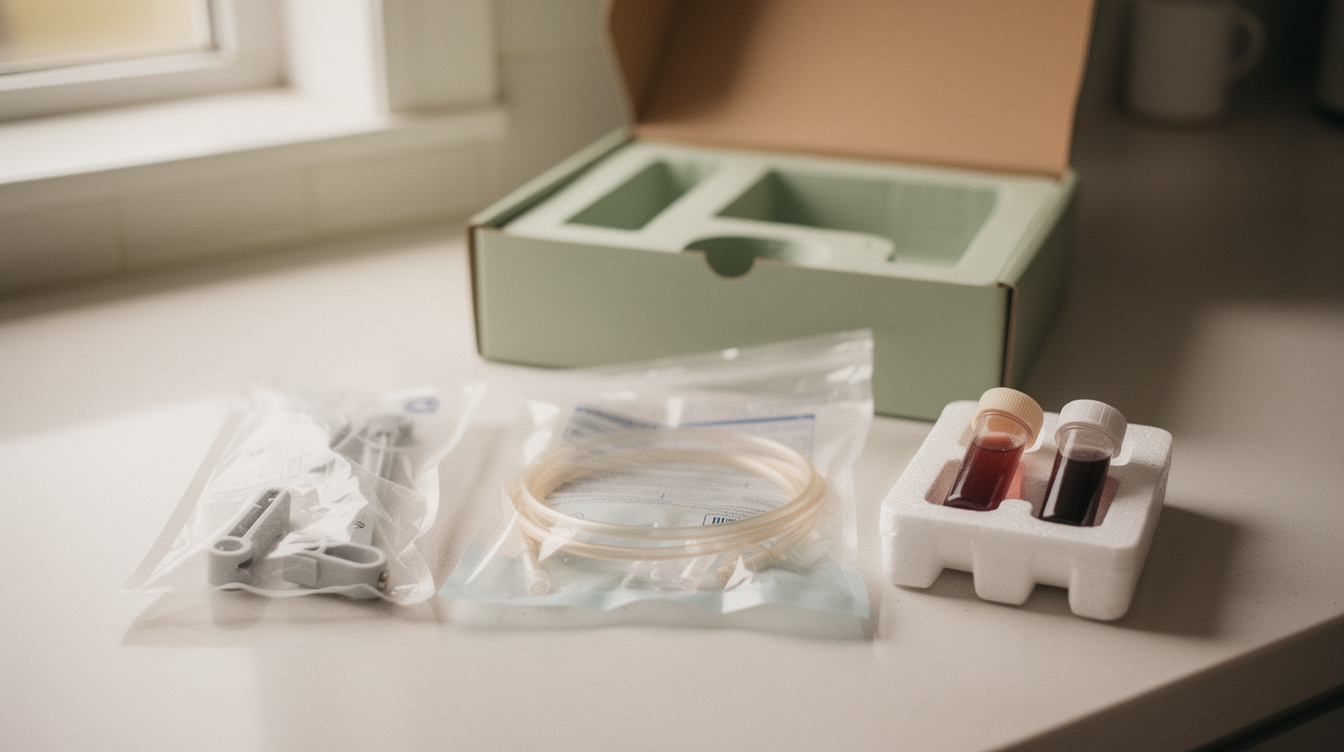
This is the reassuring part, and it is the same whichever bank you use. The collection happens after your baby is already out and the cord has been clamped and cut. The Cleveland Clinic describes providers inserting "a needle into the cord to extract the blood," and says the process is "harmless and safe" and "takes just a few minutes." MedlinePlus describes the same two methods — the provider "will either use a needle to remove blood from the cord or let the blood drip out" into a special collection bag.
On whether it interferes with your birth, HealthyChildren.org is unambiguous: "Donating cord blood is safe for the baby and doesn't interfere with labor and delivery." The Cleveland Clinic agrees that banking does not affect labor or delivery and that the baby is not harmed. Nobody is taking blood from your baby — this is the blood left behind in the cord and placenta.
One honest caveat: it does not always work. MedlinePlus notes that "sometimes the cord doesn't contain enough blood" to be collected and stored. That is not something you can control, and it is not a sign anything went wrong.
06Delayed cord clamping: do you have to choose?
If you have read anything about birth plans, you have probably run into delayed cord clamping — waiting before clamping the cord so more blood flows from the placenta to your baby. A 2025 study in a public cord blood bank's own collection data, published on the NIH's PubMed Central, notes that the World Health Organization recommends delaying cord clamping "until at least 1 minute after birth" and that the American College of Obstetricians and Gynecologists recommends "delaying cord clamping until at least 30 s to 60 s after birth."
The obvious worry is that waiting leaves less blood in the cord to collect. The study found exactly that, and then found it did not matter much. Median cord blood unit weight did fall as the delay got longer — 104 grams at 30 seconds, 97 grams at 60 seconds, 91.5 grams at 120 seconds or more — but the stem cell content, measured as total nucleated cell count, "remained stable across clamping intervals" with "no statistically significant differences." The share of units that met the bank's transplant criteria did not differ significantly either. The authors' conclusion: "the practice of delaying cord clamping to various extents (ranging from 30 s to 120 s) is compatible with public cord blood banking needs."
That is one study at one bank, not a universal rule, and it is about public banking specifically. But it does mean this is a real conversation to have with your provider rather than a forced trade-off. The same study found that only 11.1% of the units collected met the full criteria for transplant use — a useful reminder that donating is a contribution to a pool, not a guarantee that your particular unit will end up on the registry. If this is on your list, our guide to writing a birth plan is the right place to put both preferences in writing.
07The deadline: about 34 weeks
Whichever option you pick, this is not a decision you can make in the delivery room. There is paperwork, there is a consent form, and your hospital has to be set up for it.
HealthyChildren.org gives the hard number: "Cord blood donation should be arranged by the 34th week of pregnancy." The Cleveland Clinic says the same: "You should decide by about 34 weeks of pregnancy." MedlinePlus frames it as lead time rather than a week — talk with your provider "at least three months before your baby is due."
Cord blood, sorted before 34 weeks
- Decide which of the four outcomes you want — public donation, private bank, directed donation for a sibling, or nothing. For most families, the AAP's answer is public donation.
- Ask whether your hospital collects for public donation. Not all do. The Cleveland Clinic notes public banking is free "if your hospital participates," so this is the question that decides whether the free option is even available to you.
- Tell your OB or midwife. The AAP's own guidance is that this should come up at an early prenatal visit, so raise it if it has not.
- Fill out and return the consent form the way that specific bank asks. Each one has its own process.
- If you are considering a private bank, price both numbers — the one-time processing fee and the annual maintenance fee, every year, for as long as you plan to store it.
- If a sibling has a condition treatable by a cord blood transplant, say so. This is the case where the medical guidance supports storing it, and MedlinePlus notes fees may be waived.
- Add it to the third-trimester list so it does not land in the same week as everything else. Our third trimester checklist covers what else belongs in that stretch.
This is general information, not medical advice
Cord blood banking is a medical and financial decision that depends on your own family history, your hospital, and your pregnancy — and your OB, midwife, or pediatrician is the person who can weigh it against what they know about you. If anyone in your family has a blood disorder, an inherited metabolic or immune condition, or a child who has needed or may need a stem cell transplant, tell your provider. That single fact can change the answer completely.
08The short version
Cord blood transplants are real medicine that treats real diseases. The question in front of you is not whether cord blood works — it is who should be holding your baby's unit. The AAP's answer, for families without a sick sibling, is a public bank: free to you, far more likely to be used, and more tightly regulated. Paying a private company to keep it in case your own child needs it is the version the evidence supports least, and it is the version with a brochure.
Either way, it is a thirty-minute job that has to happen by about week 34 — which is exactly the kind of task that gets lost in the third trimester. That is the problem this site exists to solve: our free week-by-week planner takes your due date and places jobs like this one in the week you can still comfortably do them, instead of stacking everything into the final stretch. And once the baby is actually here, newborn basics picks up where the prep leaves off.
Questions parents actually ask
Is cord blood banking worth it?
It depends which kind. Public donation is free and the AAP recommends it — HealthyChildren.org notes there is no cost to the donor family, and that thirty times more publicly banked units get used for transplants than privately banked ones. Paying a private bank as general insurance for your own child is the version medical guidance supports least, because a child's own cord blood often cannot be used for the very conditions parents are worried about. Private banking does make sense when a sibling has a condition a cord blood transplant could treat.
How much does private cord blood banking cost?
HealthyChildren.org puts the processing fee at $1,350 to $2,350, plus an annual maintenance fee of $100 to $175. The annual fee continues for as long as the unit is stored, so it behaves like a subscription rather than a one-time purchase. Public donation, by contrast, costs the family nothing.
What is the deadline to arrange cord blood banking?
About 34 weeks. HealthyChildren.org says cord blood donation "should be arranged by the 34th week of pregnancy," and the Cleveland Clinic says to decide by about 34 weeks. MedlinePlus frames it as talking with your provider at least three months before your due date. There is a consent form and your hospital has to participate, so it cannot be arranged on the day.
Does collecting cord blood hurt the baby or affect delivery?
No. The collection happens after your baby is born and the cord has been clamped and cut, using the blood left in the cord and placenta. HealthyChildren.org says donating cord blood "is safe for the baby and doesn't interfere with labor and delivery," and the Cleveland Clinic describes the process as harmless, safe, and taking just a few minutes.
Can my child use their own banked cord blood if they get leukemia?
Often not. HealthyChildren.org states that if a child develops leukemia, that child's stored cord blood "will likely have the potential to progress to leukemia and cannot be used." The same limitation applies to inherited genetic conditions, because the banked cells carry the same genes — the FDA notes that for genetically heritable diseases, a child's own cord blood may not be recommended for treatment.
Can I have delayed cord clamping and still donate cord blood?
Possibly, and it is worth asking. A 2025 study of one public bank's collections, published on the NIH's PubMed Central, found that unit weight fell as clamping was delayed but stem cell counts stayed stable, and concluded that delaying cord clamping from 30 to 120 seconds "is compatible with public cord blood banking needs." That is one study at one bank, so ask your provider and your chosen bank what they require.
Sources
- HealthyChildren.org (AAP) — Newborn Umbilical Cord Blood Banking and Donation: AAP Policy Explained — Stem cell transplants treat children with cancer and other life-threatening diseases including metabolic, immune, and blood disorders; cord blood from public banks is used more often than privately banked cord blood; thirty times more publicly banked units are used for transplants; no cost to the donor family with public banking; private processing fee of $1,350-$2,350 and annual maintenance of $100-$175; private banks may not meet stringent requirements, causing lesser-quality cord blood; a child who develops leukemia likely cannot use their own stored cord blood; matched sibling directed donation; cord blood donation should be arranged by the 34th week of pregnancy; donating is safe for the baby and does not interfere with labor and delivery.
- HealthyChildren.org (AAP) — AAP Encourages Use of Public Cord Blood Banks — Public banks match patients worldwide, are free to donate to, and are highly regulated by oversight accrediting institutions; private banks store for the family's potential self-use and may not meet stringent requirements; cord blood from public banks is utilized at 30 times the rate of private banks; physicians should discuss the value of cord blood and the public vs. private difference at early prenatal visits; Dr. William T. Shearer quote that most parents will never need cord blood for their own family's use.
- U.S. Food and Drug Administration — Cord Blood Banking: Information for Consumers — Cord blood is used in hematopoietic (blood-forming) stem cell transplantation for some disorders of the blood-forming system; has treated certain blood cancers and some inherited metabolic and immune system disorders; cord blood for unrelated use must be licensed under a biologics license application or be subject to an investigational new drug application; cord blood for personal use or first- or second-degree relatives does not require approval before use but banks must still register and follow good tissue practice and donor screening/testing rules; registration with FDA does not mean a firm is endorsed by the agency; for genetically heritable diseases a child's own cord blood may not be recommended for treatment.
- MedlinePlus (NIH) — Cord Blood Testing and Banking — Definition of cord blood as the blood left in the umbilical cord after birth; stem cells treat leukemia, Hodgkin disease, certain anemias, and inherited metabolic and immune system disorders; public banks store donated units for any patient at no cost to the donor; family (private) banks save blood for that family's use only and usually charge collection and storage fees that can be very high, which may be waived if a family member currently has a treatable condition; collection by needle or by letting the blood drip out into a special bag; sometimes the cord does not contain enough blood; talk with your provider at least three months before the due date; children cannot use their own banked cells for genetic disorders because the cells carry the same genes.
- Cleveland Clinic — Cord Blood Banking — Definition of cord blood banking; treats blood cancers like leukemia and lymphoma, bone marrow diseases, anemias like sickle cell disease, and certain immune system disorders; researchers are studying applications for Parkinson's disease and diabetes; public banking is free if your hospital participates and private banking charges an initial collection fee plus yearly storage fees with access limited to family; collection by inserting a needle into the cord after clamping and cutting; the process is harmless and safe and takes just a few minutes and does not affect labor or delivery; decide by about 34 weeks of pregnancy; in most cases a baby will not use their own cord blood.
- Efficiency assessment of cord blood banking and compatibility with delayed cord clamping (PubMed Central, NIH) — WHO recommends delaying cord clamping until at least 1 minute after birth and ACOG recommends at least 30 to 60 seconds; median cord blood unit weight fell with longer clamping delays (104 g at 30 s, 97 g at 60 s, 91.5 g at 120 s or more); total nucleated cell counts remained stable across clamping intervals with no statistically significant differences; 11.1% of total units met transplant criteria with no significant difference between clamping time categories; authors conclude that delaying cord clamping from 30 to 120 seconds is compatible with public cord blood banking needs.
Newborn Weeks is planning help, not medical advice — always follow your own doctor, midwife, or pediatrician.
From the gear guide
- Munchkin Sparrow Travel Stroller — our pick in travel strollers
- Compact Travel Stroller with Canopy — our pick in travel strollers
- Gerber Birdseye Prefold Cloth Diapers — our pick in diapers & wipes
- Vtopmart Clear Storage Bins — our pick in milk storage
Keep reading
 Postpartum · 13 min read
Diastasis Recti After Pregnancy: How to Check for It and What Actually Helps
Diastasis recti affects 6 in 10 women after childbirth. How to check for the gap at home, which exercises help, which to skip, and when to call a provider.
Read the article Pregnancy · 13 min read
Heartburn During Pregnancy: Why It Happens and What Actually Helps
Heartburn during pregnancy hits up to 80% of pregnant people. Why it happens, what actually helps at night, and when it's worth calling your provider.
Read the article Pregnancy · 12 min read
Preeclampsia Signs and Symptoms: What to Watch For and When to Call
The preeclampsia signs worth knowing: a headache that won't quit, vision changes, sudden swelling. What the numbers mean and when to call right away.
Read the article