The journal · Pregnancy
Heartburn During Pregnancy: Why It Happens and What Actually Helps
In short
Heartburn in pregnancy is a burning feeling behind the breastbone, and the Cleveland Clinic says researchers estimate 30% to 80% of pregnant women get it. It happens because pregnancy hormones slow digestion and relax the valve at the bottom of the esophagus, and later because a growing uterus crowds the stomach. The fixes that actually work are unglamorous: smaller meals, no food in the three to four hours before bed, and sleeping with your head raised about six inches. Antacids neutralize the acid, but ask your own provider before you start any medicine. Call them right away for trouble swallowing, vomit that looks bloody or like coffee grounds, black stool, or crushing chest pressure.
You eat a perfectly reasonable dinner, lie down, and within twenty minutes there is a hot line running from your stomach up to your throat. Sitting up helps a little. Milk helps a little. Mostly you lie there doing math on how many weeks are left.
Heartburn during pregnancy is one of the most common complaints there is, and also one of the most fixable — not with a single miracle remedy, but with a handful of small, boring changes that stack up. Here is what the medical sources actually say about why it happens, what helps, what to ask your provider about, and the short list of symptoms that mean stop reading and call.
01What pregnancy heartburn actually feels like
Heartburn has nothing to do with your heart. MedlinePlus, the NIH's consumer health library, describes it as "a painful burning feeling just below or behind the breastbone." The pain "often rises in your chest from your stomach" and "may also spread to your neck or throat."
The mechanics are simple. There is a band of muscle at the lower end of your esophagus — the tube from your throat to your stomach — that normally closes off once food has gone down. When it does not close properly, MedlinePlus explains, "food or stomach acid can back up (reflux) into the esophagus." Stomach acid belongs in a stomach lined to handle it. The esophagus is not, so you feel it burn.
And it is extremely common when you are pregnant. The Cleveland Clinic notes that "researchers estimate that anywhere from 30% to 80% of pregnant women experience heartburn." That is a wide range, which tells you something honest: nobody has pinned the number down precisely, but on any reading, a lot of pregnant people are up at night with this.
02Why pregnancy causes it
MedlinePlus puts it bluntly in its list of common pregnancy symptoms: "Pregnancy and many medicines can bring on heartburn or make it worse." There are three separate things going on at once, and the Cleveland Clinic separates them out.
- Digestion slows down. "While you are pregnant, food stays in your stomach and bowels longer," MedlinePlus explains — which is exactly what produces the acid backing up. The Cleveland Clinic says the same thing from the other direction: pregnancy hormones "slow your digestive system. Food moves more slowly, increasing the likelihood of bloating, heartburn and constipation."
- The valve at the bottom of the esophagus gets loose. Per the Cleveland Clinic, "the hormone progesterone can cause your lower esophageal sphincter (LES) to relax" — and when it relaxes too much, "it doesn't seal to prevent the backflow of stomach acid." Your body is relaxing smooth muscle all over for good reasons; this is the unwelcome side effect.
- There is a baby where your stomach used to be. "As the fetus grows, your uterus gets bigger," the Cleveland Clinic notes. "It can crowd your stomach, causing stomach acid to flow upward, into your esophagus." This is plain physics, and it is why heartburn often gets worse rather than better as you go.
None of which is your fault, and none of which means you ate the wrong thing. You may well have eaten a trigger food, and we will get to those — but the underlying setup was already in place.
03When does pregnancy heartburn start?
There is no fixed week. The Cleveland Clinic says heartburn can occur anytime during pregnancy but is "more common in the third trimester, when your uterus is the largest and places the most pressure on your stomach." So if you are 30 weeks in and this just started, that fits the pattern exactly. If it started at 10 weeks, that fits too — the hormonal slowdown does not wait for a bump.
Here is something we will not tell you: that it reliably disappears the moment you give birth. It is a claim you will see repeated everywhere, and none of the sources we fetched for this article actually states it, so we are not going to present it as fact. What the sources do say is that the third-trimester version is driven by pressure from the largest your uterus will get. Ask your own provider what to expect afterward — they can tell you about your pregnancy rather than about pregnancy in general.
If you are heading into the last stretch, our third trimester checklist covers what is worth getting done while you still have the energy — and a few things worth moving earlier than most lists put them.
04What actually helps
Almost everything on this list is about when and how much you eat rather than what — which is good news, because the when and how much are under your control on a day when nothing else is.
Heartburn relief that the sources actually back
- Eat smaller meals, more often. Both MedlinePlus and the Cleveland Clinic start here: small meals instead of three large ones. A smaller stomach volume is a smaller amount of acid to push back up.
- Stop eating three to four hours before bed. MedlinePlus says to "avoid eating within 3 to 4 hours of bedtime." This is the single highest-value change most people can make, and the hardest one, because evening is when pregnancy hunger shows up.
- Don't lie down right after a meal. MedlinePlus advises "not lying down flat right after a meal." The Cleveland Clinic puts a number on it: wait two to three hours after eating before lying down.
- Sit upright while you eat, and eat slowly. Both are on the Cleveland Clinic's list. Slow eating also makes the smaller-meal habit easier to keep.
- Drink between meals rather than during them. The Cleveland Clinic recommends this, and MedlinePlus separately advises "not drinking large amounts of liquid before bedtime." Liquid takes up room you do not have.
- Skip the usual trigger foods. MedlinePlus's list: alcohol, caffeine, chocolate, citrus, spicy and fatty foods, and tomatoes. The Cleveland Clinic adds fried and carbonated items and suggests limiting caffeine.
- Don't exercise straight after eating. MedlinePlus says to avoid exercising for at least two hours after you eat.
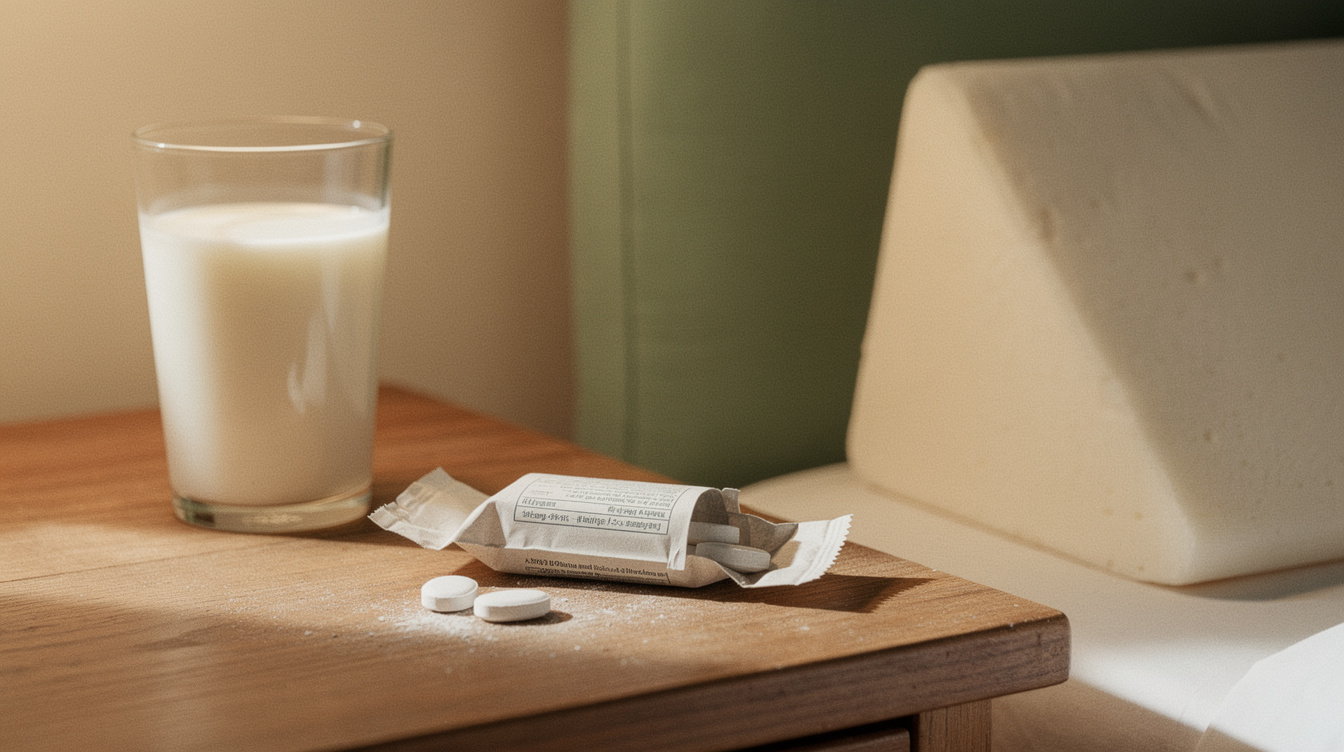
- Try the gentle stuff. The Cleveland Clinic lists yogurt, milk, honey stirred into warm milk, and chewing gum to help neutralize acid. These are low-risk things to try, not guaranteed fixes — and worth knowing before you reach for a medicine.
One more, and it belongs to the person who is not pregnant: if smoking happens in your house, MedlinePlus lists stopping smoking or using tobacco among its home-care steps for heartburn. That one is worth doing for about fifteen other reasons too.
05Night heartburn: the one that wakes you up
Lying flat removes the only thing that was keeping acid down, which is gravity. The fix is to put gravity back.
MedlinePlus is specific: "sleep with your head raised about 6 inches." The Cleveland Clinic gives the same advice as elevating the head of your bed. Note that this means raising the whole upper half of you — stacking pillows under your head alone tends to bend you at the neck and do very little for your stomach. A wedge pillow, or something solid under the legs at the head of the bed, works better than a pillow tower.
Our guide to pregnancy sleep positions covers how to stack this with the other things you are trying to get right overnight, because by the third trimester there are several and they do not always agree with each other.
If heartburn is waking you up, that is worth a mention at your next visit
The Cleveland Clinic lists "heartburn that wakes you up at night" among the reasons to contact your healthcare provider — alongside heartburn that persists despite lifestyle changes. Being woken up is not just an inconvenience to tolerate until delivery; it is on the clinical list. Say it out loud at your next appointment rather than saving it up.
06Antacids and medicine: what to ask about
This is the part where we are going to be more careful than most articles, because the right answer genuinely depends on you, your pregnancy, and anything else you take.
The Cleveland Clinic's instruction is direct: "talk to your healthcare provider before taking antacids or any other medicine for heartburn," and it notes that the risk of harm to a fetus "tends to be most significant during the first trimester." MedlinePlus says the same from the other side: "if you continue to have heartburn, talk to your provider about medicines that can help." So the move is not to guess in a drugstore aisle — it is to arrive at your appointment with the question already formed.
How antacids work, and how to use them
Antacids are the chewable tablets and liquids that "work by neutralizing the stomach acid that causes heartburn," per MedlinePlus. Timing matters more than people realize: "take antacids about 1 hour after eating or when you have heartburn. If you are taking them for symptoms at night, do not take them with food."
The ingredient also changes the side effects, which is useful to know when you are already dealing with pregnancy digestion. MedlinePlus notes that brands with magnesium "may cause diarrhea," while brands with calcium or aluminum "may cause constipation" — and rarely, calcium-based ones "may cause kidney stones or other problems." It also warns that large amounts of aluminum-containing antacids can put you at risk for calcium loss and weaker bones. And one line worth taking seriously: "contact your provider if you need to use antacids on most days." Daily reliance is a signal, not a solution.
If antacids are not enough
There are stronger acid-reducing medicines, and your provider is the one to pick among them. For context on one of the common ones, the MotherToBaby fact sheet on famotidine — MotherToBaby is the service run by the Organization of Teratology Information Specialists that answers exactly these questions — notes that famotidine "has been used to treat acid reflux (heartburn) or peptic ulcer disease" and that "studies on the use of famotidine in pregnancy do not report an increased chance of birth defects." It is also candid about what is not known: "studies have not been done to see if famotidine can increase the chance of miscarriage." For later on, it adds that "taking famotidine while breastfeeding is not expected to cause problems in children who are nursing."
That fact sheet ends where this section does: "it is important to talk with your healthcare providers before making any changes to how you take your medication." Bring the actual bottle or a photo of the label to your appointment — it saves a round of phone tag.
07When heartburn is a reason to call
Most pregnancy heartburn is miserable and harmless. A short list of symptoms is neither, and it is worth knowing them cold so you are not deciding at 2 a.m. whether this counts.
MedlinePlus says to seek urgent care if you "vomit material that is bloody or looks like coffee grounds," or if you have "a squeezing, crushing, or pressure in your chest." The Cleveland Clinic adds to the call-your-provider list: heartburn that persists despite lifestyle changes, heartburn that wakes you at night, trouble swallowing, spitting up blood, black stool, and losing weight. MedlinePlus also flags heartburn that "does not go away after a few weeks of self-care."
Upper-belly pain in pregnancy is not automatically heartburn
This is the one to remember. Pain high in the abdomen can be a sign of preeclampsia rather than reflux. The MedlinePlus page on preeclampsia lists "belly pain on the right side, below the ribs" — pain that "may also be felt in the right shoulder" — along with "nausea and vomiting (a worrisome sign)," a "headache that does not go away or becomes worse," and vision changes including flashing lights, spots, light sensitivity, or blurry vision. Its instruction is plain: "contact your provider if you have symptoms of preeclampsia during your pregnancy or after delivery." Our guide to preeclampsia signs and symptoms goes through this in detail. If severe upper-belly pain shows up with any of those other symptoms, do not file it under heartburn — call.
This is general information, not medical advice
Everything above comes from the sources listed at the bottom of this page, but none of them knows you. Your obstetrician, midwife, or family doctor is the right person to tell you what is safe in your pregnancy, which medicines fit with anything else you take, and whether what you are feeling is reflux or something that needs a closer look. Asking is not an imposition — it is the job.
08Small changes, in the right order
If you only do three things: shrink the meals, stop eating three to four hours before bed, and raise the head of the bed about six inches. Those are the ones with the clearest backing and the lowest cost, and together they handle the night-time version — which is the version that actually wears people down.
The rest of the third trimester has the same shape as this: a long list of small things, and no obvious order to do them in. That is the problem we built this site to solve. Enter your due date and you will get a free, personalized week-by-week plan, with the heavy tasks front-loaded into the middle of pregnancy so the last stretch stays light — because by then, lying down flat is hard enough.
Questions parents actually ask
Why is heartburn so common during pregnancy?
Three things happen at once. Pregnancy hormones slow digestion, so food stays in your stomach longer, as MedlinePlus explains. Progesterone relaxes the lower esophageal sphincter — the valve at the bottom of the esophagus — so it does not seal properly against stomach acid. And as the Cleveland Clinic notes, a growing uterus crowds the stomach and pushes acid upward. The Cleveland Clinic says researchers estimate that 30% to 80% of pregnant women experience it.
When does heartburn start in pregnancy?
There is no set week. The Cleveland Clinic says heartburn can happen at any point in pregnancy but is more common in the third trimester, when the uterus is largest and puts the most pressure on the stomach. Starting earlier is also normal, since the hormonal slowdown in digestion begins well before there is much pressure.
What is the fastest relief for pregnancy heartburn at night?
Raise your head. MedlinePlus advises sleeping with your head raised about six inches, and the Cleveland Clinic recommends elevating the head of the bed. Raise your whole upper body — a wedge pillow or blocks under the head of the bed frame — rather than stacking pillows under your head alone. Pair it with not eating in the three to four hours before bed, which MedlinePlus also recommends.
Can I take antacids while pregnant?
Ask your own provider first. The Cleveland Clinic's instruction is to talk to your healthcare provider before taking antacids or any other heartburn medicine, and it notes the risk of harm to a fetus tends to be most significant in the first trimester. If your provider says yes, MedlinePlus advises taking antacids about an hour after eating or when heartburn hits, and contacting your provider if you find you need them on most days.
Which foods should I avoid for pregnancy heartburn?
MedlinePlus lists alcohol, caffeine, chocolate, citrus, spicy and fatty foods, and tomatoes. The Cleveland Clinic adds fried and carbonated foods and drinks and suggests limiting caffeine. Keep in mind that meal size and timing usually matter more than any single food — smaller meals, eaten sitting up, with nothing in the few hours before bed.
When should I call my provider about heartburn in pregnancy?
MedlinePlus says to seek urgent care for vomit that is bloody or looks like coffee grounds, or for squeezing, crushing, or pressure in your chest. Call your provider for heartburn that persists despite lifestyle changes, heartburn that wakes you at night, trouble swallowing, spitting up blood, black stool, or weight loss, per the Cleveland Clinic. And pain high on the right side of your belly under the ribs can be a sign of preeclampsia rather than reflux — MedlinePlus lists that among preeclampsia symptoms, so call about it rather than assuming it is heartburn.
Sources
- Cleveland Clinic — Heartburn During Pregnancy: Causes & Treatment — Researchers estimate 30% to 80% of pregnant women experience heartburn; more common in the third trimester when the uterus is largest and puts the most pressure on the stomach; hormones slow the digestive system so food moves more slowly, increasing bloating, heartburn and constipation; progesterone relaxes the lower esophageal sphincter so it does not seal against backflow of stomach acid; a growing uterus crowds the stomach and pushes acid into the esophagus; self-care steps including small frequent meals, eating slowly and sitting upright, drinking between meals, avoiding fried, spicy, fatty, citrus and carbonated items, limiting caffeine, waiting 2-3 hours after eating before lying down, elevating the head of the bed, and trying yogurt, milk, honey in warm milk or gum to neutralize acid; talk to a provider before taking antacids or any heartburn medicine; risk of harm to the fetus tends to be most significant in the first trimester; contact a provider for heartburn that persists despite lifestyle changes, heartburn that wakes you at night, trouble swallowing, spitting up blood, black stool, or weight loss.
- MedlinePlus (NIH) — Common symptoms during pregnancy — While pregnant, food stays in the stomach and bowels longer, which may cause heartburn (stomach acid moving back up into the esophagus); reduce it by eating small meals, avoiding spicy and greasy foods, not drinking large amounts of liquid before bedtime, not exercising for at least 2 hours after eating, and not lying down flat right after a meal; if heartburn continues, talk to your provider about medicines that can help.
- MedlinePlus (NIH) Medical Encyclopedia — Heartburn — Heartburn is a painful burning feeling just below or behind the breastbone that often rises in the chest from the stomach and may spread to the neck or throat; a band of muscle at the lower end of the esophagus normally closes it off, and when it does not, food or stomach acid can back up into the esophagus; pregnancy and many medicines can bring on heartburn or make it worse; home care including avoiding alcohol, caffeine, chocolate, citrus, spicy and fatty foods and tomatoes, eating smaller meals, avoiding eating within 3 to 4 hours of bedtime, sleeping with the head raised about 6 inches, and stopping smoking or tobacco use; seek urgent care for vomit that is bloody or looks like coffee grounds or for squeezing, crushing or pressure in the chest; contact a provider if heartburn does not go away after a few weeks of self-care or if there is trouble swallowing.
- MedlinePlus (NIH) Medical Encyclopedia — Taking antacids — Antacids work by neutralizing the stomach acid that causes heartburn; take them about 1 hour after eating or when heartburn occurs, and not with food if taking them for night-time symptoms; brands with magnesium may cause diarrhea while brands with calcium or aluminum may cause constipation; rarely, calcium brands may cause kidney stones or other problems; large amounts of aluminum-containing antacids may risk calcium loss and weak bones; contact your provider if you need to use antacids on most days.
- MotherToBaby (OTIS) — Famotidine fact sheet — Famotidine has been used to treat acid reflux (heartburn) or peptic ulcer disease; studies on the use of famotidine in pregnancy do not report an increased chance of birth defects; studies have not been done to see if famotidine can increase the chance of miscarriage; taking famotidine while breastfeeding is not expected to cause problems in nursing children; talk with your healthcare providers before making any changes to how you take your medication.
- MedlinePlus (NIH) Medical Encyclopedia — Preeclampsia — Preeclampsia symptoms include belly pain on the right side below the ribs, which may also be felt in the right shoulder; nausea and vomiting described as a worrisome sign; a headache that does not go away or becomes worse; and vision changes including flashing lights or spots, light sensitivity, and blurry vision; contact your provider if you have symptoms of preeclampsia during pregnancy or after delivery.
Newborn Weeks is planning help, not medical advice — always follow your own doctor, midwife, or pediatrician.
From the gear guide
- Kolcraft Cloud Plus Umbrella Stroller — our pick in travel strollers
- Graco Gomax Frame Stroller — our pick in travel strollers
- Rocinha Disposable Changing Pads — our pick in diaper bags & changing pads
- KeaBabies Organic Soothe Swaddle — our pick in swaddle & receiving blankets
Keep reading
 Pregnancy · 14 min read
Cord Blood Banking: What It Costs, What It Treats, and What the AAP Recommends
Cord blood banking, explained: what it treats, what private banks charge, and why the AAP recommends donating to a public bank unless a sibling needs it.
Read the article Postpartum · 13 min read
Diastasis Recti After Pregnancy: How to Check for It and What Actually Helps
Diastasis recti affects 6 in 10 women after childbirth. How to check for the gap at home, which exercises help, which to skip, and when to call a provider.
Read the article Pregnancy · 12 min read
Preeclampsia Signs and Symptoms: What to Watch For and When to Call
The preeclampsia signs worth knowing: a headache that won't quit, vision changes, sudden swelling. What the numbers mean and when to call right away.
Read the article