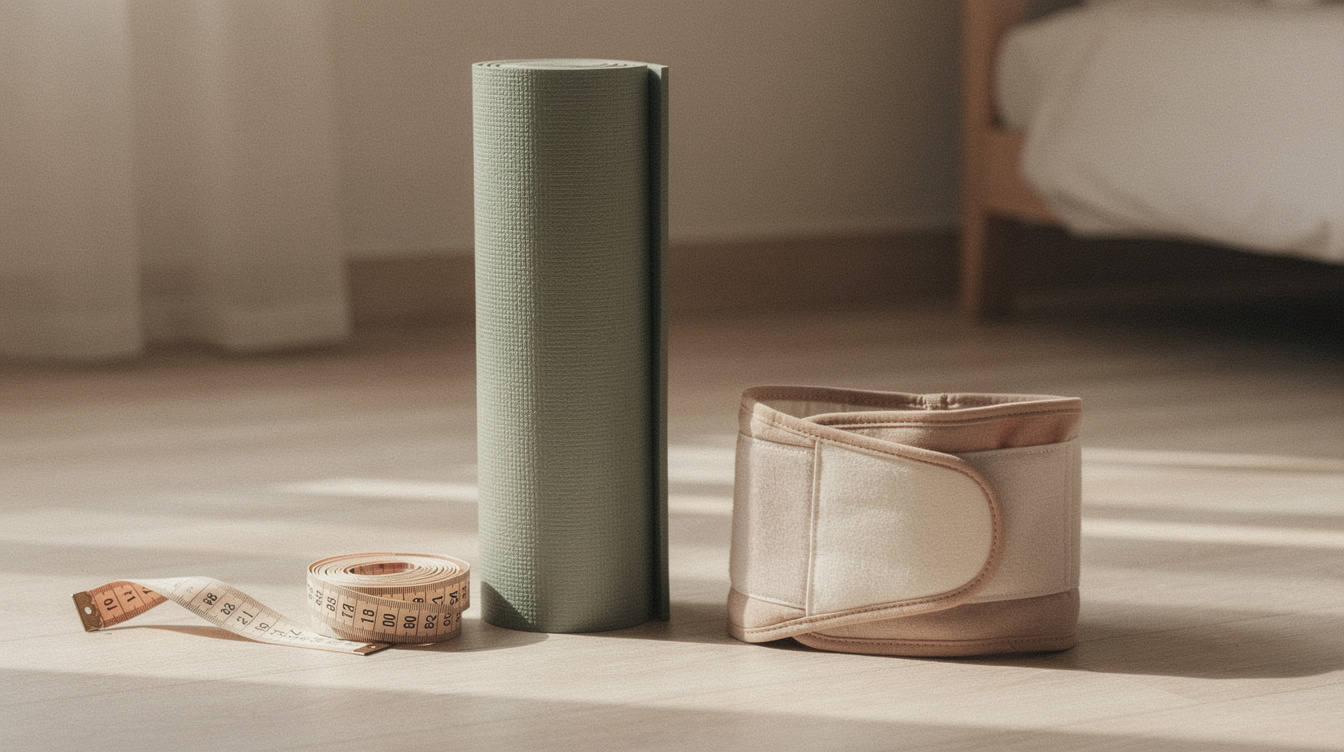
The journal · Postpartum
Diastasis Recti After Pregnancy: How to Check for It and What Actually Helps
In short
Diastasis recti is a gap between the two halves of your abdominal muscles, caused by the tissue down the middle of your belly thinning and stretching during pregnancy. It is extremely common — the Cleveland Clinic says about 6 in 10 women have it after childbirth — and for most people it narrows a lot on its own over the first year. You can check for it at home by lying on your back and feeling for the gap with your fingers; two or more finger widths is worth mentioning to your provider. Gentle deep-core work with a physical therapist is the standard first step, and the honest research picture is that it improves how your core works more reliably than it fully closes the gap.
A few weeks after your baby is born, you look down and there is still a bump — but it is a different kind of bump. Softer. Sometimes there is a ridge or a little tunnel down the middle when you sit up, or your belly cones to a point when you get out of bed. That is usually diastasis recti, and almost nobody mentions it to you beforehand.
It is one of the most common things that happens to a body after pregnancy, and one of the most oversold. There is a large industry built on closing the gap in six weeks. Here is what the clinical sources and the published research actually say — including the part where the evidence is weaker than the marketing.
This is general information, not medical advice
Every recovery is different, and a gap in your abdominal muscles is exactly the kind of thing worth having someone put their hands on. Anything here about checking, exercising, or timing is worth running past your own OB, midwife, or a pelvic floor physical therapist — they can feel what is happening and tell you what applies to you. If you have pain, a bulge that will not go away, or anything that feels like a lump near your belly button, call them.
01What diastasis recti actually is
Your abdominal muscles are not one sheet. The rectus abdominis — the pair of muscles people call a six-pack — runs in two columns down the front of your belly, joined in the middle by a band of connective tissue called the linea alba. The Cleveland Clinic describes diastasis recti as "the separation of your rectus abdominis muscles," which happens when "your abdomen stretches during pregnancy and creates a gap in the abdominal muscles."
The muscles themselves do not tear. What changes is the tissue between them: during pregnancy "your linea alba thins and pulls apart," and after stretching for months it does not always spring back to its old tension. So the gap is really a stretched seam, not an injury — which matters, because the fix is about restoring tension, not re-attaching anything.
Clinically the gap gets measured as an inter-rectus distance — how far apart the two columns sit. The Cleveland Clinic's threshold is simple: "An abdominal gap wider than 2 centimeters is considered diastasis recti." A systematic review in Surgical Endoscopy uses a similar number, about 22 millimeters measured a few centimeters above the belly button with the muscles relaxed.
02How common it is — and how much of it goes away on its own
Common enough that it is closer to normal than not. The Cleveland Clinic says diastasis recti affects "6 in 10 women after childbirth," with 45% still having it at six months postpartum.
The most useful numbers come from a prospective study of 300 first-time mothers followed from pregnancy through a year after birth, published in the British Journal of Sports Medicine by Sperstad and colleagues. They checked the same women at four points:
- 33.1% had diastasis recti at 21 weeks pregnant
- 60.0% at six weeks postpartum
- 45.4% at six months postpartum
- 32.6% at twelve months postpartum
Read that curve the right way and it is genuinely reassuring. The peak is right after birth, and then it falls by nearly half over the first year without anyone being handed a specialty routine. The Surgical Endoscopy review puts the same point plainly: the separation "regresses spontaneously after childbirth in most women" — while also noting that at 12 months, about a third of women still have it.
So if you are six weeks out and panicking about your middle: statistically, you are at the worst point of the whole timeline. Our postpartum recovery timeline covers what else is still in motion at that stage.
03How to check for diastasis recti at home
This is the one self-check that is genuinely worth doing, mostly so you know what you are dealing with before your postpartum visit. Here is the method the Cleveland Clinic describes.
The finger check, step by step
- Lie on your back with your knees bent, feet flat on the floor or bed.
- Place your fingertips just above your belly button, pointing down toward your feet.
- Lift your shoulders slightly off the floor — a small lift, not a full sit-up.
- Feel for the gap between the two sides. The Clinic's instruction is to "use your fingers to feel for a gap between the abs" and "see how many fingers can fit in the gap between your right and left abdominals."
- Check above and below, too. The Sperstad study measured at three places — about 4.5 cm above the belly button, at it, and 4.5 cm below — because a gap is often wider in one spot than another.
- Note the width, not just the feel. A gap of "two or more finger widths" is the Cleveland Clinic's cue to bring it up with a healthcare provider.
What you are feeling for is width and also springiness — whether the tissue has any tension to it when you lift. Your provider can confirm it properly; the Cleveland Clinic notes they may use "their hands and fingers to feel your abdominal area" or measure it with "ultrasound, measuring tape or a tool called a caliper."
04The signs, including the one everyone notices first
According to the Cleveland Clinic, the usual signs are:
- A visible bulge or "pooch" above or below the belly button
- "Softness or jelly-like feeling around your belly button"
- "Coning or doming when you contract your ab muscles" — the ridge that appears as you sit up
- Low back pain, or finding everyday lifting and carrying harder than it used to be
On pain, two sources are worth holding together. The Cleveland Clinic says "Diastasis recti isn't painful" in itself, though the knock-on effects can be uncomfortable. And the Sperstad study found "no difference in reported lumbopelvic pain" between the women who had diastasis recti and the women who did not. That is a helpful finding: if your back hurts at a year postpartum, the gap is not automatically the explanation, and it is worth getting the real cause looked at rather than assuming.
05What actually helps
The standard conservative approach is gentle, deliberate work on the deep abdominal muscles — not the ones you can see. The Cleveland Clinic's advice is to "perform gentle movements that tighten your abdominal muscles," and specifically to "work with a physical therapist who has experience with diastasis recti." That referral is the single highest-value thing on this page. A pelvic floor or postpartum physical therapist will watch you breathe, brace, and move, and correct the thing a video cannot see.
There is real trial evidence that structured exercise narrows the gap. A 2024 randomized controlled trial in PLoS One assigned 28 postpartum women to either a conventional abdominal exercise plan or a hypopressive one — 12 sessions over six weeks — and measured the gap by ultrasound. Both groups improved: the gap narrowed by an average of 3.06 mm at one measurement point and 2.88 mm at another, with no significant difference between the two approaches, and women who had given birth more than once benefited most. The authors' conclusion: "A reduction in IRD has been achieved with the implementation of both 6-week exercise programs."
Note the units, though. That is about three millimeters in six weeks, in a study of 28 people. It is a real effect, and it is not a before-and-after photo.
06The honest part: what exercise does and does not do
This is where most articles on diastasis recti quietly overpromise, so here is the uncomfortable half of the literature. The Surgical Endoscopy systematic review found that physical therapy plans "were unable to reduce IRD in a relaxed state," achieving "a limited reduction in IRD during muscle contraction" instead. Its flat statement is that complete resolution of the separation, measured with the muscles relaxed, following a course of physical therapy is not described in current literature. One study it reviewed reported that 87% of patients who had physical therapy alone were dissatisfied and went on to choose surgery.
That review is written from a surgeon's vantage point, and it sees the people for whom conservative care did not settle the matter — so it is not the whole picture either. But put the two bodies of evidence side by side and a sane expectation emerges: good core rehabilitation reliably improves how your abdominal wall works — how it tensions, how it holds under load, how it feels to lift your baby — and narrows the gap modestly. What it does not dependably do is return a relaxed belly to its pre-pregnancy measurement. If someone promises you that in eight weeks, they are ahead of the research.
Which is an argument for picking the right goal. Strength you can use on the floor with your baby, with a car seat, and up the stairs is a better target than a number measured lying down.
07What to skip for now
Some of the most popular abdominal exercises push the gap outward instead of drawing it together. The Cleveland Clinic lists these to avoid:
- Crunches and sit-ups — the classic mistake, and the one most people start with
- Planks and push-ups
- Downward dog and boat pose
- Anything that makes your belly bulge or cone outward as you do it. That doming is the useful signal: if it appears, the movement is too much for where your tissue is right now
Heavy lifting is worth a second look
In the Sperstad study, most of the suspected risk factors showed no significant difference between women with and without diastasis recti — with one exception. Lifting heavy loads 20 or more times a week was associated with higher odds of having it (odds ratio 2.18, with a confidence interval of 1.05 to 4.52, meaning roughly double the odds but with a wide margin). It is a single finding from one group of women, not a law. But if your days involve repeated heavy lifting, it is a fair thing to raise with your provider — and a fair reason to let someone else carry the groceries for a while. If you gave birth by cesarean, follow your own surgical restrictions first; our c-section recovery guide covers that timeline.
08When to call your provider
The Cleveland Clinic's threshold is clear: "If you have more than a two-finger gap between your abdominals or are experiencing pain, contact your healthcare provider." Two more reasons to call sooner rather than later: a bulge that stays pushed out, or anything that feels like a distinct lump near your belly button, since the Clinic notes surgery is considered "if you have an umbilical hernia" — a separate problem that needs looking at.
Otherwise, the natural moment to raise it is the postpartum visit. Womenshealth.gov, from the U.S. Office on Women's Health, says "Your doctor will check your recovery at your postpartum visit, about six weeks after birth," and that this is the appointment to discuss resuming normal activities and a fitness plan. Until then, MedlinePlus keeps it simple: "Follow your doctor's instructions on how much activity, like climbing stairs or walking, you can do for the next few weeks." Put it on the list for that visit — ours is the postpartum checklist — because it is easy to forget once you are in the room with a baby on your lap.
On surgery: the Surgical Endoscopy review notes that repair is generally considered for "cosmetic or functional impairment," and that the separation itself "poses no risk of strangulation" — meaning it is not a condition that becomes an emergency if you leave it. There is no clock forcing a decision.
09There is no deadline on this
The thing worth carrying away is the least urgent sentence in any of these sources. The Cleveland Clinic says it outright: "It's never too late to repair your diastasis recti. With the proper exercises, you can fix your ab separation years after you've delivered your last baby."
So the first postpartum year does not have to include a core routine. If all you can manage right now is feeding a baby and sleeping in pieces, that is the correct use of this month. The gap will still be addressable when you have an hour and the inclination, and the odds are decent it will have narrowed on its own in the meantime.
And if you are reading this while still pregnant, trying to get ahead of what comes after: that is what we built this site for. Enter your due date and you will get a free week-by-week to-do list that front-loads the real preparation into the middle of pregnancy — including lining up the postpartum support worth having in place before you need it.
Questions parents actually ask
How do I know if I have diastasis recti?
Lie on your back with your knees bent, put your fingertips just above your belly button, and lift your shoulders slightly off the floor. The Cleveland Clinic says to feel for the gap between your right and left abdominal muscles and see how many finger widths fit in it. Two or more finger widths is worth bringing up with your provider, who can confirm it by hand or with an ultrasound, measuring tape, or a caliper. A gap wider than 2 centimeters counts as diastasis recti.
How common is diastasis recti after pregnancy?
Very common. The Cleveland Clinic says it affects about 6 in 10 women after childbirth, with 45% still having it at six months postpartum. A study of 300 first-time mothers published in the British Journal of Sports Medicine found 60.0% had it at six weeks postpartum, 45.4% at six months, and 32.6% at twelve months.
Does diastasis recti go away on its own?
Often it improves a great deal on its own. The Cleveland Clinic says mild cases with a little separation may improve with minimal effort, and a systematic review in Surgical Endoscopy notes the separation regresses spontaneously after childbirth in most women. The same review points out that about a third of women still have it at 12 months, so it does not always resolve completely.
Can exercise close the gap completely?
Probably not completely, and it is worth knowing that up front. A 2024 randomized controlled trial in PLoS One found six weeks of abdominal exercise narrowed the gap by about 3 millimeters in 28 postpartum women. But a systematic review in Surgical Endoscopy found physical therapy did not reduce the gap when the muscles were relaxed, and stated that complete resolution following a course of physical therapy is not described in current literature. Rehabilitation reliably improves how your core functions; it does not dependably restore a pre-pregnancy measurement.
Which exercises should I avoid with diastasis recti?
The Cleveland Clinic lists crunches and sit-ups, planks and push-ups, and downward dog and boat pose, plus any movement that makes your belly bulge or cone outward. That coning is the signal to stop — it means the load is more than your tissue can hold right now. Gentle movements that engage the deep abdominal muscles are the recommended alternative, ideally guided by a physical therapist experienced with diastasis recti.
Does diastasis recti cause back pain?
Not necessarily. The Cleveland Clinic lists low back pain among the possible effects, but says diastasis recti is not painful in itself. The study of 300 first-time mothers found no difference in reported lower back and pelvic pain between women who had diastasis recti and women who did not. So if you have back pain, it is worth having the actual cause assessed rather than assuming the gap is responsible.
Sources
- Cleveland Clinic — Diastasis Recti (Abdominal Separation) — Definition as separation of the rectus abdominis muscles; the linea alba thins and pulls apart during pregnancy; affects 6 in 10 women after childbirth and 45% at six months postpartum; a gap wider than 2 centimeters is considered diastasis recti; signs including a bulge or pooch, jelly-like feeling around the belly button, and coning or doming on contraction; diastasis recti isn't painful in itself; the at-home finger check and the two-finger-width threshold for contacting a provider; diagnosis by hand, ultrasound, measuring tape, or caliper; treatment with gentle movements and a physical therapist experienced with diastasis recti; exercises to avoid (crunches, sit-ups, planks, push-ups, downward dog, boat pose, anything causing bulging); surgery considered for umbilical hernia or a tummy tuck; mild cases may improve with minimal effort; it's never too late to repair it.
- Sperstad JB, Tennfjord MK, Hilde G, Ellström-Engh M, Bø K (2016). Diastasis recti abdominis during pregnancy and 12 months after childbirth: prevalence, risk factors and report of lumbopelvic pain. British Journal of Sports Medicine 50(17) (PubMed abstract) — Prospective cohort of 300 first-time pregnant women; diastasis recti defined as a palpated separation of two or more fingerbreadths 4.5 cm above, at, or 4.5 cm below the umbilicus; prevalence of 33.1% at gestation week 21, 60.0% at six weeks postpartum, 45.4% at six months, and 32.6% at twelve months; no significant differences in risk factors except heavy lifting 20 or more times weekly (odds ratio 2.18, 95% CI 1.05-4.52); no difference in reported lumbopelvic pain between women with and without diastasis recti.
- Effect of hypopressive and conventional abdominal exercises on postpartum diastasis recti: a randomized controlled trial. PLoS One (2024), via NIH / PMC — Randomized controlled trial of 28 postpartum women (14 per group) comparing hypopressive and conventional abdominal exercise over six weeks and 12 sessions; inter-rectus distance measured by ultrasound; both groups showed significant reduction, averaging 3.06 mm at 2 cm above the umbilicus and 2.88 mm at 5 cm above; no significant difference between the two approaches; women who had given birth more than once benefited most.
- The general surgeon's perspective of rectus diastasis: a systematic review of treatment options. Surgical Endoscopy (2017), via NIH / PMC — Diagnostic threshold of roughly 22 mm inter-rectus distance measured a few centimeters above the umbilicus in a relaxed state; the condition involves thinning and widening of the linea alba with laxity of the abdominal wall muscles; physical therapy was unable to reduce the gap in a relaxed state and achieved only limited reduction during muscle contraction; complete resolution following a course of physical therapy is not described in current literature; one study found 87% of patients having physical therapy alone were dissatisfied and opted for surgery; the separation regresses spontaneously after childbirth in most women, though 33% still have it at 12 months; repair indications are based on cosmetic or functional impairment and the condition poses no risk of strangulation.
- Womenshealth.gov (U.S. Office on Women's Health) — Recovering from Birth — The postpartum visit happens about six weeks after birth and is when a doctor checks recovery; that appointment is the place to discuss resuming normal activities and a fitness plan.
- MedlinePlus (National Library of Medicine) — Postpartum Care — Follow your doctor's instructions on how much activity, such as climbing stairs or walking, you can do in the weeks after birth; general guidance to rest as much as possible during postpartum recovery.
Newborn Weeks is planning help, not medical advice — always follow your own doctor, midwife, or pediatrician.
From the gear guide
- Mamazing Ultra Air Stroller — our pick in travel strollers
- Jeep Altitude Compact Travel Stroller — our pick in travel strollers
- Baby Einstein Curiosity Cove Jumper — our pick in activity centers & jumpers
- Cosco Kids Highchair, Flower Garden — our pick in high chairs
Keep reading
 Pregnancy · 14 min read
Cord Blood Banking: What It Costs, What It Treats, and What the AAP Recommends
Cord blood banking, explained: what it treats, what private banks charge, and why the AAP recommends donating to a public bank unless a sibling needs it.
Read the article Pregnancy · 13 min read
Heartburn During Pregnancy: Why It Happens and What Actually Helps
Heartburn during pregnancy hits up to 80% of pregnant people. Why it happens, what actually helps at night, and when it's worth calling your provider.
Read the article Pregnancy · 12 min read
Preeclampsia Signs and Symptoms: What to Watch For and When to Call
The preeclampsia signs worth knowing: a headache that won't quit, vision changes, sudden swelling. What the numbers mean and when to call right away.
Read the article