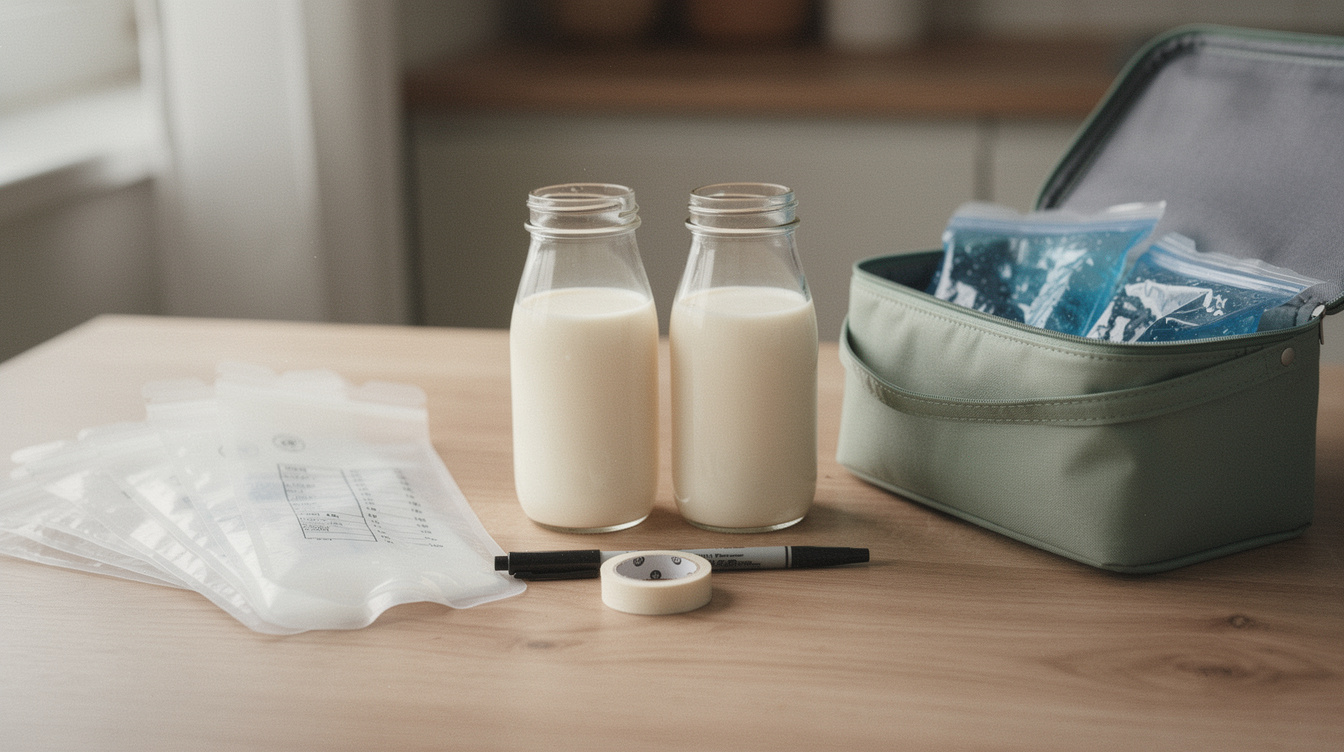
The journal · Feeding
Breast Milk Storage Guidelines: How Long It Lasts in the Fridge, Freezer, and Diaper Bag
In short
Freshly pumped breast milk stays safe for about 4 hours at room temperature, up to 4 days in the refrigerator, roughly 6 months in a standard freezer, and up to 12 months in a deep freezer. In an insulated cooler with ice packs, it holds for about 24 hours. Once your baby has drunk from the bottle, use the rest within 2 hours and never refreeze thawed milk. Warm it in a bowl of warm water — never in a microwave.
You pump for twenty minutes and end up with three ounces of pale, faintly-yellow gold. And then, of course, the question — how long is this actually good for? Which shelf? Which bag? What happens if it sits on the counter for an hour while you put the older kid to bed?
The answers are settled. The AAP, the CDC, La Leche League and the Academy of Breastfeeding Medicine all publish milk-storage guidelines, and the numbers agree more than they disagree. This is the plain-English version — the times, the containers, and the small mistakes that turn hard-earned milk into a wasted bottle.
01How long fresh breast milk lasts, by where you keep it
Every number below is for freshly expressed milk from a healthy, full-term baby. Milk that has already been refrigerated or thawed runs on its own — shorter — clock, which comes further down.
- Room temperature (77°F / 25°C or colder): up to 4 hours. The CDC puts the safe limit at 4 hours; the AAP and the Academy of Breastfeeding Medicine call 4 hours "optimal" and say "6-8 hours acceptable under very clean conditions." When in doubt, use 4.
- Refrigerator (40°F / 4°C or colder): up to 4 days. HealthyChildren.org (AAP) says "up to 4 days is best," stored "in the back" where the temperature holds steady.
- Insulated cooler bag with ice packs: about 24 hours. Good for a shift, a drive, or a flight. (Cleveland Clinic)
- Standard freezer (0°F / -18°C or colder): about 6 months best, up to 12 months acceptable. The CDC and Academy of Breastfeeding Medicine agree on "within 6 months is best" with 12 months at the outside; Cleveland Clinic is a little more conservative for a fridge-mounted freezer, at 3 to 4 months.
- Deep freezer (-4°F / -20°C or colder): up to 12 months. The AAP notes milk "is generally considered safe for feeding for up to 12 months of freezer storage," and that colder is better — a deep freezer outperforms a fridge-mounted freezer with a shared door.
Why the numbers vary a little
Milk does not spoil at midnight on day four. The longer times — 6-8 hours out, 5-8 days in the fridge, 12 months frozen — can be safe under very clean pumping and storage conditions, and the shorter ones are the numbers you can hit every time without perfect technique. When in doubt, use the shorter number.
02Four rules that apply everywhere
Do these every time you store a bottle
- Store in small batches — 2 to 4 ounces per container. HealthyChildren.org recommends "small batches, ideally 2 to 4 ounces to prevent waste." A hungry baby who only wants three ounces should not force you to pour out a six-ounce bottle.
- Label every container with the date it was pumped. Cleveland Clinic says to label containers with "the date expressed and the amount of milk." Add your baby's name too if the bottle is heading to daycare.
- *Keep milk in the back* of the fridge or freezer, not the door.** Both HealthyChildren.org and La Leche League International note that the door swings, temperatures dip, and milk clocks itself out sooner.
- Leave headspace when you freeze. La Leche League International recommends leaving "an inch (2.5 cm) of space" because milk expands as it freezes — a bag filled to the brim will split, and a rigid bottle will pop its cap.
03Thawing milk from the freezer
There are three approved ways to thaw a bag or bottle of frozen milk, according to HealthyChildren.org: overnight in the refrigerator, held under warm running water, or set in a container of warm water. Overnight in the fridge is the gentlest, if you know what tomorrow needs; the warm-water methods are what you reach for when you did not plan ahead.
- Once fully thawed, milk goes on a new clock. Per the CDC, thawed milk is safe in the refrigerator for up to 24 hours from the time it finishes thawing — not from when you took it out of the freezer.
- Once warmed to room temperature, use it within 2 hours.
- Never refreeze thawed milk. Cleveland Clinic and La Leche League International are both flat on this — once thawed, it does not go back.
04Warming a bottle (and never with a microwave)
Set the bottle or bag in a bowl of warm water, or hold it under a warm tap, until it reaches about body temperature. La Leche League International recommends warming milk "slowly in lukewarm water to protect the fat content and nutrients." Swirl the bottle gently to blend the fat layer back in — do not shake it hard.
Skip the microwave, every time
HealthyChildren.org is direct: "Microwaving breast milk is not safe due to the risk of scalding your baby." Microwaves heat water molecules unevenly and leave hot spots — pockets of near-boiling milk hidden inside a bottle that still feels warm-to-the-touch on the outside. The FDA warns the same way about formula. Warm water bath, always.
05Once your baby has started drinking the bottle
HealthyChildren.org: "Any remaining breast milk left in a bottle after your baby is finished with a feeding should be used within 2 hours — or, if quickly refrigerated, used for the next feeding." Two hours is the outside limit. If your baby drinks half a bottle and dozes off, you can quickly pop the rest in the fridge and offer it at the next feed. If the bottle sits on the changing table for three hours, pour it out.
That is one of the quiet wins of paced bottle feeding, which slows a bottle down so your baby stops when they are actually done. You end up pouring smaller amounts, wasting less, and needing this rule less often.
06On the go — cooler, work, daycare
An insulated bag with two frozen ice packs keeps expressed milk safe for about 24 hours — both Cleveland Clinic and the CDC put it there. It is what you want for a work shift, a drive, or the cooler you drop off at daycare. Once you are back near a fridge, move the milk over. If the ice packs melted somewhere along the way, treat that milk as if it had been at room temperature: use it within 2 hours or discard it.
07What to store it in
The container matters less than the size and the cleanliness. La Leche League International recommends "glass or hard-sided plastic containers with well-fitting tops." Cleveland Clinic ranks glass first because it "preserves the components of milk the best," with BPA-free hard-sided plastic second, and freezer-safe milk-storage bags third — ideally stood upright inside a firmer container so they cannot spring a leak. Avoid any plastic marked with the #7 recycle symbol; polypropylene is a safe alternative.
One small habit that saves a lot of milk over a year: chill freshly pumped milk in the fridge first before adding it to already-refrigerated milk from earlier in the day. Pouring still-warm milk on top of chilled milk warms the whole batch and shortens its clock.
This is general information, not medical advice
These guidelines are for healthy, full-term babies. If your baby was born premature, is in the NICU, or has a medical condition, your hospital or pediatrician will give you tighter numbers to follow — the ones that apply to your baby beat any general guide, including this one. Ask once, so you know for sure.
08The point of all of it
Feeding a baby is a task you will repeat thousands of times in a year, and small habits compound. Label the bag, put it in the back of the fridge, warm it gently, do not pour more into the bottle than your baby will drink — and your pumping actually gets used instead of poured out. For the wider first-weeks picture, our newborn basics guide covers feeding, burping, sleep and diapers in the same sourced-not-invented way, and if you are still pregnant, our free week-by-week planner sits at the front of the site so the pump-and-fridge setup is ready before the baby is.
Questions parents actually ask
How long does freshly pumped breast milk last in the refrigerator?
Up to 4 days, per the CDC and HealthyChildren.org — stored in the back of the fridge where the temperature stays steady, not in the door. The Academy of Breastfeeding Medicine gives 5-8 days as an outside maximum in very clean conditions, but 4 is the number you can rely on every time.
Can I put a half-finished bottle back in the fridge?
If your baby only had a little, HealthyChildren.org says you can quickly refrigerate the remainder and use it at the next feeding. Any milk left in a bottle for more than 2 hours after your baby is finished should be thrown out — once actively fed from, milk is on a 2-hour clock.
Is it safe to microwave breast milk?
No. HealthyChildren.org warns that microwaving is not safe because of the risk of scalding. Microwaves heat unevenly and create hidden hot spots that can burn your baby's mouth even when the bottle feels cool on the outside. Warm the bottle in a bowl of warm water or under a warm tap instead.
Can I combine milk from different pumping sessions?
Yes, as long as you chill the freshly pumped milk in the fridge before adding it to already-refrigerated milk from earlier. Pouring warm milk into chilled milk raises the temperature of the whole batch and shortens its safe storage window.
How long does breast milk last in a cooler bag with ice packs?
About 24 hours, per Cleveland Clinic and the CDC. That covers a work shift, a long drive, or a cross-country flight. Once you are back near a fridge, move the milk over. If the ice packs melt somewhere along the way, treat the milk as if it had been at room temperature — use it within 2 hours or discard it.
Do I have to thaw frozen breast milk overnight, or can I thaw it faster?
Both work. HealthyChildren.org says you can put the frozen bag or bottle in the refrigerator overnight, hold it under warm running water, or set it in a bowl of warm water. What you can never do is thaw milk in the microwave, and you never refreeze milk once it has thawed.
Sources
- HealthyChildren.org (AAP) — Storing and Preparing Expressed Breast Milk — Room temperature up to 4 hours is best; refrigerator up to 4 days is best; freezer up to 9 months (12 in a deep freezer); store in small batches of 2-4 ounces; label containers with the date; store in the back of the fridge/freezer; thaw in the refrigerator overnight, under warm running water, or in a container of warm water; do not microwave — risk of scalding; leftover milk from a feeding should be used within 2 hours or, if quickly refrigerated, used for the next feeding.
- American Academy of Pediatrics — Milk Storage Guidelines — After 4 hours at room temperature or 4 days in the refrigerator, freeze for long-term storage; milk is generally considered safe for feeding for up to 12 months of freezer storage; colder is preferable and a deep freezer outperforms a standard fridge-mounted freezer; plastic or glass containers are both fine; minimize transfers to reduce fat and calorie loss.
- La Leche League International — Storing Human Milk — CDC guidelines: up to 4 hours at 77°F room temperature, up to 4 days refrigerated, within 6 months best and up to 12 months acceptable in the freezer, up to 24 hours after thawing in the refrigerator; ABM guidelines: 4 hours optimal / 6-8 hours acceptable at room temperature, 4 days optimal / 5-8 days acceptable in the refrigerator, 6 months optimal / 12 months acceptable frozen; leftover milk from a feeding should be used within 2 hours; warm milk slowly in lukewarm water to protect fat and nutrients; use glass or hard-sided plastic containers with well-fitting tops; leave an inch of headspace to allow for expansion when freezing; avoid BPA/BPS plastics — polypropylene is a safe alternative.
- Cleveland Clinic — How to Store Your Breast Milk Safely — Room temperature up to 4 hours (2 hours if previously refrigerated or frozen then thawed); refrigerator up to 4 days; standard fridge-mounted freezer up to 3-4 months; separate deep freezer up to 6-12 months; insulated cooler with ice packs up to 24 hours while traveling; glass is the first-choice container because it preserves milk components best; hard-sided BPA-free plastic second; freezer bags for freezer storage but prone to leaking; store 2-4 ounces per container; label with date expressed and amount; store at the back of the fridge/freezer; never refreeze thawed milk; discard warmed leftover milk after 2 hours.
Newborn Weeks is planning help, not medical advice — always follow your own doctor, midwife, or pediatrician.
From the gear guide
- Ingenuity 3D Mini Convenience Stroller — our pick in travel strollers
- gb Pockit Air All-Terrain — our pick in travel strollers
- Aquaphor Advanced Therapy Healing Ointment — our pick in diaper rash cream
- JunVpic Glass Milk Pitcher — our pick in milk storage
Keep reading
 Newborn basics · 12 min read
Newborn Breathing Patterns: The Pauses, Fast Breaths, and Grunts That Are Normal (and When to Call)
Newborn breathing patterns can look alarming. Learn which pauses, fast breaths, and noises are normal, and the warning signs that mean call now.
Read the article Newborn basics · 12 min read
Thrush in Babies: How to Tell It From Milk Tongue, and What Actually Helps
Thrush in babies looks like milk but won't wipe off. How to tell the difference, how it's treated, and what to do about bottles and breastfeeding.
Read the article Pregnancy · 11 min read
When Do You Feel the Baby Move? First Flutters, Kick Counts, and When to Call
When do you feel the baby move? Most people notice first flutters around 16 to 20 weeks. What they feel like, how kick counts work, and when to call.
Read the article