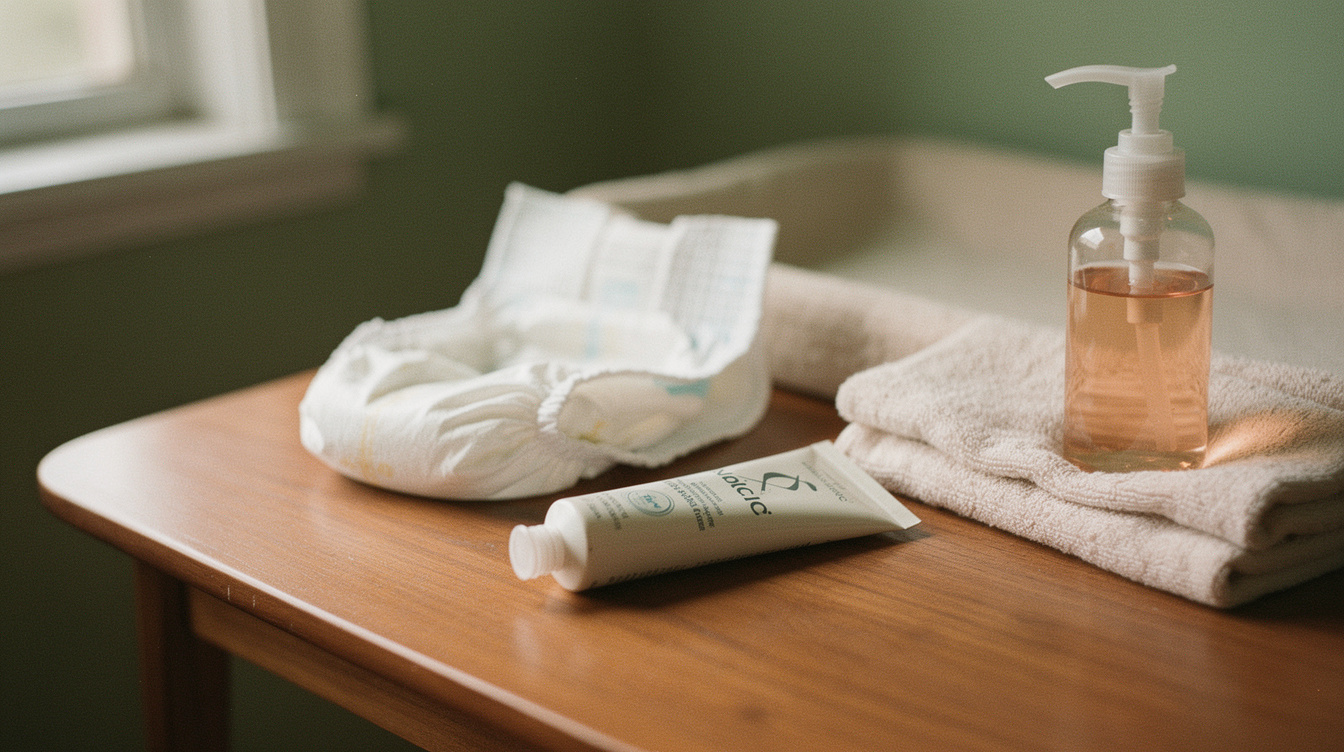
The journal · Newborn basics
Diaper Rash in Newborns: What Causes It, How to Prevent It, and What Actually Clears It Up
In short
Most newborn diaper rash is irritation from urine and stool sitting on delicate skin — so the fix is the same as the prevention: change diapers as soon as they're wet or dirty, clean gently with warm water, let the skin air-dry, and put a thick layer of zinc-oxide or petroleum-jelly cream between the skin and the next diaper. A simple rash usually clears in two to three days with that routine. Call your pediatrician if the rash is bright red with sharp edges (that's yeast, and it needs an antifungal), if there are blisters, pus, or open sores, if your baby has a fever, or if a newborn under six weeks develops any rash.
The first time you see it — that patch of angry pink skin on your one-week-old's bottom — it feels like you did something wrong. You didn't. Almost every baby gets diaper rash at some point, and almost every case is the same simple thing: soft newborn skin spent a little too long against a wet or soiled diaper.
The good news is that the fix is not complicated and it does not require anything you cannot buy at a drugstore. What matters is doing the small things consistently — and knowing the handful of signs that mean it is not a plain rash anymore. Here is what the AAP, Nemours KidsHealth, and MedlinePlus actually say, with nothing invented in between.
01What actually causes diaper rash
"Diaper rash" is a category, not one thing. The AAP groups the causes into four buckets, and knowing which one you're looking at changes what you do about it.
Irritant rash — by far the most common. This is the pink-to-red patch you get when urine and stool sit against the skin for too long. Seattle Children's is direct about the culprit: "Stool left on the skin can be very irritating because it contains bacteria." It shows up on the parts a diaper actually touches — the buttocks, the front, the thighs — and usually spares the deep skin folds of the groin. It gets worse during a bout of diarrhea or a stretch of teething.
Yeast (candida) rash. When the diaper area stays warm and damp for long stretches, the yeast that lives on everyone's skin can overgrow. Per the AAP, a yeast rash looks like "shiny, bright red or pink patches with sharp edges" and tends to settle into the groin folds — the exact spots an irritant rash usually spares. It is common after a course of antibiotics, because antibiotics kill off some of the friendly bacteria that normally keep yeast in check. Yeast will not clear with plain barrier cream — it needs an antifungal.
Bacterial rash (impetigo). Less common, but the one you don't want to miss. The AAP describes it as bright red skin around the anus, or "yellow crusting, weeping, or pimples." Seattle Children's similarly notes that "Bacteria cause sores, yellow scabs, pimples or draining pus." This one needs a call to the pediatrician.
Allergic reaction. Some babies react to a dye, fragrance, elastic, or preservative in a particular brand of diaper or wipe. The rash tends to match wherever the offending material touches — a ring around the waistband, patches under the elastic. Switching brands usually settles it down.
02How to prevent it in the first place
Prevention is boring and it works. MedlinePlus puts the whole strategy into one sentence: "The best treatment for a diaper rash is to keep the skin clean and dry." Everything below is a way of doing that.
The prevention routine
- Change wet and dirty diapers fast. MedlinePlus says to "change your baby's diaper often and as soon as possible after the baby urinates or passes stool." Nemours KidsHealth suggests checking about every two hours in the newborn stage, and always after a poop.
- Clean gently, with water when you can. MedlinePlus recommends "water and a soft cloth or cotton ball to gently clean the diaper area with every diaper change." No scrubbing.
- Pat, don't rub. Then let it air-dry. MedlinePlus says to "pat the area dry or allow to air-dry." Rubbing dry skin against a fresh diaper is a lot of friction on tissue that's already annoyed.
- Give the bottom real air time. Seattle Children's puts it plainly: "Expose the bottom to air as much as possible." MedlinePlus suggests laying your baby on a towel without a diaper whenever possible. Ten minutes here and there adds up.
- Put the diaper on loosely. MedlinePlus and Seattle Children's both recommend fastening it loosely at the waist. Airflow inside the diaper matters as much as what's outside it.
- Use a thin coat of barrier cream at every change if your baby is prone to rash. MedlinePlus notes that "zinc oxide or petroleum jelly-based products help keep moisture away from your baby's skin." A thin protective layer at each change is often enough to keep a rash from starting.
- Skip wipes with alcohol or fragrance. They sting an already-irritated bottom. Fragrance-free, alcohol-free wipes are the safer default, per MedlinePlus.
03How to treat a rash that has already started
For a plain, red-but-not-broken irritant rash, the treatment is the prevention routine, done more strictly, plus a much thicker layer of barrier cream. Nemours KidsHealth says most rashes improve within two to three days of doing this well.
The treatment routine
- Change even more often. Every wet or soiled diaper — the moment you notice it. This is not the week to stretch a diaper.
- Rinse with warm water instead of wiping. Seattle Children's advises to "rinse the baby's skin with lots of warm water during each diaper change," and Nemours KidsHealth suggests soaking your baby's bottom in warm water between changes. A little squirt bottle of warm water and a soft cloth beats a wipe on raw skin.
- Pat dry and give it a few extra minutes of air before the next diaper goes on. Damp skin under a fresh diaper is what got you here.
- Apply a thick layer of zinc-oxide or petroleum-based cream. Nemours KidsHealth says to put it on "like cake icing" — a visible white coat, not a see-through smear.
- Leave the old layer on. At the next change, gently clean off stool from the top but don't scrub the barrier off the skin. The layer underneath is what's protecting the healing tissue.
- Skip powders. Cornstarch and talc are not recommended and can be inhaled by a baby.
- Skip over-the-counter antibiotic ointment. The AAP is explicit: "Do not use over-the-counter antibiotic ointment for diaper rashes; sometimes ingredients in these products can worsen skin irritation."
How thick is thick enough? Cake icing.
The single most common mistake with barrier cream is putting on too little. Nemours KidsHealth uses the cake-icing image on purpose: you should not be able to see the skin through it. The AAP goes further and notes that with a plain irritant rash, there is essentially no upper limit — the cream's whole job is to keep urine and stool from touching the skin, and a thin film can't do that.
04Wipes, water, and what to actually clean with
Regular baby wipes are fine on healthy skin for most babies. When there's already a rash, they aren't the friend they usually are — the alcohol or fragrance in some brands stings, and even the mild ones can drag against inflamed skin. Nemours KidsHealth recommends "a wet washcloth instead of baby wipes" for babies with sensitive skin or an active rash.
The lowest-friction option — literally — is a small squirt bottle of warm water. Squirt, dab dry with a soft cloth, air a beat, cream. It sounds fussy for one change, but it is the fastest way to turn a raw bottom around. For the whole basic diapering routine when nothing is wrong, see our guide to changing a newborn diaper.
05How to tell if it's yeast (and why barrier cream won't cut it)
If a rash isn't improving after two or three days of the routine above — or if it's a shiny bright red with sharply defined borders and it's crowded into the skin folds — think yeast. Small "satellite" spots around the main patch, per MedlinePlus, are another giveaway. It is especially common after antibiotics, because antibiotics knock down the bacteria that normally keep yeast in check.
Yeast rash needs an antifungal cream, not just barrier paste. MedlinePlus lists the usual options: "Nystatin, miconazole, clotrimazole, ketoconazole." Some are over-the-counter and some are prescription — a quick call to the pediatrician will tell you what to use and how long. Keep doing the changing, cleaning, and air-drying routine while you treat it; damp skin is what let the yeast get going in the first place.
06When to call the pediatrician
Most rashes never get to this list. But if any of these show up, don't try to wait it out at home.
Call your pediatrician if
- The rash hasn't started improving in two to three days of the routine above, per Nemours KidsHealth — it may be yeast or something that needs a prescription.
- You see blisters, pus, open sores, or yellow crusting. Seattle Children's says to call within 24 hours for "any pimples, blisters, boils, yellow scabs, or open sores."
- Your baby has a fever along with the rash — per the AAP.
- The rash is spreading past the diaper area onto the belly, back, arms, or face, per MedlinePlus.
- There is bright red skin that peels off in sheets — Seattle Children's treats this as an urgent-care situation.
- Your baby is under six weeks old and any rash appears, per MedlinePlus. Newborn skin is a lot less forgiving, and infections in this window are treated more cautiously.
This is general information, not medical advice
Every baby's skin is a little different. If something looks off, if a rash is not clearing, or if your gut says this is more than a plain rash, call your own pediatrician — they know your baby and you should not have to guess. That is exactly what they are there for.
07The routine that keeps it from coming back
Once the skin has healed, most parents can drop back to fragrance-free wipes and skip the cream at every change. Some babies — especially the ones who get rashes with every bout of loose stool or teething — do better with a thin protective layer of zinc-oxide cream on healthy skin all the time. It doesn't hurt, and it saves you from starting from zero the next time your baby has three dirty diapers in a row.
Diapers are the task new parents do more than anything else, and small improvements in the routine compound fast. If you're still learning the mechanics, our changing a newborn diaper guide covers the basics, and what's normal for newborn poop will tell you which colors and textures are worth a second glance. The rest of the newborn learning curve — burping, sleep, when to call the doctor — lives on our newborn basics page, each piece sourced the same way this one is. And if you are still pregnant, our free week-by-week planner puts the prep that makes those first weeks easier right where it belongs: in the weeks before the baby arrives.
Questions parents actually ask
How long does newborn diaper rash usually take to clear up?
A plain irritant rash typically improves within two to three days of frequent changes, gentle water cleaning, air time, and a thick layer of zinc-oxide or petroleum-based cream, according to Nemours KidsHealth. If it hasn't started improving in that window, it may be a yeast infection and needs an antifungal — call your pediatrician.
What's the best cream for newborn diaper rash?
For a plain irritant rash, MedlinePlus recommends products based on zinc oxide or petroleum jelly — both work by keeping urine and stool from touching the skin. Nemours KidsHealth says to apply it like cake icing, thick enough that you can't see the skin through it. Skip over-the-counter antibiotic ointments; the AAP says they can make diaper rash worse.
How can I tell if my baby's rash is yeast?
The AAP says yeast rash looks like shiny, bright red or pink patches with sharp edges, and it often shows up in the deep skin folds of the groin — the exact spots a plain irritant rash usually spares. Small satellite spots around the main patch and a rash that won't clear with barrier cream also point to yeast. It's especially common after antibiotics and needs an antifungal cream, not just diaper paste.
Should I use wipes or water on a rash?
On healthy skin, fragrance-free and alcohol-free wipes are fine for most babies. When there's an active rash, Nemours KidsHealth recommends a wet washcloth instead — or a small squirt bottle of warm water and a soft cloth — because even mild wipes can drag against inflamed skin. Seattle Children's suggests rinsing with plenty of warm water at each change until the rash clears.
When should I call the pediatrician about diaper rash?
Call if the rash isn't improving after two to three days, if there are blisters, pus, or open sores, if your baby has a fever, if the rash is spreading past the diaper area, or if any rash appears in a baby younger than six weeks. Seattle Children's treats bright red skin that peels off in sheets as an urgent-care situation.
Do I need to give my baby diaper-free time every day?
Not required, but it helps — especially if your baby is rash-prone. MedlinePlus and Seattle Children's both recommend laying your baby on a towel without a diaper whenever you can, so the skin gets time to dry out fully. Even a few short stretches a day make a noticeable difference.
Sources
- HealthyChildren.org (AAP) — Common Diaper Rashes & Treatments — Irritant dermatitis is the most common type of diaper rash and is caused by urine and stool contact; yeast rash looks like shiny, bright red or pink patches with sharp edges and often follows antibiotic use; bacterial (impetigo) rash from staph/strep shows as yellow crusting, weeping, or pimples; allergic reactions to dyes, elastics, fragrances, or preservatives in diapers or wipes; barrier creams containing zinc oxide and petroleum jelly are the mainstay of prevention and treatment; there is no such thing as too much diaper paste; do not use over-the-counter antibiotic ointment for diaper rashes because ingredients can worsen irritation; call the pediatrician if rash persists beyond 2-3 days, if blisters/pus/crusting appear, if there is fever, or if there is severe pain.
- Nemours KidsHealth — Diaper Rash — Diaper rash looks sore, red, scaly, and tender; change wet or soiled diapers as soon as possible and clean the area well; check about every two hours; soak baby's bottom between diaper changes with warm water; pat the skin gently with a soft cloth when drying; put the diaper on loosely to prevent chafing; use a wet washcloth instead of baby wipes on sensitive skin; apply barrier cream containing zinc oxide or petroleum thickly, like cake icing; most rashes improve within 2 to 3 days of consistent home care; cloth diaper users should avoid fabric softeners and dryer sheets.
- MedlinePlus (NIH) — Diaper rash — The best treatment for diaper rash is to keep the skin clean and dry; change diapers as soon as possible after baby urinates or passes stool; lay baby on a towel without a diaper whenever possible; use water and a soft cloth or cotton ball to gently clean the diaper area with every change; pat the area dry or allow to air-dry; put diapers on loosely; zinc oxide or petroleum jelly-based products help keep moisture away from the skin; skip wipes with alcohol or fragrance; antifungal medicines for yeast include nystatin, miconazole, clotrimazole, and ketoconazole; call the doctor if the rash worsens or persists beyond 2-3 days, spreads beyond the diaper area to abdomen/back/arms/face, includes pimples/blisters/pus, comes with fever, or appears in the first 6 weeks after birth; small satellite red patches suggest yeast.
- Seattle Children's Hospital — Diaper Rash — Stool left on the skin is very irritating because it contains bacteria; rashes just around the anus are common during diarrhea; bacterial infection causes sores, yellow scabs, pimples, or draining pus; rinse the baby's skin with lots of warm water during each diaper change; change diapers more often to prevent skin contact with stool; expose the bottom to air as much as possible; attach the diaper loosely at the waist; use a protective ointment like Vaseline or Desitin as a barrier; bright red skin that peels off in sheets is an urgent-care sign; call within 24 hours for any pimples, blisters, boils, yellow scabs, or open sores; call during office hours if the rash is unresolved after three days of treatment.
Newborn Weeks is planning help, not medical advice — always follow your own doctor, midwife, or pediatrician.
From the gear guide
- Graco SnugRide Lite Infant Car Seat Base — our pick in infant car seats
- Baby Trend Snap N Go EX — our pick in infant car seats
- Aquaphor Baby Healing Ointment — our pick in diaper rash cream
- Maymom Wide-Mouth Collection Bottles — our pick in milk storage
Keep reading
 Newborn basics · 12 min read
Newborn Breathing Patterns: The Pauses, Fast Breaths, and Grunts That Are Normal (and When to Call)
Newborn breathing patterns can look alarming. Learn which pauses, fast breaths, and noises are normal, and the warning signs that mean call now.
Read the article Newborn basics · 12 min read
Thrush in Babies: How to Tell It From Milk Tongue, and What Actually Helps
Thrush in babies looks like milk but won't wipe off. How to tell the difference, how it's treated, and what to do about bottles and breastfeeding.
Read the article Pregnancy · 11 min read
When Do You Feel the Baby Move? First Flutters, Kick Counts, and When to Call
When do you feel the baby move? Most people notice first flutters around 16 to 20 weeks. What they feel like, how kick counts work, and when to call.
Read the article