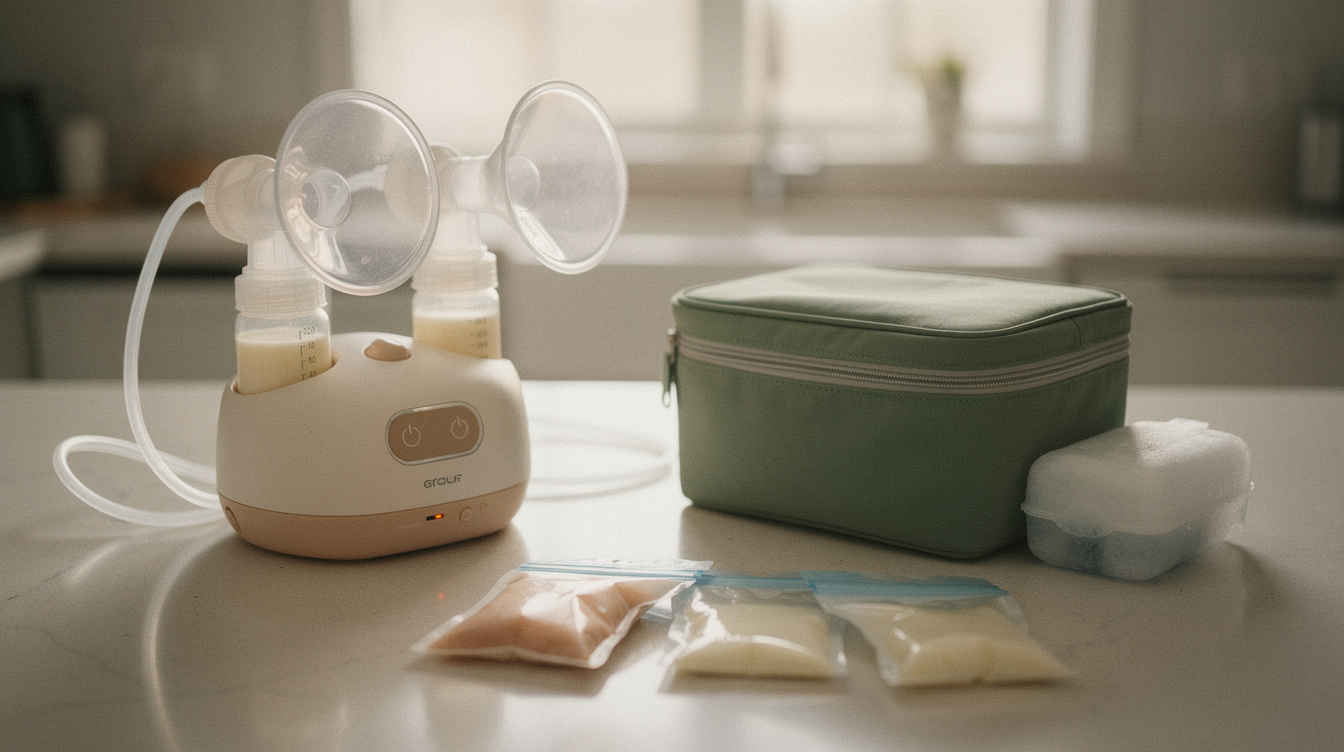
The journal · Feeding
How Often to Pump Breast Milk: A Schedule That Actually Fits Your Situation
In short
There is no single pumping schedule, because the answer depends on why you are pumping. The rule the CDC and La Leche League both give is the same one: pump about as often as your baby is drinking milk. Since the AAP says breastfed newborns nurse roughly 10 to 12 times in 24 hours, a parent who is pumping instead of nursing is pumping a lot in the early weeks — including at least once overnight. If you are back at work and your baby still nurses at home, the AAP puts that at one to three sessions a day, at least 10 minutes each. And whatever the schedule, pump parts get cleaned after every single use.
Almost every pumping question arrives in the same shape: "how often should I be doing this?" And almost every answer online is a chart — sessions per day, minutes per session, times on a clock — written as if every parent holding a pump is in the same situation. They are not. A parent whose baby is in the NICU, a parent who exclusively pumps at home, and a parent pumping twice in an office bathroom are all asking the same question and need three different answers.
So here is the honest version, sorted by situation, with every number traced to a source you can click and read yourself. The good news is that the underlying rule is simple, and once you have it, you can work out your own schedule without a chart at all.
This is general information, not medical advice
Milk supply, weight gain, and feeding plans are specific to you and your baby. Anything here is worth running past your own pediatrician, OB, midwife, or a lactation consultant — they can watch a feeding, look at your baby's weight, and tell you what applies to your situation. If your baby is not gaining as expected, or pumping hurts, call them rather than adjusting a schedule from the internet.
01The one rule underneath every pumping schedule
Your body makes milk in response to milk being removed. That is the whole mechanism, and it is why every credible source gives the same instruction in slightly different words.
The CDC puts it this way: "When away from your baby or if you exclusively pump your milk, try to pump as often as your baby is drinking breast milk." And it explains why that works — "Pumping as often as your baby normally drinks breast milk should help your body make about the amount of milk your baby needs."
La Leche League International says the same thing from the other direction: "Ideally, you would pump as often as your baby would nurse," adding that "Most mothers find that pumping every 2-3 hours maintains their milk supply."
So the real question is not "how often should I pump." It is "how often would my baby be eating right now, and how much of that am I replacing with a pump?" Answer that and the schedule falls out on its own.
02What your baby's feeding pattern actually looks like
To use that rule you need the baseline. The AAP is specific about newborns: "Breastfed newborns usually nurse every 2 hours from the start of the feeding to the next feeding so 10-12 sessions in 24 hours is the norm." For bottle-fed newborns it says "most newborns eat every 2 to 3 hours; 8 times is generally recommended as the minimum every 24 hours."
The amounts are smaller than most people expect. The same AAP page notes that most breastfed infants take about an ounce per feeding in the first few weeks, an amount that slowly increases over time and tops out at roughly four and a half ounces by a year old. If you pump and see an ounce in the bottle, that is not a failure — for a newborn, that is a feeding.
One more line from that page is worth taping to the fridge: "If your baby is having trouble gaining weight, don't wait too long between feeding―even if it means waking your baby." What you collect in a single session is a poor measure of your supply anyway. Weight gain and wet diapers are the measures that count, and those belong to your pediatrician.
03If you are pumping instead of nursing
This is the highest-frequency situation, because the pump is doing the entire job. Nothing is being removed from your breasts except by you, so the schedule has to stand in for a newborn's full feeding pattern — the 10 to 12 sessions in 24 hours the AAP describes above, or close to it, which works out to a session roughly every two to three hours around the clock in the early weeks.
The clearest clinical schedule we could verify comes from the AAP's guidance for parents of premature or ill newborns — parents whose babies cannot yet feed at the breast at all, and who therefore depend entirely on expressing. It says to "Pump within 6-8 hours after delivery" and then to "Pump 5-6 times a day (every 3-4 hours and at least once in the middle of the night) or even more often once your breasts begin to fill up with milk."
Note the two halves of that instruction: a floor, and then more often as your milk comes in. The same page gives the reason to take the floor seriously — "Long stretches without pumping can shut down your milk supply, so be sure you keep up a regular schedule of milk expression." That is the single most important sentence on this page. It is the long gap, not the short session, that costs you.
That page is written for the NICU situation specifically, so treat the numbers as the floor for a parent whose baby is not feeding directly, and ask your own provider or a lactation consultant what your situation calls for. If you are in the first week and waiting on your milk, when does milk come in walks through the normal timeline.
Do not skip the night session in the early weeks
The AAP's schedule for parents expressing for a premature or ill newborn explicitly includes "at least once in the middle of the night," and warns that long stretches without pumping can shut down supply. A full night off sounds like mercy and is the one thing most likely to cost you milk while supply is still being established. If you are sharing night feeds with a partner or a night nurse, the pump still has to happen — the person who feeds the bottle and the person who empties the breasts do not have to be the same person.
04If you are back at work and your baby still nurses at home
Completely different math. Your baby is still removing milk directly for most of the day, so the pump only has to cover the feeds you are missing. The AAP's guidance on expressing milk at work puts that at "one to three times per day," and adds that if you need more milk, pumping "more frequently for at least 10 minutes per session" is what helps.
Three practical points from the sources for this situation:
- Start before your first day back. The CDC recommends you "Consider pumping a few weeks before returning to work or school, or when you'll be away from your baby." Pumping is a skill, and a first attempt in a strange room on a deadline is the worst possible practice session.
- If you are coming up short, add a session rather than lengthening one. The CDC's advice is to "try adding an extra pumping session if pumping enough milk is difficult." Frequency does more work than duration.
- Letdown is psychological as well as physical. The AAP suggests that "Thinking about your baby—how comforted they will be as they drink your breast milk and how good for them your milk is—may help you relax and start your milk flow," and notes that "Some parents find that looking at a photograph of their baby or even listening to a tape of their hunger cry works like a charm."
05How long each session should last
The only session length we could verify from a top-tier source is the AAP's work guidance: "at least 10 minutes per session" when you are trying to build supply. Beyond that, the sources describe pumping until the milk flow slows rather than watching a clock — and a double pump shortens the whole thing considerably.
On that point everyone agrees. La Leche League says "Using a pump that can express milk from both breasts at the same time will save the most time," and that "Double pumping also provides very strong stimulation to keep a good milk supply." The Office on Women's Health says the same: "Double pumping (pumping both breasts at the same time) may collect more milk in less time." And the AAP tells parents of premature babies to "Be sure you have a comfortable, electric, double pump to go home with before you are discharged from the hospital."
Two small adjustments that change the output
- Hand express first. La Leche League notes that "Some mothers find that hand expressing for 1-2 minutes before using the pump gives them better results." The CDC goes further and says "It is good for all mothers to know how to hand express their breast milk," because it helps "if your breasts are feeling extra full, or if you lack access to a manual or electric breast pump." The Office on Women's Health adds that hand expression "gets easier with practice and can be as fast as pumping."
- Check the flange size. The plastic funnel that sits against your breast is called a flange or shield, and the fit matters. La Leche League's instruction is short: "Be sure your flange is not too tight, nor too loose." A badly sized one hurts and empties you less well — worth having someone look at if pumping is uncomfortable.
06Which pump you need (and what it costs)
The Office on Women's Health lays out the three options plainly. Hand expression uses no equipment at all — "You use your hand to squeeze and press on your breast to remove milk" — and is "Good if you are not often away from your baby or you need an option that is always with you. But all moms should learn how to hand express in case of emergency."
A manual pump — "You use your hand and wrist to operate a hand-held device to pump the milk" — runs about $30 to $50 and is "Useful for occasional pumping." An electric pump "Runs on battery or plugs into an electrical outlet," costs $150 and up, and is the one that double pumps. If you are pumping several times a day, that last category is not a luxury.
07Cleaning the parts — the step nobody schedules
The CDC's pumping page is blunt that "Keeping the parts of your pump clean is very important," and its hygiene guidance spells out what that means in practice. This adds real minutes to every session, so it belongs in the schedule rather than as an afterthought.
The CDC's pump-cleaning routine
- Wash your hands first. "Wash your hands well with soap and water for 20 seconds" before touching the pump or the parts.
- Rinse right after pumping. "Rinse breast pump parts that come into contact with breast/breast milk under running water to remove remaining milk."
- Wash in a separate basin, not the sink itself. Use a clean wash basin with dishwashing soap and warm water — germs in the sink can contaminate the parts.
- Air-dry, do not towel-dry. "Allow them to air-dry after each use" on a clean dish towel in a protected area, rather than rubbing them dry.
- Sanitize at least once a day. The CDC says to "Sanitize pump parts at least once daily" and that this is "especially important if your baby is less than 2 months old, was born prematurely, or has a weakened immune system." Boil for 5 minutes, use a dishwasher cycle with hot water and heated drying, or steam per the manufacturer's directions — always after cleaning, not instead of it.
- Store the dry parts protected. Once fully air-dried, store them "in a clean, protected area such as inside an unused, sealable food storage bag."
08How long the milk keeps once it is out
A pumping schedule is only half the job; the milk then has to survive until someone feeds it. The Office on Women's Health gives these limits for freshly expressed milk: up to 4 hours at room temperature (up to 77°F), up to 4 days in the refrigerator at 40°F, and in a freezer at 0°F or colder, "Within 6 months is best. Up to 12 months is acceptable." A cooler with ice packs holds it up to 24 hours.
Once it is thawed, use it "within 24 hours of thawing it in the refrigerator," and once it has been warmed, within 2 hours. Our full breast milk storage guidelines go deeper on containers, labeling, and what to do with a half-finished bottle.
09Putting it together
If you take one thing from this page, make it the rule rather than any of the numbers: pump about as often as your baby is drinking, and do not let long gaps open up while your supply is still being established. Everything else — 5 sessions or 10, 10 minutes or 25, manual or electric — is that one rule applied to your particular week.
And if the overnight sessions are the part that is breaking you, that is a staffing problem rather than a personal failing. Feeding around the clock while recovering from birth is genuinely a two-person job, and plenty of families bring in help for exactly the stretch where pumping and sleep are competing. Our page on overnight newborn help explains what that looks like, and the newborn basics guide covers the rest of the first weeks, sourced the same way this page is.
Questions parents actually ask
How often should I pump breast milk?
As often as your baby is drinking milk. The CDC's guidance is to "pump as often as your baby is drinking breast milk" when you are away from your baby or exclusively pumping, and La Leche League says most mothers find pumping every 2 to 3 hours maintains supply. Since the AAP says breastfed newborns typically nurse 10 to 12 times in 24 hours, a parent replacing all of those feeds with a pump is pumping very frequently in the early weeks. If your baby still nurses at home and you are only covering a workday, the AAP puts that at one to three sessions a day.
How long should each pumping session last?
The AAP's work guidance is at least 10 minutes per session when you are trying to build supply, and it says pumping more frequently is what helps most. A double electric pump — one that empties both breasts at the same time — shortens each session and, as La Leche League notes, provides very strong stimulation to keep a good milk supply.
Do I have to pump at night?
In the early weeks, yes, if the pump is doing the feeding. The AAP's schedule for parents expressing milk for a premature or ill newborn specifically includes at least one session in the middle of the night, and warns that long stretches without pumping can shut down your milk supply. Once supply is well established, talk to your own provider or a lactation consultant about dropping it.
When should I start pumping if I am going back to work?
A few weeks ahead. The CDC recommends considering pumping a few weeks before returning to work or school, or before any time you will be away from your baby. That gives you time to practice with the pump, learn what your output looks like, and build up a small supply before the first day back.
I am only getting an ounce when I pump. Is that normal?
For a newborn, an ounce is a feeding. The AAP says most breastfed infants take about 1 ounce per feeding in the first few weeks, increasing slowly over time and reaching roughly four and a half ounces by a year old. What you get in a single pumping session is also not a reliable measure of your supply — if you are worried about your baby's intake, the things to check are weight gain and diapers, with your pediatrician.
How often do I have to clean the pump parts?
After every single use, and sanitize at least once a day. The CDC says to rinse the parts that touch milk under running water right after pumping, wash them in a clean basin rather than directly in the sink, and let them air-dry. Daily sanitizing — boiling for 5 minutes, a dishwasher cycle with hot water and heated drying, or steam — is especially important if your baby is under 2 months old, was born prematurely, or has a weakened immune system.
Sources
- CDC — Pumping Breast Milk — Pump as often as your baby is drinking breast milk when away or exclusively pumping; pumping as often as your baby normally drinks should help your body make about the amount your baby needs; consider pumping a few weeks before returning to work or school; add an extra pumping session if pumping enough milk is difficult; all mothers should know how to hand express, which helps when breasts are extra full or a pump is unavailable; keeping pump parts clean is very important.
- HealthyChildren.org (AAP) — How Often and How Much Should Your Baby Eat? — Breastfed newborns usually nurse every 2 hours, so 10-12 sessions in 24 hours is the norm; bottle-fed newborns eat every 2-3 hours with 8 times as the recommended minimum per 24 hours; most breastfed infants take about 1 ounce per feeding in the first few weeks, rising to roughly 4.5 ounces at a year; do not wait too long between feedings if a baby is having trouble gaining weight, even if it means waking the baby.
- HealthyChildren.org (AAP) — Mother's Own Milk for Very Premature & Very Low Birth Weight Babies — Pump within 6-8 hours after delivery; pump 5-6 times a day (every 3-4 hours and at least once in the middle of the night), or more often once the breasts begin to fill; long stretches without pumping can shut down milk supply; have a comfortable electric double pump before hospital discharge. Guidance written for parents of premature or ill newborns who cannot feed at the breast.
- HealthyChildren.org (AAP) — Expressing Breast Milk at Work: Tips for Nursing Parents — Pumping one to three times per day while at work; pump more frequently for at least 10 minutes per session; work with your employer to identify a space for expressing milk; thinking about your baby, looking at a photograph, or listening to a recording of their hunger cry can help start milk flow.
- La Leche League International — Pumping Milk — Ideally you would pump as often as your baby would nurse; most mothers find pumping every 2-3 hours maintains supply; a pump that expresses both breasts at the same time saves the most time and provides very strong stimulation to keep a good milk supply; hand expressing for 1-2 minutes before pumping gives some mothers better results; make sure the flange is neither too tight nor too loose.
- Office on Women's Health (U.S. Department of Health and Human Services) — Pumping and Storing Breastmilk — Hand expression description and that all moms should learn it; manual pumps cost about $30-$50 and suit occasional pumping; electric pumps run on battery or an outlet and cost $150+; double pumping may collect more milk in less time; storage limits for freshly expressed milk — up to 4 hours at room temperature (up to 77°F), up to 4 days in the refrigerator at 40°F, within 6 months is best and up to 12 months acceptable in a 0°F freezer, up to 24 hours in a cooler with ice packs; use thawed milk within 24 hours and warmed milk within 2 hours.
- CDC — How to Clean and Sanitize Breast Pumps — Wash hands with soap and water for 20 seconds before pumping; rinse pump parts that contact milk under running water after every use; wash in a clean basin rather than directly in the sink; allow parts to air-dry rather than towel-drying; sanitize pump parts at least once daily, especially important if the baby is under 2 months, premature, or immunocompromised; sanitizing methods are boiling for 5 minutes, a dishwasher cycle with hot water and heated drying, or steam per manufacturer directions; store dry parts in a clean, protected area such as an unused sealable food storage bag.
Newborn Weeks is planning help, not medical advice — always follow your own doctor, midwife, or pediatrician.
From the gear guide
- Ergobaby Omni Breeze — our pick in baby carriers
- BabyBjörn Baby Carrier Harmony — our pick in baby carriers
- Dr. Brown's Deluxe Bottle Warmer and Sterilizer — our pick in bottle warmers
- Goodbaby No-Touch Forehead Thermometer — our pick in thermometers
Keep reading
 Newborn basics · 13 min read
The Newborn Startle Reflex: Why Their Arms Fly Out (and When It Stops)
The newborn startle reflex (Moro reflex) makes your baby's arms fly out at nothing. What it is, when it fades, and how to stop it waking them.
Read the article Pregnancy · 12 min read
Braxton Hicks Contractions: What They Feel Like, and How to Tell Them From Labor
Braxton Hicks contractions are practice contractions, not labor. What they feel like, when they start, how to tell them from real labor, and when to call.
Read the article Feeding · 11 min read
Breast Engorgement: What Actually Relieves It When Your Milk Comes In
Breast engorgement peaks around day five. What actually relieves it: frequent feeding, softening before the latch, and cold between feeds. Source-cited.
Read the article