The journal · Newborn basics
How to Take a Baby's Temperature (and Which Number Actually Counts)
In short
For a baby under three months, the only temperature number a doctor will act on is a rectal one — the AAP calls it "the most reliable and accurate for infants." Use a digital thermometer, a dab of petroleum jelly, and a gentle half-inch; hold it in place until it beeps. An armpit or digital forehead reading is a fine first check, but if it looks high, confirm it rectally before you call. A rectal reading of 100.4 degrees Fahrenheit or higher in a baby three months or younger means call the pediatrician immediately — that is not a wait-until-morning number.
Your baby feels warm. You put your lips to their forehead, then the back of their neck, then their forehead again, and you still have no idea. This is the moment almost every new parent discovers they do not actually know how to take a baby's temperature — and that the thermometer in the bathroom drawer may not be the right one.
It is worth getting right before you need it, because in the first three months a single number decides whether you call the pediatrician tonight or in the morning. Here is the method, the thermometer to use, and what the AAP, the NIH, and a published comparison study actually say — with nothing filled in by guesswork.
01Start with the right thermometer
One rule comes before everything else: use a digital thermometer. The AAP is blunt about the alternative — "Do NOT use a mercury thermometer. These thin glass devices filled with the silvery metal can break and release toxic levels of mercury fumes." If there is an old glass one in the house, it is not a backup. It is something to get rid of.
After that, the thermometer that is right depends entirely on how old your baby is. The AAP's own breakdown:
- Rectal — recommended for babies under three months, and usable at any age (AAP).
- Armpit (axillary) — the least accurate, but acceptable at any age for screening (AAP).
- Ear (tympanic) — "Can be used on children age 6 months and older. Not reliable for younger babies" (AAP). Seattle Children's says the same: not accurate before six months.
- Forehead (temporal artery) — the AAP's current page says it "can be used for all ages," and it has to be a digital one. Seattle Children's is explicit that "forehead temperatures must be digital. Forehead strips are not accurate."
- Oral (in the mouth) — not yet. "Oral use is not recommended until a child is age 4 or older" (AAP).
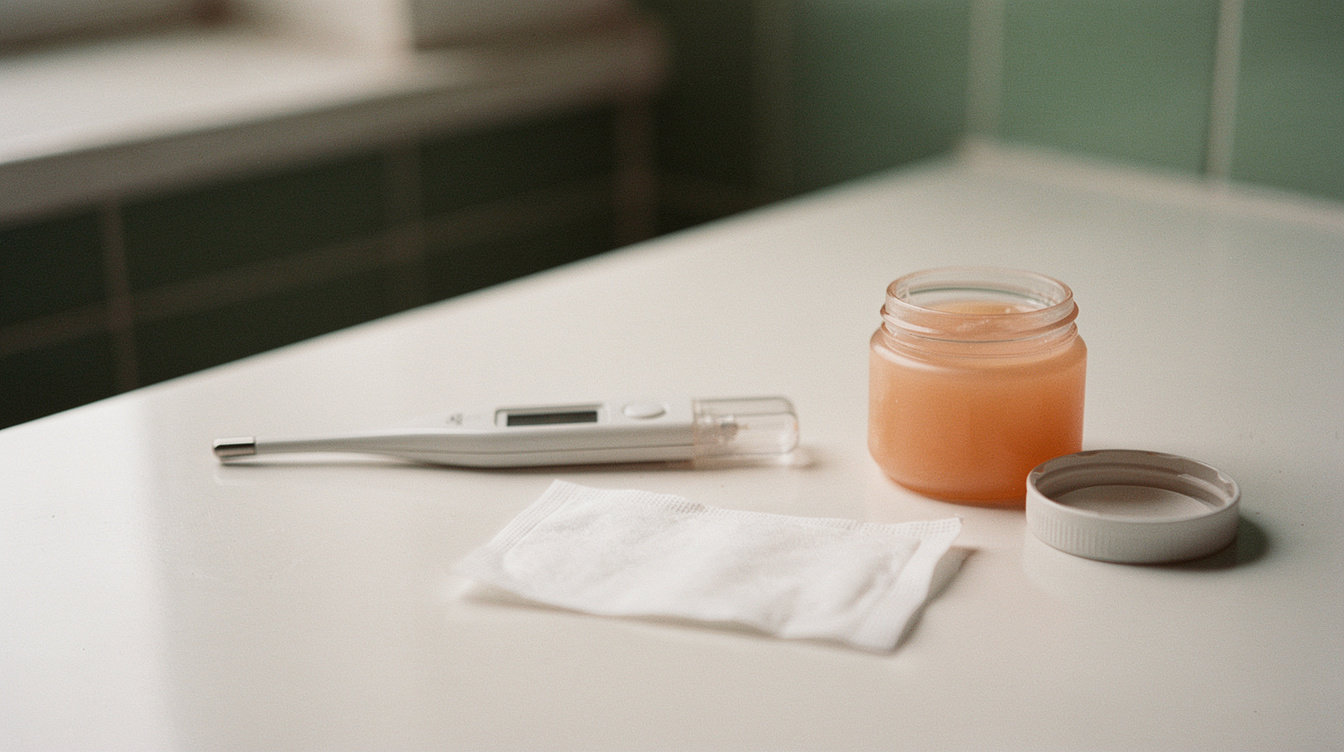
So for a newborn, the shopping list is short: one inexpensive digital thermometer you are willing to dedicate to rectal use, and a small jar of petroleum jelly. That is the whole kit.
02How to take a rectal temperature, step by step
Nobody looks forward to this one. It takes about a minute, it does not hurt when it is done gently, and it is the reading your pediatrician will ask for. The AAP calls a rectal reading "the most reliable and accurate for infants, especially babies under 3 months old" (HealthyChildren.org).
Taking a rectal temperature
- Turn the thermometer on first, before your baby is in position, so you are not fumbling with buttons one-handed.
- Dab on petroleum jelly. The AAP says to apply lubricant such as petroleum jelly to the tip of the thermometer and to your baby's bottom.
- Get your baby into position. Belly-down across your lap, or on their back with their legs pulled up toward their chest — whichever you can hold steady (AAP).
- Slide it in gently, and not far. The AAP says half an inch for a baby under six months, up to one inch for an older baby, and adds: "Be gentle. There should not be any resistance." Seattle Children's puts it as "no more than ½ inch" under six months and no more than one inch from six to twelve months.
- Hold the thermometer in place and your baby still until it beeps — usually under a minute (AAP). Never walk away from a thermometer that is still in.
- Clean it afterward with soap and water or an alcohol swab (AAP).
- Label it. The AAP's advice, word for word: "Label the rectal thermometer so it is not accidentally used in the mouth." A strip of tape and a marker is enough.
One timing note worth knowing: a warm bath can throw a reading off. MedlinePlus, the NIH's consumer health library, advises waiting at least an hour after a hot bath before measuring body temperature. If you have just finished bath time and your baby feels warm, give it a little while — or take the reading before the bath instead.
One case where rectal is the wrong choice
Seattle Children's advises avoiding rectal temperatures in children with leukemia, other cancers, or weakened immunity. If that describes your baby, ask your own care team which method they want you to use at home — they will have a specific answer, and it may not be the general one.
03The easier methods: what they are actually good for
The armpit and the forehead are not useless — they are just a different job. Think of them as a first look rather than the final answer.
The armpit. Seattle Children's calls an armpit temperature "the safest" option under three months and "good for screening," and gives a clear follow-up rule: if the armpit reading is above 99 degrees Fahrenheit, confirm it with a rectal reading. The technique matters — make sure the armpit is dry, put the tip in it, and "close the armpit by holding the elbow against the chest" until the thermometer beeps. A thermometer tucked into a loose armpit is measuring the room.
The forehead. The AAP's current guidance is that a digital temporal artery thermometer can be used at any age, and Seattle Children's notes that "new research shows that forehead temps may also be accurate under 3 months of age." But the honest version includes the caveat: an older AAP page says these devices are "relatively new so their reliability has not yet been verified," and a study of 995 children published in Acta Paediatrica found forehead readings agreed with rectal readings only within a wide range (−1.2 to +1.5 degrees Celsius) and caught fever 81 percent of the time. Its authors concluded that "temporal measurement of temperature is not currently recommendable" and that "for the exact measurement of temperature, the rectal method is still recommended" (NIH / PMC).
The same study found the ear thermometer did better — 89 percent sensitivity overall, above 90 percent in children six months to five years — but still described it as useful "for screening purposes," not for an exact number.
Don't do thermometer math
You will see advice to add a degree to an armpit reading. Do not bother — Seattle Children's lists armpit thresholds on their own terms (99 degrees Fahrenheit or higher counts) rather than telling parents to adjust anything, and the simplest honest move is to report the number you got and the method you used. For reference, MedlinePlus notes a rectal reading typically runs 0.5 to 1 degree Fahrenheit higher than an oral one, while armpit and forehead readings typically run 0.5 to 1 degree lower. Those are averages for understanding the difference — not a formula to apply to your baby.
04The number that matters: 100.4
Here is the whole reason this technique is worth practicing before you need it. According to the AAP, "A rectal temperature reading of 100.4 degrees Fahrenheit (38 degrees Celsius) or higher is considered a fever" — and for the youngest babies, that reading is an immediate phone call: "If your baby is 3 months of age or younger and has a rectal temperature of 100.4 degrees Fahrenheit (38 degrees Celsius) or higher, call your pediatrician immediately."
The thresholds loosen as babies get older. The same AAP page says to contact the doctor for a fever reaching 101 degrees Fahrenheit (38.3 Celsius) or greater between three and six months, and 103 degrees Fahrenheit (39.4 Celsius) or higher after six months.
That is why the method is not a technicality. "He felt hot and the forehead thing said 100.6" is a different conversation than "his rectal temperature is 100.6." Our guide to a newborn fever and when to call covers what happens next — what to say, what to watch for, and why a fever in a brand-new baby gets taken seriously even when the baby seems fine.
05What to have ready before anyone is sick
A 2 a.m. fever is a bad time to discover the thermometer needs batteries. This is a ten-minute job you can do any evening.
Your fever kit, assembled early
- A digital thermometer you have tested once, so you know how long it takes to beep and that it has power.
- A small jar of petroleum jelly kept with it, not across the house.
- A label on the rectal thermometer — tape and a marker, per the AAP's advice.
- Soap, water, or alcohol swabs nearby for cleaning it afterward.
- Your pediatrician's after-hours number saved in your phone under a name you can find while half-awake.
- A note of your baby's exact age in weeks, because the threshold that applies to them depends on it.
This is general information, not medical advice
This page explains how to measure a temperature and what the published thresholds are. It cannot tell you whether your baby is sick. Your pediatrician knows your baby, their history, and anything that changes the usual rules — call them with any fever in a baby three months or younger, and any time your baby seems unwell to you, whatever the thermometer says. Trusting your own read on your baby is not overreacting.
06One small skill, learned in advance
Taking a baby's temperature is one of maybe a dozen small, physical skills nobody teaches you and everybody needs in the first months — alongside burping, swaddling, nail trimming, and getting a car seat buckled correctly. The rest of them are on our newborn basics guide, each one sourced the same way this page is. And if you are still pregnant, our free week-by-week planner puts the ten-minute jobs like this one into the weeks when you still have ten quiet minutes to spare.
Questions parents actually ask
What is the most accurate way to take a baby's temperature?
Rectally, with a digital thermometer. The AAP describes a rectal reading as the most reliable and accurate for infants, especially babies under three months old, and recommends rectal measurement for that age group. A published comparison of 995 children in Acta Paediatrica came to the same conclusion: for the exact measurement of temperature, the rectal method is still recommended.
How far should I insert a rectal thermometer in a baby?
Half an inch for a baby under six months, and up to one inch for an older baby, according to the AAP — which also says to be gentle and that there should not be any resistance. Seattle Children's gives the same depths: no more than half an inch under six months, no more than one inch from six to twelve months. Hold the thermometer in place until it beeps, and never leave it unattended.
Can I use a forehead or ear thermometer on a newborn?
The AAP's current guidance is that a digital forehead (temporal artery) thermometer can be used at all ages, while ear thermometers can be used from six months and are not reliable for younger babies. But the research is cautious: in a study of 995 children, forehead readings caught fever 81 percent of the time and ear readings 89 percent, and the authors recommended the ear device only for screening and the rectal method for an exact number. For a baby under three months, confirm anything that looks high with a rectal reading before you call.
What temperature is a fever in a baby?
A rectal reading of 100.4 degrees Fahrenheit (38 Celsius) or higher is a fever, per the AAP. If your baby is three months old or younger and has a rectal temperature at or above that, the AAP says to call your pediatrician immediately. From three to six months the AAP's call-the-doctor threshold is 101 degrees Fahrenheit, and after six months it is 103 degrees Fahrenheit.
Do I need to add a degree to an armpit temperature?
No — report the number you got and the method you used, and let your pediatrician interpret it. Seattle Children's treats an armpit reading of 99 degrees Fahrenheit or higher as the screening threshold on its own terms, and advises confirming anything above 99 with a rectal reading in a young baby. For context, MedlinePlus notes armpit and forehead readings typically run about 0.5 to 1 degree Fahrenheit lower than an oral reading, but that is an average, not a correction to apply.
Why can't I use a glass thermometer?
Because of what is inside it. The AAP says not to use a mercury thermometer, because these thin glass devices can break and release toxic levels of mercury fumes. A digital thermometer is safer, faster, and costs very little.
Sources
- HealthyChildren.org (AAP) — How to Take Your Child's Temperature — A fever is usually a temperature of 100.4F (38C) or higher; do not use a mercury thermometer because the glass can break and release toxic mercury fumes; rectal recommended under 3 months and usable at any age; oral not recommended until age 4; ear usable from 6 months and not reliable for younger babies; forehead (temporal artery) can be used for all ages; armpit least accurate but acceptable for screening; rectal technique — petroleum jelly on the tip and on the baby's bottom, belly-down across the lap or on the back with legs pulled to the chest, insert half an inch (under 6 months) to one inch, be gentle with no resistance, hold still until it beeps, disinfect with soap and water or an alcohol swab, label the rectal thermometer so it is not used in the mouth.
- HealthyChildren.org (AAP) — Fever and Your Baby — A rectal reading of 100.4F (38C) or higher is considered a fever; a baby 3 months or younger with a rectal temperature at or above 100.4F means calling the pediatrician immediately; contact the doctor at 101F (38.3C) or greater for 3-6 months and 103F (39.4C) or higher after 6 months; a rectal reading is the most reliable and accurate for infants, especially babies under 3 months.
- HealthyChildren.org (AAP) — Best Ways to Take a Temperature — Digital thermometers are the recommended choice and the AAP no longer recommends mercury thermometers because the glass may break; rectal or oral readings are more accurate than under the arm; oral becomes an option around age four or five; ear thermometers are an acceptable choice but most pediatricians prefer digital electronic thermometers; temporal artery thermometers are relatively new so their reliability has not yet been verified.
- MedlinePlus (NIH) — Body Temperature Norms — Average normal body temperature is 98.6F (37C); a rectal temperature runs about 0.5-1F higher than an oral temperature while armpit and forehead readings run about 0.5-1F lower; rectal technique uses petroleum jelly on the bulb and insertion of about half an inch to one inch; wait at least an hour after a hot bath before measuring body temperature.
- Seattle Children's Hospital — Fever: How to Take a Temperature (0-12 Months) — Under 3 months, an armpit temperature is the safest and good for screening, and an armpit reading above 99F should be confirmed rectally; new research suggests forehead temperatures may also be accurate under 3 months; forehead thermometers must be digital because forehead strips are not accurate; ear thermometers are not accurate before 6 months; rectal depth of no more than half an inch under 6 months and no more than one inch from 6-12 months, using petroleum jelly and holding until the thermometer beeps; armpit technique requires a dry armpit with the elbow held against the chest; fever thresholds of 100.4F rectal and 99F armpit; avoid rectal temperatures in children with leukemia, other cancers, or weakened immunity.
- Acta Paediatrica (via NIH / PMC) — Forehead or ear temperature measurement cannot replace rectal measurements, except for screening purposes — Study of 995 children (median age 24 months, 39% febrile) comparing ear and forehead thermometers against rectal measurement as the reference; ear agreement limits -0.97 to +1.07C with 89% sensitivity for fever overall and above 90% only in children 6 months to 5 years; forehead agreement limits -1.2 to +1.5C with 81% sensitivity; authors concluded temporal measurement is not currently recommendable, ear measurement proved useful for screening purposes, and for the exact measurement of temperature the rectal method is still recommended.
Newborn Weeks is planning help, not medical advice — always follow your own doctor, midwife, or pediatrician.
From the gear guide
- Kolcraft Cloud Plus Umbrella Stroller — our pick in travel strollers
- Graco Gomax Frame Stroller — our pick in travel strollers
- Nuliie Breastmilk Storage Bags — our pick in milk storage
- Smily Mia Penguin Hand Teether — our pick in pacifiers
Keep reading
 Postpartum · 12 min read
Perineal Care After Birth: How to Soothe Stitches and Soreness
Perineal care after birth, step by step: ice in the first day, a peri bottle, sitz baths, stitches that dissolve on their own, and when to call.
Read the article Pregnancy · 14 min read
Morning Sickness: When It Starts, What Actually Helps, and When to Call
Morning sickness usually starts around weeks 4 to 9 and eases by 12 to 16. What actually helps, what to skip, and the signs worth calling your provider about.
Read the article Feeding · 11 min read
Sore Nipples From Breastfeeding: Why It Hurts and What Actually Helps
Sore nipples from breastfeeding are common in the first days — but lasting pain is a warning sign, not a rite of passage. What AAP, WIC, and LLL advise.
Read the article