The journal · Feeding
Sore Nipples From Breastfeeding: Why It Hurts and What Actually Helps
In short
A little nipple tenderness in the first days is common — La Leche League USA says up to 90 percent of nursing parents feel it, and typical latch-on pain fades within about 30 seconds of the feeding starting. What is not normal is pain that gets worse, lasts through the whole feeding, continues past the first couple of weeks, or leaves cracks, blisters, or bleeding. That is almost always a sign of something fixable, usually the latch. Fix the cause, keep the skin moist and clean, and get hands-on help early — because the pain is a signal, not a stage you have to endure.
Nobody warns you that the first week of breastfeeding can make you dread the next feeding. Your baby latches, you brace, and for a few seconds it is all you can do not to pull away. Then somebody tells you it is just part of it, and you decide to grit your teeth for six more weeks.
Here is the part that actually matters: some early tenderness is common, but real, lasting pain is not something you are supposed to push through. USDA WIC puts it in four words: "you don't need to breastfeed with pain!" Pain is information. It usually points to something specific and fixable, and the sooner you find it, the faster your skin heals. Here is how to tell ordinary soreness from a warning sign, what causes each, and what the AAP, WIC, La Leche League, MedlinePlus, and the Cleveland Clinic actually recommend doing about it.
01What normal early soreness feels like
Some sensitivity at the start is extremely common. The AAP notes that "many women find that their nipples are somewhat sensitive for the first few days, until they become used to breastfeeding." La Leche League USA puts a number on it: "up to 90% of nursing parents experience nipple tenderness."
But that typical soreness has a shape to it, and knowing the shape is what lets you tell it apart from a problem. According to La Leche League USA, ordinary latch-on pain:
- Lasts no more than about 30 seconds into the feeding, then eases off
- Feels mild — often described as being like a bad sunburn
- Does not continue through the whole feeding, and does not hurt between feedings
- Tends to peak around day three after birth and settle down within about two weeks
- Leaves no visible damage — no cracks, blisters, or bleeding
Anything outside that description is worth treating as a signal. La Leche League USA is direct about it: "nipple pain that increases or lasts beyond the first couple weeks should be interpreted as a warning that something may be wrong." So is intense or excruciating pain, pain that runs through the entire feeding, skin damage of any kind, or a nipple that comes out of your baby's mouth misshapen.
02The latch is the first place to look
Most of the time, sore nipples are a positioning problem wearing a skin-problem costume. The AAP explains the mechanism plainly: "Some babies suck on the nipple without taking enough of the areola into the mouth, which can result in a lot of pain for you." The nipple ends up compressed against the hard roof of the mouth instead of sitting deep and safe where it belongs.
There is a simple test for this that costs nothing. USDA WIC says: "If your nipple is pinched, flat, or a different shape than usual after you breastfeed, you may need to adjust baby's latch." A nipple shaped like a new tube of lipstick when it comes out is the single most useful clue you will get.
What to change at the next feeding
- Check where the lips and gums land. The AAP says to "check again to be sure that your baby's lips and gums are on the areola as she nurses and not just on the nipple." Lips on nipple alone is the whole problem in one picture.
- Look at the nipple's shape afterward. Pinched, creased, flattened, or lipstick-shaped means the latch needs adjusting, per WIC.
- Change positions. Both the AAP and La Leche League USA recommend varying how you hold your baby, so the pressure does not land in the same spot every time.
- Never pull your baby off a latch. WIC says to "gently break the latch by inserting a clean finger into the corner of your baby's mouth" — pulling against active suction is its own kind of injury.
- Get a trained set of eyes on a feeding. The AAP advises contacting your pediatrician or a lactation specialist when self-care measures are not enough. Someone watching one real feeding will find in two minutes what a video cannot.
Our full guide to getting a good latch walks through the positioning step by step, with the same sources behind it. If the latch keeps slipping no matter what you try, that is worth investigating rather than repeating — La Leche League USA lists tongue-tie, a restricted frenulum under the baby's tongue, among the causes of nipple pain when a baby cannot grasp enough breast tissue or position the tongue properly.
03The other causes worth ruling out
When the latch looks fine and it still hurts, run down this list. Every item here comes from one of the sources above.
- The pump. WIC names an incorrect flange size as a cause of nipple trauma, and the Cleveland Clinic adds suction set too high. A pump turned up is not a pump working better.
- Engorgement. The Cleveland Clinic lists engorged breasts stretching the nipple tissue as a cause of cracks — a very full breast is harder for a small mouth to latch onto deeply.
- Over-washing. MedlinePlus says to "avoid soaps and harsh washing or drying of your breasts and nipples. This can cause dryness and cracking." WIC agrees that plain water is enough.
- Thrush, a yeast infection. WIC describes it as itching, burning, cracked or pink and flaky skin, or shooting pain between feedings. Our guide to thrush in babies covers what it looks like on both of you and why you both get treated.
- A milk blister. WIC describes these as smooth, shiny white dots on the nipple, and suggests warm compresses plus gentle massage and expression for relief.
- Tight clothing and constant comfort sucking. WIC lists tight clothing as a source of trauma; the Cleveland Clinic lists frequent non-nutritive suckling.
- Skin conditions. MedlinePlus notes that "scaly, flaking, itchy skin" is most often eczema or a bacterial or fungal infection — all of which are treatable, and none of which get better by waiting.
One timing note that surprises people: the Cleveland Clinic says cracked nipples most often show up "during the second or third week after your baby is born" — not on day one. So pain that arrives after a good first week is not you imagining things, and it is not you suddenly doing it wrong.
04How to help the skin heal
Fixing the cause is the real treatment. But while the skin repairs itself, these are the measures the sources actually support.
Care that helps nipples heal
- Pat dry, then moisturize. The AAP: "Gently pat your nipples dry after a feeding and then apply colostrum, breast milk, or medical-grade purified lanolin to soothe and heal them." MedlinePlus says the same for cracks: "apply 100% pure lanolin after feedings."
- Skip ordinary creams and lotions. The AAP warns these "may actually make the problem worse." WIC adds to avoid ointments with astringents.
- No soap on your breasts. Both the AAP and MedlinePlus say to leave the soap out of it. The Cleveland Clinic also suggests switching to unscented soaps and shampoos generally.
- Keep things dry and breathable. The AAP says to take plastic breast shells off after 30 minutes and to avoid plastic-lined nursing pads, which trap moisture against healing skin.
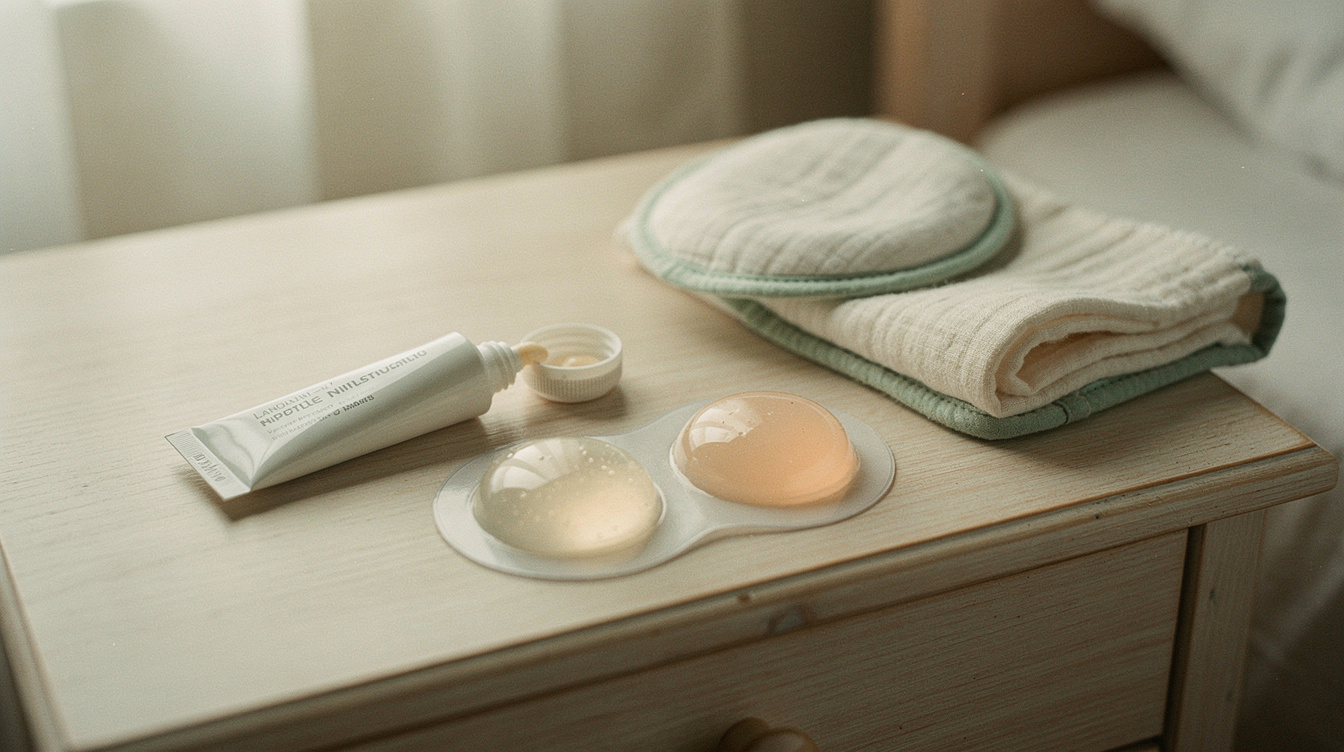
- Try cool or warm relief. The Cleveland Clinic suggests warm compresses or hydrogel nipple pads; La Leche League USA mentions gel pads too, and warns against drying nipples with a hair dryer or sun lamp.
- Give the worse side a break. The Cleveland Clinic suggests alternating breasts during nursing, or pumping and bottle-feeding temporarily while a bad crack heals.
- Expect days to weeks, not months. The Cleveland Clinic puts healing at "anywhere from a few days to a few weeks," with the soreness usually easing before the skin fully closes.
Lanolin or lanolin-free? The sources genuinely differ
The AAP recommends medical-grade purified lanolin, and MedlinePlus recommends 100% pure lanolin after feedings. The Cleveland Clinic instead suggests a lanolin-free nipple balm, and also mentions medical-grade MediHoney gel. We are not going to pretend there is one settled answer here, because there is not. Both approaches aim at the same thing — keeping the wound moist rather than letting it scab and re-crack — and your own pediatrician, OB, or lactation consultant is the right person to pick between them for your skin, especially if you have a wool allergy.
05When to stop managing it yourself
Cracked skin is an open door. The Cleveland Clinic is blunt that without treatment, cracks can bleed and allow bacteria in, which can lead to mastitis or a breast abscess. Call your provider, per the Cleveland Clinic, if the cracks are not healing, your nipple feels swollen or warm, you develop flu-like symptoms, or the pain is interfering with nursing or pumping. MedlinePlus adds a breast that is "warm to the touch, red, or painful" — that one is caused by an infection and needs treatment.
Mastitis deserves its own mention because it feels different from sore skin. The AAP describes it as "swelling, warmth, burning, redness or pain," often with "fever, flu-like symptoms or general aches." Its rule for when to call: "if symptoms continue for more than 24 hours or get worse, contact your doctor." Importantly, you keep nursing — the AAP says frequent nursing helps drain the breast and keeps the infection from worsening, and the antibiotics used "generally do not cause any problems for the nursing infant." Our guide to mastitis covers the whole picture.
This is general information, not medical advice
Nipple pain has a lot of possible causes, and some of them look alike from the outside. A pediatrician, OB, midwife, or an IBCLC-certified lactation consultant can watch an actual feeding and tell you which one you are dealing with — something no article can do. If you have a fever, a red or hot area on the breast, bleeding that will not stop, or pain that is getting worse instead of better, call them today rather than waiting it out.
06It is supposed to get better
The most useful thing to hold onto in a painful week two is that this is almost always temporary and almost always fixable. The AAP says it outright: "In most cases, nipple soreness is a temporary issue and should not stand in the way of successful breastfeeding."
What makes the difference is treating pain as a question to answer rather than a tax to pay. Check the latch, look at the shape of your nipple after a feeding, rule out the pump and thrush, keep the skin moist and soap-free, and ask for hands-on help early instead of at the end of your rope. The rest of the feeding learning curve — burping, hunger cues, how often, how much — is laid out the same sourced way in our newborn basics guide.
Questions parents actually ask
Is it normal for breastfeeding to hurt at first?
Mild tenderness in the first days is common — La Leche League USA says up to 90 percent of nursing parents experience nipple tenderness, and the AAP notes many women find their nipples somewhat sensitive for the first few days. But typical latch-on pain lasts no more than about 30 seconds into the feeding, does not continue between feedings, and leaves no cracks or blisters. Pain beyond that is a signal, not a normal stage.
How long do sore nipples last when breastfeeding?
La Leche League USA describes typical soreness as peaking around day three after birth and resolving within about two weeks. For actual cracks, the Cleveland Clinic estimates healing takes anywhere from a few days to a few weeks once the cause is addressed. Pain that increases or lasts past the first couple of weeks should be treated as a warning that something is wrong.
What is the fastest way to heal cracked nipples?
Fix the cause first — usually the latch — because skin cannot heal while it is being re-injured at every feeding. For the skin itself, the AAP says to gently pat nipples dry and apply colostrum, breast milk, or medical-grade purified lanolin, and MedlinePlus recommends 100% pure lanolin after feedings. The Cleveland Clinic suggests a lanolin-free balm, warm compresses, or hydrogel pads. All of them say to skip soap and harsh washing.
How do I know if my baby's latch is causing the pain?
WIC gives a simple check: if your nipple is pinched, flat, or a different shape than usual after a feeding, the latch likely needs adjusting. The AAP adds to make sure your baby's lips and gums are on the areola as she nurses, not just on the nipple. If it still hurts after you adjust, have a pediatrician or lactation specialist watch a real feeding.
When should I call a doctor about nipple pain?
The Cleveland Clinic says to contact a provider if the cracks are not healing, the nipple feels swollen or warm, you develop flu-like symptoms, or the pain is interfering with nursing or pumping. MedlinePlus adds a breast that is warm to the touch, red, or painful, which is caused by infection. For mastitis specifically, the AAP says to contact your doctor if symptoms continue for more than 24 hours or get worse.
Should I stop breastfeeding until my nipples heal?
Usually no. La Leche League USA's approach is to continue nursing while addressing the underlying cause, and the Cleveland Clinic suggests alternating breasts or temporarily pumping and bottle-feeding to give a badly cracked side a rest. With mastitis the AAP is clear that you should keep breastfeeding or expressing, because frequent draining helps the infection resolve. Your own provider or lactation consultant can tell you what fits your situation.
Sources
- HealthyChildren.org (AAP) — Treating Breast Pain — Many women find nipples somewhat sensitive for the first few days; babies who suck on the nipple without taking enough areola cause a lot of pain; check that lips and gums are on the areola and not just the nipple; vary feeding positions; pat nipples dry and apply colostrum, breast milk, or medical-grade purified lanolin; creams and lotions may make the problem worse; remove plastic breast shells after 30 minutes; avoid plastic-lined nursing pads; do not use soap on the breasts; contact a pediatrician or lactation specialist if self-care is not enough; nipple soreness is usually temporary and should not stand in the way of successful breastfeeding.
- USDA WIC Breastfeeding Support — Help for Sore Nipples — A nipple that is pinched, flat, or a different shape after feeding means the latch may need adjusting; break the latch by inserting a clean finger into the corner of the baby's mouth; nipple trauma from incorrect pump flange size, over-cleaning, and tight clothing; thrush signs include itching, burning, cracked or pink and flaky skin, and shooting pain between feedings; milk blisters appear as smooth, shiny white dots; warm compresses plus gentle massage and expression for blisters; avoid harsh soaps and ointments with astringents; water alone is enough; "you don't need to breastfeed with pain!"
- La Leche League USA — Sore Nipples — Up to 90% of nursing parents experience nipple tenderness; pain that increases or lasts beyond the first couple of weeks is a warning sign; typical latch-on pain lasts no more than 30 seconds into the feeding, is often compared to a bad sunburn, peaks around day three and resolves within two weeks, with no visible skin damage; warning signs include excruciating pain, pain through the whole feeding or between feedings, cracks, blisters, bleeding, and a misshapen nipple; causes include inadequate breast tissue grasp, improper tongue positioning, tongue-tie, flat or inverted nipples; continue nursing while addressing the cause; vary positions; apply expressed milk; ultrapure modified lanolin or coconut oil for moist wound healing; gel pads; avoid hair dryers and sun lamps.
- Cleveland Clinic — Cracked Nipple (Nipple Fissure) — Cracked nipples are common while breastfeeding, especially for first-time nursing parents, and symptoms typically appear during the second or third week after birth; causes include engorged breasts stretching nipple tissue, improper latch, pump suction set too high or incorrect flange size, and frequent non-nutritive suckling; treatment includes lanolin-free nipple balm, medical-grade MediHoney gel, warm compresses or hydrogel nipple pads, unscented soaps and shampoos, alternating breasts or temporarily pumping, and lactation support; healing takes anywhere from a few days to a few weeks; contact a provider if cracks are not healing, the nipple is swollen or warm, flu-like symptoms develop, or symptoms interfere with nursing or pumping; untreated cracks can bleed and allow bacteria to cause mastitis or a breast abscess.
- MedlinePlus (NIH) — Breastfeeding: Skin and Nipple Changes — Apply 100% pure lanolin after feedings for cracked nipples; avoid soaps and harsh washing or drying of the breasts and nipples because it causes dryness and cracking; a breast that is warm to the touch, red, or painful is caused by an infection and needs treatment; scaly, flaking, itchy skin is most often eczema or a bacterial or fungal infection; contact your provider about unusual skin and nipple changes.
- HealthyChildren.org (AAP) — Mastitis: What Breastfeeding Parents Need to Know — Mastitis happens when an area of the breast does not drain enough, leading to inflammation; symptoms include swelling, warmth, burning, redness or pain, plus fever, flu-like symptoms or general aches; contact your doctor if symptoms continue for more than 24 hours or get worse; keep breastfeeding or expressing because frequent nursing helps drain the breast and prevents worsening; treatment includes cold compresses, antibiotics, frequent breastfeeding, rest, fluids, and anti-inflammatory pain medication; the antibiotics used generally do not cause problems for the nursing infant.
Newborn Weeks is planning help, not medical advice — always follow your own doctor, midwife, or pediatrician.
From the gear guide
- Hauck Sport Travel Stroller — our pick in travel strollers
- Mompush Wiz 2-in-1 Stroller — our pick in travel strollers
- Lansinoh Stay Dry Nursing Pads — our pick in pumping & nursing bras
- Frida Mom 2-in-1 Postpartum Ice Maxi Pads — our pick in postpartum recovery
Keep reading
 Postpartum · 12 min read
Perineal Care After Birth: How to Soothe Stitches and Soreness
Perineal care after birth, step by step: ice in the first day, a peri bottle, sitz baths, stitches that dissolve on their own, and when to call.
Read the article Pregnancy · 14 min read
Morning Sickness: When It Starts, What Actually Helps, and When to Call
Morning sickness usually starts around weeks 4 to 9 and eases by 12 to 16. What actually helps, what to skip, and the signs worth calling your provider about.
Read the article Newborn basics · 11 min read
How to Take a Baby's Temperature (and Which Number Actually Counts)
How to take a baby's temperature step by step: why rectal is the number doctors act on, what the armpit and forehead are good for, and the 100.4 rule.
Read the article