The journal · Postpartum
Perineal Care After Birth: How to Soothe Stitches and Soreness
In short
Up to 90% of people who give birth vaginally have some tearing, and the care is simpler than it sounds: ice for the first 24 hours, then a peri bottle of warm water every time you use the bathroom, warm sitz baths a few times a day, acetaminophen or ibuprofen, and stool softeners so the first bowel movement is not a battle. Stitches dissolve on their own — nothing has to be taken out. Most small tears feel much better within about two weeks and are healed by the six-week visit. Call your provider for a fever of 100.4°F or higher, foul-smelling discharge, pain that gets worse instead of better, or heavy bleeding.
Nobody warns you that the first trip to the bathroom after a vaginal birth can feel more intimidating than the birth did. You have been handed a squeeze bottle, a pad roughly the size of a paperback, and a cheerful instruction to "rinse as you go" — and that is about the extent of the briefing before you go home.
So here is the longer version. Perineal care after birth is a short, repeatable routine, and once you know the order of operations it stops being frightening. Below is what the tissue down there is actually doing, the handful of tools that do most of the work, what to hold off on, and the specific symptoms that mean stop reading and call your provider — every piece of it from sources we fetched and checked.
This is general information, not medical advice
Your own OB, midwife, or family doctor knows your delivery, your repair, and your history — and the instructions they gave you win over anything on this page. If something hurts more than it did yesterday, smells wrong, or just feels off, call them. Postpartum questions are not an imposition; answering them is the job.
01What is actually healing down there
The perineum is the stretch of tissue between the vagina and the rectum. As MedlinePlus puts it, "even if you did not have a tear or an episiotomy, the area may be swollen and somewhat tender" — so soreness alone is not evidence that something went wrong.
Tearing is extremely common. The Cleveland Clinic says plainly that "up to 90% of women who give birth will have some tearing during a vaginal delivery." Tears get sorted into four degrees, and knowing which one you had tells you roughly what the next few weeks look like:
- First degree — a minor skin injury that, per the Cleveland Clinic, "usually doesn't require stitches."
- Second degree — the most common kind. It reaches into the muscle underneath and "requires stitches."
- Third degree — extends from the vagina toward the anus and involves the anal sphincter muscles. Stitches are needed.
- Fourth degree — the most severe, reaching through the sphincter into the rectum, sometimes repaired in an operating room with dissolvable stitches.
On the question everyone asks first: nothing has to be taken back out. "Your stitches do not need to be removed. Your body will absorb them," says MedlinePlus, and the Cleveland Clinic puts a timeline on it — "any stitches will dissolve on their own within six weeks."
As for when it stops hurting: the Cleveland Clinic's guidance is that most small tears feel noticeably better within about two weeks, with larger ones taking longer and some discomfort lingering for a month or two. That is the honest range, and it is wide on purpose — a first-degree graze and a third-degree repair are not the same recovery.
02The first 24 hours: ice, and not much else
Day one has exactly one job, and it is swelling. MedlinePlus is direct: "Ask your nurse to apply ice packs right after the birth. Using ice packs in the first 24 hours after birth decreases the swelling and helps with pain." Ob/Gyn Dr. Suzanne Young, writing for the Cleveland Clinic, gives the same instruction: "Ice helps relieve pain and inflammation and is a standard treatment immediately after delivery."
Warm water is the one thing to wait on. MedlinePlus says to "wait until 24 hours after you have given birth" before taking a sitz bath or a warm bath — and when you do bathe, to "use clean linens and towels and make sure the bathtub is clean each time you use it." So: cold first, warm starting tomorrow.
03The routine that does most of the work
After that first day, perineal care comes down to three or four small habits repeated several times a day. None of them is complicated, and all of them are in the sources above.
Your daily perineal care routine
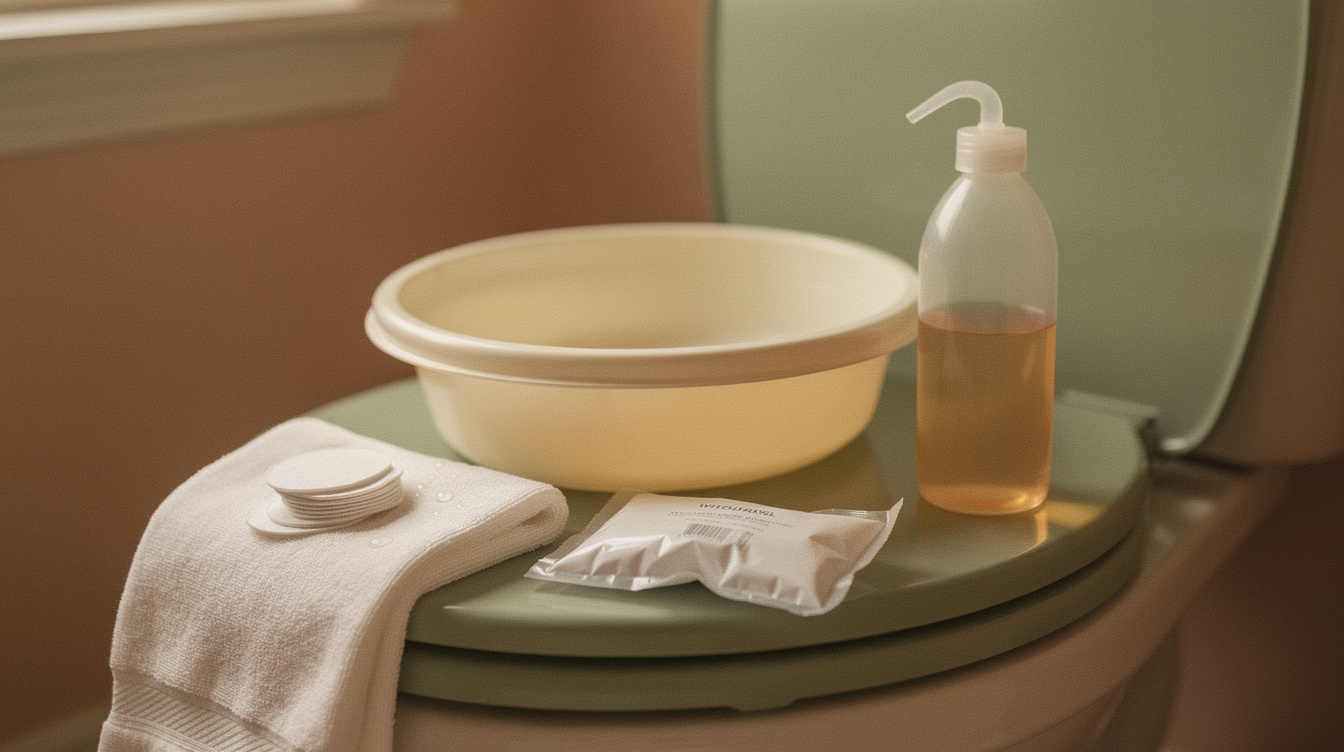
- Rinse instead of wiping. "After you urinate or have a bowel movement, spray warm water over the area and pat dry with a clean towel or baby wipe" (MedlinePlus). Dr. Young's version of the same step: "Fill the bottle with warm water and gently rinse down below after you pee or poop." Pat front to back, never scrub.
- Sitz bath a few times a day. MedlinePlus advises using "sitz baths (sit in water that covers your vulvar area) a few times a day" once you are past the 24-hour mark. Dr. Young explains why it helps: "Soaking in warm water promotes blood flow to the area to speed the healing process."
- Keep cold on hand past day one. The Cleveland Clinic lists ice packs and cooling sanitary pads among standard at-home care, along with witch hazel pads laid on top of a maxi pad and numbing sprays for surface pain.
- Stay ahead of constipation. "Take stool softeners and drink lots of water. This will prevent constipation. Eating lots of fiber will also help" (MedlinePlus). Dr. Young goes further: "We often recommend taking over-the-counter laxatives right after delivery to prevent constipation."
- Sit smarter. For more severe tears the Cleveland Clinic suggests a donut pillow, which takes the pressure off the repair instead of straight onto it.
- Rest like it is part of the treatment. Dr. Young advises avoiding strenuous activity, because rest is what gets healing started in the first days after delivery.
04The bathroom, honestly
Two specific fears are worth naming, because both are normal and both are manageable.
Urinating may sting at first. MedlinePlus says "passing urine may hurt during the first day" and that "most often this discomfort goes away in a day or so." The peri bottle is the fix — warm water running over the area while you go dilutes the urine so it is far less sharp on healing tissue.
The first bowel movement is about pressure, not the stitches. The thing to avoid is straining, which is exactly why every source above puts stool softeners near the top of the list. MedlinePlus also treats a stalled bowel as a reason to call: it lists going four or more days without a bowel movement among the symptoms to report. Our guide to postpartum constipation covers the fiber, fluid, and timing details.
On bleeding, expect it to taper. MedlinePlus notes that "blood flow should gradually decrease during your first day," and that you may pass "a few smaller clots" when a nurse presses on your uterus to check it. What is normal week by week is laid out in our piece on postpartum bleeding.
05Pain relief you can actually take
MedlinePlus keeps it simple: "Take medicine like acetaminophen or ibuprofen to relieve pain." If you are nursing, Dr. Young notes in the Cleveland Clinic article that most pain medications are safe to take while breastfeeding, and she recommends oral ibuprofen or acetaminophen alongside topical options like a numbing spray.
Two things worth saying out loud. First, taking something is not weakness — pain that keeps you from moving, sitting, or sleeping slows everything else down. Second, check with your own provider or pharmacist before adding anything on top of what you were sent home with, especially if you were prescribed something at discharge.
06Pelvic floor exercises: gently, and not on the toilet
Kegel exercises appear in the episiotomy aftercare instructions on MedlinePlus, which tells you to squeeze the muscles you would use to hold in urine. Its dedicated pelvic floor exercise page gives the method in numbers: "Tighten your pelvic floor muscles. Hold tight and count 3 to 5 seconds. Relax the muscles and count 3 to 5 seconds. Repeat 10 times, 3 times a day (morning, afternoon, and night)."
Finding the right muscles is the part people get wrong. MedlinePlus describes it as "like pretending you are urinating and then holding it" — and warns against practicing while you actually urinate more than twice a month, because that can weaken the pelvic floor and strain the bladder and kidneys. It also cautions that overdoing it "can lead to straining when you urinate or move your bowels," and that squeezing too hard can leave the vaginal muscles over-tight and intercourse painful. Expect patience, not speed: "after 4 to 6 weeks, you should have fewer symptoms."
If you had a third- or fourth-degree repair, ask your provider when to start rather than starting on your own. The repair timeline, not the calendar, decides.
07What to hold off on
There is one clear waiting period in the aftercare instructions. MedlinePlus says to wait six weeks before you "use tampons," "have sexual intercourse," or "do any other activity that might rupture (break) the stitches." Dr. Young's advice matches: no sex for six weeks, no strenuous activity, and no straining on the toilet.
Six weeks is the floor, not a deadline you have to meet. The Cleveland Clinic lists painful intercourse among the reasons to call a provider — so if the calendar says six weeks and your body does not agree, that is information to pass along, not something to push through.
08When to call instead of waiting it out
This is the part worth reading twice, because healing should trend in one direction. Pain that is worse on day eight than day four is not part of the plan.
- Pain that is getting worse, or that keeps going despite medication (MedlinePlus; Cleveland Clinic).
- A fever of 100.4°F or higher (Cleveland Clinic).
- Foul-smelling discharge, or stitches that smell or hurt (MedlinePlus; Cleveland Clinic).
- A wound that opens up (MedlinePlus).
- Blood clots larger than a walnut (MedlinePlus), or heavy bleeding soaking through a large pad every hour for two hours in a row (Dr. Young, Cleveland Clinic).
- No bowel movement for four days or more (MedlinePlus).
- Losing control of your bowels, or painful urination that is not settling (Cleveland Clinic).
The CDC's urgent warning signs apply for a full year
Some postpartum symptoms are emergencies regardless of how your perineum is doing. The CDC's Hear Her campaign lists these urgent maternal warning signs: a "headache that won't go away or gets worse over time," "dizziness or fainting," "changes in your vision," "fever of 100.4°F or higher," "extreme swelling of your hands or face," "thoughts about harming yourself or your baby," "trouble breathing," "chest pain or fast-beating heart," "severe nausea and throwing up," "severe belly pain that doesn't go away," "vaginal bleeding or discharge after pregnancy," "severe swelling, redness, or pain of your leg or arm," and "overwhelming tiredness." Its instruction is the one to remember: "If you feel like something just isn't right, or you aren't sure if it's serious, talk to your health care provider" — and "be sure to tell them if you are pregnant or were pregnant within the last year."
09Six weeks, one routine, and someone else holding the baby
Perineal healing is unglamorous and mostly uneventful: rinse, soak, ice, soften, rest, repeat. The reason it is worth doing properly is that it quietly determines how the rest of the first six weeks feel — how you sit to feed, how you sleep, whether a walk to the mailbox is pleasant or a negotiation. Our postpartum recovery timeline sets this alongside everything else happening in those weeks, and the postpartum essentials list covers the peri bottle, pads, and sitz basin worth having in the bathroom before you need them.
And the single most effective thing on the whole list is not a product. It is not being the one who gets up at 3 a.m. while a repair is a week old. If that help is not already lined up, line it up now — that is exactly what this site exists to help you arrange.
Questions parents actually ask
How long does it take for perineal stitches to heal after birth?
They dissolve on their own — the Cleveland Clinic says any stitches will dissolve within six weeks, and MedlinePlus confirms they do not need to be removed because your body absorbs them. For comfort, the Cleveland Clinic's guidance is that most small tears feel considerably better within about two weeks, while larger tears can stay uncomfortable for a month or two and are generally healed by the six-week postpartum visit.
How do I use a peri bottle?
Fill it with warm water and rinse the area every time you use the bathroom. MedlinePlus says to "spray warm water over the area and pat dry with a clean towel or baby wipe" after urinating or having a bowel movement, and Ob/Gyn Dr. Suzanne Young describes the same step for the Cleveland Clinic: fill the bottle with warm water and gently rinse afterward. Pat dry front to back rather than wiping.
When can I start taking sitz baths after giving birth?
After the first 24 hours. MedlinePlus advises waiting until 24 hours after birth before a sitz bath or warm bath, then using one a few times a day, sitting in water that covers the vulvar area. In the first day, ice is the recommended treatment instead — MedlinePlus says ice packs in the first 24 hours decrease swelling and help with pain.
What can I take for perineal pain while breastfeeding?
MedlinePlus lists acetaminophen or ibuprofen for pain relief after an episiotomy or tear, and Dr. Young notes in the Cleveland Clinic's article that most pain medications are safe to take while breastfeeding, recommending oral ibuprofen or acetaminophen plus topical options such as a numbing spray. Check with your own provider or pharmacist before adding anything to what you were prescribed at discharge.
How common is tearing during a vaginal delivery?
Very common. The Cleveland Clinic states that up to 90% of women who give birth will have some tearing during a vaginal delivery. Second-degree tears are the most common type and require stitches; first-degree tears usually do not.
When should I call my provider about perineal pain or stitches?
Call if pain is getting worse or is not controlled by medication, if you have a fever of 100.4°F or higher, foul-smelling discharge, stitches that smell or hurt, a wound that opens, blood clots larger than a walnut, heavy bleeding soaking a large pad every hour for two hours in a row, no bowel movement for four or more days, loss of bowel control, or painful urination that is not settling. The CDC also lists urgent maternal warning signs — including a severe headache, vision changes, trouble breathing, chest pain, and overwhelming tiredness — that warrant immediate care any time within a year of being pregnant.
Sources
- MedlinePlus (NIH) — Episiotomy: Aftercare — Spray warm water over the area and pat dry after urinating or a bowel movement; use sitz baths a few times a day, waiting until 24 hours after birth; ice packs in the first 24 hours decrease swelling and help with pain; take acetaminophen or ibuprofen for pain; take stool softeners, drink lots of water, and eat fiber to prevent constipation; Kegel exercises squeezing the muscles used to hold in urine; stitches do not need to be removed because the body absorbs them; wait 6 weeks before tampons, intercourse, or any activity that might rupture the stitches; call for worsening pain, no bowel movement for 4+ days, blood clots larger than a walnut, foul-smelling discharge, or a wound that opens.
- MedlinePlus (NIH) — After Vaginal Delivery: In the Hospital — Definition of the perineum as the area between vagina and rectum; the area may be swollen and tender even without a tear or episiotomy; ice packs in the first 24 hours decrease swelling and pain; wait 24 hours after birth before warm baths and use clean linens and a clean tub; blood flow should gradually decrease during the first day with a few smaller clots possible; passing urine may hurt during the first day and usually eases in a day or so; stool softeners may be given.
- Cleveland Clinic — Vaginal Tears During Childbirth — Up to 90% of women who give birth have some tearing during a vaginal delivery; the four degrees of tearing, with first degree usually not requiring stitches, second degree the most common and requiring stitches, third degree involving the anal sphincter, and fourth degree reaching the rectum; any stitches dissolve on their own within six weeks; most small tears feel better within about two weeks while larger tears take longer; at-home care including peri bottle, ice packs and cooling pads, sitz baths, stool softeners, over-the-counter pain medication, a donut pillow for severe tears, numbing sprays and witch hazel pads; reasons to call a provider including painful or odorous stitches, fever, worsening pain despite medication, loss of bowel control, painful urination, and painful intercourse.
- Cleveland Clinic Health Essentials — Treating Vaginal Tears After Birth (Dr. Suzanne Young, DO) — Fill the peri bottle with warm water and gently rinse after urinating or a bowel movement; soaking in warm water promotes blood flow to speed healing; ice relieves pain and inflammation and is standard treatment immediately after delivery; most pain medications are safe while breastfeeding, with oral ibuprofen or acetaminophen and topical numbing spray recommended; witch hazel pads on a maxi pad for pain relief; over-the-counter laxatives often recommended right after delivery to prevent constipation; avoid strenuous activity, straining, and sex for six weeks; call a provider for fever of 100.4°F or higher, foul-smelling discharge, or heavy bleeding soaking a large pad hourly for two consecutive hours.
- MedlinePlus (NIH) — Kegel Exercises: Self-Care — A Kegel is like pretending you are urinating and then holding it; tighten the pelvic floor muscles and hold for 3 to 5 seconds, relax for 3 to 5 seconds, repeat 10 times, 3 times a day; fewer symptoms after 4 to 6 weeks; do not practice while urinating more than twice a month because it can weaken the pelvic floor and damage the bladder and kidneys; overdoing it can lead to straining when urinating or moving the bowels; squeezing too forcefully can over-tighten the vaginal muscles and cause pain during intercourse.
- CDC Hear Her — Urgent Maternal Warning Signs and Symptoms — The full list of urgent maternal warning signs, including a headache that will not go away or gets worse, dizziness or fainting, changes in vision, fever of 100.4°F or higher, extreme swelling of hands or face, thoughts about harming yourself or your baby, trouble breathing, chest pain or fast-beating heart, severe nausea and vomiting, severe belly pain that does not go away, vaginal bleeding or discharge after pregnancy, severe swelling, redness, or pain of a leg or arm, and overwhelming tiredness; advice to talk to a health care provider if something does not feel right and to say you are pregnant or were pregnant within the last year.
Newborn Weeks is planning help, not medical advice — always follow your own doctor, midwife, or pediatrician.
From the gear guide
- Munchkin Sparrow Travel Stroller — our pick in travel strollers
- Compact Travel Stroller with Canopy — our pick in travel strollers
- OmniBoost Booster Seat with Tray — our pick in high chairs
- Moonsea Changing Pad Cover 2-Pack — our pick in diaper bags & changing pads
Keep reading
 Pregnancy · 14 min read
Morning Sickness: When It Starts, What Actually Helps, and When to Call
Morning sickness usually starts around weeks 4 to 9 and eases by 12 to 16. What actually helps, what to skip, and the signs worth calling your provider about.
Read the article Newborn basics · 11 min read
How to Take a Baby's Temperature (and Which Number Actually Counts)
How to take a baby's temperature step by step: why rectal is the number doctors act on, what the armpit and forehead are good for, and the 100.4 rule.
Read the article Feeding · 11 min read
Sore Nipples From Breastfeeding: Why It Hurts and What Actually Helps
Sore nipples from breastfeeding are common in the first days — but lasting pain is a warning sign, not a rite of passage. What AAP, WIC, and LLL advise.
Read the article