The journal · Newborn basics
Newborn Reflux and Spit-Up: What's Normal, What Isn't, and What Helps
In short
Spit-up affects about half of young babies and almost always looks worse than it is. It happens because the muscle at the top of your baby's stomach is still developing, so milk comes back up easily. Reflux usually starts in the first weeks, peaks around 4 to 5 months, and clears by 12 to 14 months. What helps: burping during and after feeds, smaller and more frequent feeds, and holding your baby upright for 20 to 30 minutes after eating. No matter how much your baby spits, always put them down on their back to sleep. Call the pediatrician if your baby vomits forcefully after every feed, spits up blood or green or yellow fluid, refuses to eat, or is not gaining weight.
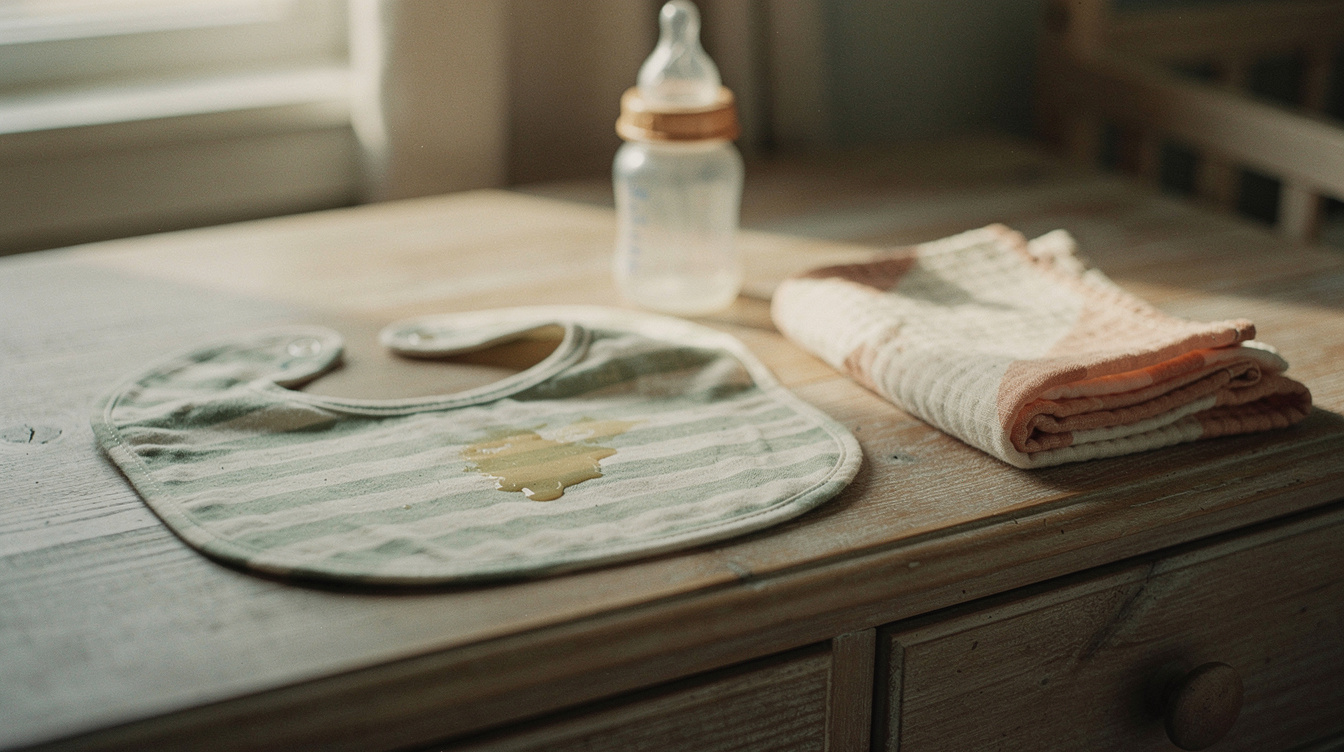
There is a laundry-day version of new parenthood nobody warns you about: a burp cloth on your shoulder at all times, drying constellations of milk stains on the couch, the third outfit change before lunch. If it feels like your baby is spitting up constantly, you are not imagining it — and you are not doing anything wrong. Spit-up is one of the single most common reasons parents call the pediatrician in the first six months of life, and about half of babies do it.
There is also a short, specific list of things that turn "just spit-up" into "call now," and it is worth knowing them cold. Here is what reflux actually is, why it is happening, the small changes that genuinely reduce it, and the warning signs that mean it is not just standard newborn plumbing — with nothing invented in between.
01What "reflux" and "spit-up" actually mean
Doctors use "reflux" and "spit-up" to mean the same thing when they are talking about a baby. As the AAP puts it, "spit-up (also called reflux, gastroesophageal reflux or GER) is the movement of stomach contents into the esophagus" — food goes up when it is supposed to stay down. MedlinePlus puts it in plainer terms: "Gastroesophageal reflux (GER), often called reflux or spitting up, happens when food or milk comes back up from your baby's stomach into the esophagus."
There is a second, more serious version — GERD — but it is uncommon and needs a doctor. Cleveland Clinic draws the line clearly: GER is "an occasional episode of acid reflux that older kids and adults describe as indigestion or heartburn. It's harmless and not a disease." GERD, by contrast, is "chronic acid reflux that may affect a person's quality of life and damage their esophagus." Almost everything parents call "reflux" is the harmless first thing.
02Why it happens — and why it eventually stops
Babies spit up because the muscle at the top of the stomach — the one that keeps food down in you and me — is still under construction. The AAP describes it as a "flap (the esophageal sphincter)" and notes that spit-up "will grow less frequent and stop as your baby's muscles mature — especially that flap." Add a small stomach full of milk plus air, and any bounce, jiggle, or car ride can pop the flap open.
Which is why the timeline is what it is. Cleveland Clinic gives the shape of it: "Infant reflux usually begins at 2 to 3 weeks and peaks at 4 to 5 months. It should fully go away at 9 to 12 months." MedlinePlus adds: "Most babies spit up several times a day during their first 3 months. They usually stop spitting up between the ages of 12 and 14 months." So if you are drowning in burp cloths at week six, that is right on schedule — and if you are still catching spit-up at nine months, that is also right on schedule.
03How much spit-up is actually normal
A lot more than you would think. Seattle Children's describes typical infant reflux as "spitting up 1 or 2 mouthfuls of milk at a time" that happens "with no effort or crying" — and puts the frequency at "half of young babies." Half.
The visual is deceiving. What looks like half a bottle on your shirt is usually a tablespoon of milk mixed with a lot of saliva, spread wide. The tell is not the puddle — it is the baby. A baby who spits up and then goes right back to eating, sleeping, and being a baby is doing exactly what the textbook says babies do. Pediatricians even have a nickname for these babies: happy spitters.
04What actually helps
None of these will make spit-up disappear, and no honest source promises they will. What they will do is meaningfully reduce it. Every tip below comes straight from AAP, NIDDK, or Cleveland Clinic guidance, and none of them require a special product.
Small changes that reduce spit-up
- Burp during a feed, not just after it. Cleveland Clinic says to "burp your baby during and after feedings." The NIDDK says the same thing in one line: "burp your infant more often." Halfway through a bottle, at breast switches, or any natural pause is a burp window — see our how to burp a baby guide for the three positions that actually work.
- Feed a little less, a little more often. The AAP names overfeeding directly and recommends parents "avoid overfeeding" and "feed your baby smaller amounts more frequently." A stomach that is not full to the top has less to send back up.
- Hold your baby upright for 20 to 30 minutes after each feed. NIDDK: "hold the infant upright for 20 or 30 minutes after he or she eats, if practical." Cleveland Clinic gives the same window: "Keep your baby upright for about 30 minutes after they eat." Wear them in a carrier, hold them on your chest, sit and read — anything that keeps gravity on your side.
- Skip the bouncing right after meals. The AAP is direct: "Limit active play after meals and hold your baby upright." That means no jiggly walks, no infant swing on high, no immediate diaper change with the legs in the air. Tummy time is great — after the milk has had time to settle, not right after eating.
- Slow the bottle down. The AAP names overfeeding as the number-one cause, and a fast-flow nipple is how overfeeding happens. Our paced bottle feeding guide covers the WIC-taught method that keeps a feed at 15 to 30 minutes instead of five.
- Keep them out of secondhand smoke. The NIDDK adds one many parents miss: "avoid exposing the infant to secondhand smoke." Smoke exposure worsens reflux.
- Talk to your pediatrician before switching formulas or cutting food groups. For persistent spit-up, some pediatricians will try "a dairy-free diet if you're breastfeeding" or "thickening their formula with a very small amount of baby cereal" (AAP) — but those are prescriptions from your own doctor, not fixes to try on your own.
05The one place parents get this wrong
It feels intuitive that a spitty baby should sleep with their head propped up, or on their side, so they do not choke. It is wrong, and it is dangerous. The NIDDK is unambiguous: a baby "should always be placed on his or her back for sleep." That is true even for babies with reflux, even for babies with diagnosed GERD, and even for babies who spit up a lot at night.
Back to sleep, always — even with reflux
Wedges, inclined sleepers, "anti-reflux" positioners, and side-sleeping are not solutions — they have been linked to sleep-related infant deaths, and the AAP and CDC have specifically recommended against them. Flat, on the back, in a bare crib is the only sleep surface a baby with reflux should be on. If reflux at night is bad enough that you feel you have to prop your baby up, that is a call-your-pediatrician conversation, not a Google-a-hack one. See our safe sleep for newborns guide for the full checklist.
06Spit-up vs. vomiting — how to tell
This is the single most useful thing to be able to do at 2 a.m., and it is not hard. Spit-up is quiet. Seattle Children's describes it as coming with "no effort" and "no pain or crying during reflux." A little milk rolls out, the baby seems fine, and you reach for the burp cloth.
Vomiting looks and sounds different. The same source describes it as "forceful," with the baby appearing "uncomfortable during vomiting." The AAP describes true vomiting as "muscle contractions that occur after every feeding" where "the vomit shoots out with force." That word — force — is the tell. If the milk is arcing across the changing table, that is not spit-up.
07When to call the pediatrician
Most spit-up needs nothing but a laundry basket. This is the list that means pick up the phone — pulled from the AAP, NIDDK, Cleveland Clinic, and Seattle Children's, verbatim in places.
- Forceful, projectile vomiting after every feeding. The AAP: "Always contact your pediatrician if your baby vomits forcefully after every feeding." NIDDK adds "vomiting that is regularly forceful, also called projectile vomiting."
- Blood in the spit-up or vomit, or vomit that looks like coffee grounds. NIDDK: "vomit that contains blood or looks like coffee grounds." Seattle Children's calls "blood in the spit up" a reason to seek care right away.
- Green or yellow fluid in the spit-up. The AAP's GERD guidance flags any "blood or greenish color in the spit-up" as a reason to call.
- Refusing to feed, or feeding poorly. The AAP lists "refusal to feed" as a red flag; MedlinePlus lists "poor eating or refusing to eat" as a GERD symptom.
- Not gaining weight, or losing it. NIDDK: "failure to thrive, meaning that an infant or a child weighs less or is gaining less weight than expected."
- Arching, crying, or acting in pain during or after feeds. The AAP flags "crying and/or arching their back during feeds (like they seem to be in pain)."
- A cough that will not go away, wheezing, or trouble breathing. The AAP GERD guidance lists "respiratory symptoms — including wheezing and coughing."
- A choking episode where your baby turns blue or goes limp. Seattle Children's: seek immediate care if the baby "choked on milk and turned blue or went limp." That is a 911 situation, not a phone call.
- Spit-up that starts before 2 weeks or begins after 6 months. The NIDDK flags either bookend as a reason to be seen.
- In a baby under a month, anything that "looks or acts abnormal in any way." Seattle Children's says this directly for babies under 1 month.
General information, not medical advice
This page is a summary of pediatric guidance from the AAP, NIDDK, Cleveland Clinic, MedlinePlus, and Seattle Children's — not a diagnosis. If any of the signs above match your baby, or if the puddle just feels wrong to you, call your pediatrician's nurse line. That is exactly what they are there for, and reflux is one of the most familiar calls they take.
08When reflux is actually GERD
If spit-up is causing real problems — poor weight gain, chronic irritability, refusing to eat, respiratory symptoms — the doctor may look at whether your child has crossed the line from GER (normal) into GERD (a treatable condition). MedlinePlus describes GERD as "a more serious and long-lasting type of reflux." Cleveland Clinic uses similar framing: "chronic acid reflux that may affect a person's quality of life."
Treatment starts with the same steps as above — burping, upright time, smaller feeds, diet adjustments — and only escalates if those do not work. Cleveland Clinic is careful about medication for infants: providers prescribe it "only when necessary and for as short a time as possible." The NIDDK adds that medicines are reserved for when an infant "has esophagitis or has bothersome GERD symptoms that don't improve after lifestyle changes." Nobody is prescribing an acid blocker to a happy spitter, and nobody should be.
09One last thing
If you take one thing from this page, take this: a baby who spits up a lot and is otherwise happy, eating well, and gaining weight is a normal baby doing a normal thing on a normal schedule. Buy an extra pack of burp cloths, keep the changing-table mat washable, and stop taking pictures of the puddle to text to your mother — it will look exactly the same tomorrow.
And when it stops, sometime between your baby's first birthday and about fifteen months, you will barely remember when it started. Until then, the rest of the newborn learning curve is on our newborn basics guide — burping, sleep, diapers, and when to call the doctor, each one sourced the same way this page is.
Questions parents actually ask
How much spit-up is normal for a newborn?
Seattle Children's describes typical infant reflux as "spitting up 1 or 2 mouthfuls of milk at a time" that happens "with no effort or crying," and puts the frequency at about half of young babies. MedlinePlus adds that most babies "spit up several times a day during their first 3 months." What looks like half a bottle on your shirt is usually a tablespoon of milk spread wide with a lot of saliva — the tell is not the puddle but the baby, who should look content and gain weight.
When does baby spit-up stop?
According to Cleveland Clinic, "infant reflux usually begins at 2 to 3 weeks and peaks at 4 to 5 months. It should fully go away at 9 to 12 months." MedlinePlus puts the outer edge slightly later: babies "usually stop spitting up between the ages of 12 and 14 months." Reflux that continues past 18 months is unusual and worth talking to your pediatrician about.
Can a baby with reflux sleep on their side or with the head elevated?
No. The NIDDK states a baby "should always be placed on his or her back for sleep," including babies with reflux and diagnosed GERD. Wedges, inclined sleepers, and "anti-reflux" positioners have been linked to sleep-related infant deaths and are not recommended. If night reflux feels bad enough to prop your baby up, that is a call-your-pediatrician conversation.
What is the difference between spit-up and vomiting?
Spit-up is effortless — Seattle Children's describes it as coming with "no effort" and "no pain or crying." Vomiting is the opposite: the AAP describes it as "muscle contractions that occur after every feeding" in which "the vomit shoots out with force," and Seattle Children's calls it "forceful" with the baby appearing "uncomfortable." If the milk is arcing across the changing table, that is not spit-up — call your pediatrician.
What actually reduces spit-up?
The AAP, NIDDK, and Cleveland Clinic all recommend the same short list: burp your baby during and after feeds, feed smaller amounts more frequently to avoid overfeeding, and hold your baby upright for 20 to 30 minutes after eating. Avoid bouncing or active play right after meals. If those changes do not help, or if any of the warning signs above show up, talk to your pediatrician before changing formula or diet on your own.
When should I call the doctor about my baby's spit-up?
Call if your baby vomits forcefully after every feed, if there is blood in the spit-up or the vomit looks like coffee grounds, if the fluid is green or yellow, if your baby refuses to eat, is not gaining weight, arches or cries in pain during feeds, has a cough or wheeze that will not go away, or if spit-up starts before 2 weeks or begins after 6 months. Any choking episode where your baby turns blue or goes limp is a 911 call.
Sources
- HealthyChildren.org (AAP) — Why Babies Spit Up — The esophageal sphincter is described as a flap that lets stomach contents back up; spit-up will grow less frequent and stop as the baby's muscles mature; call the pediatrician if your baby vomits forcefully after every feeding or if there is ever blood in the vomit; forceful vomiting is described as "muscle contractions that occur after every feeding" in which "the vomit shoots out with force"; tips to reduce spit-up include "avoid overfeeding," "feed your baby smaller amounts more frequently," "burp your baby more frequently," and "limit active play after meals and hold your baby upright."
- HealthyChildren.org (AAP) — Gastroesophageal Reflux (GER) & GERD — Definition of spit-up as "the movement of stomach contents into the esophagus"; GERD as a disease when reflux is associated with other symptoms or lasts beyond infancy; GERD red flags include refusal to feed, crying and/or arching the back during feeds, blood or greenish color in the spit-up, and respiratory symptoms including wheezing and coughing; treatments include burping in an upright position, keeping the baby upright for about a half hour after feeding, smaller and more frequent feedings, thickening formula with a very small amount of baby cereal, or a dairy-free diet if breastfeeding.
- Cleveland Clinic — Reflux in Babies — Definition of infant reflux as food traveling back up from the stomach into the esophagus; GER as an occasional episode of acid reflux described by older kids and adults as indigestion or heartburn that is harmless and not a disease; GERD as chronic acid reflux that may affect quality of life and damage the esophagus; timeline that infant reflux usually begins at 2 to 3 weeks, peaks at 4 to 5 months, and fully resolves at 9 to 12 months; GERD symptoms including forceful spitting up, refusal to nurse, not gaining weight, and vomiting blood; home tips to burp during and after feedings and keep the baby upright for about 30 minutes after eating; medications used only when necessary and for as short a time as possible.
- MedlinePlus (NIH) — Reflux in Infants — Definition of gastroesophageal reflux as food or milk coming back up from the baby's stomach into the esophagus; reflux is very common in healthy babies and usually starts to get better by 6 months and goes away by 12 months, with reflux beyond 18 months being unusual; most babies spit up several times a day during their first 3 months and stop between 12 and 14 months; GERD as a more serious and long-lasting type of reflux; GERD symptoms include arching of the back during or after eating, coughing, gagging or trouble swallowing, irritability or crying especially after eating, and poor eating or refusing to eat; guidance to hold the baby upright for 30 minutes after feedings.
- NIDDK (NIH) — Treatment for GER & GERD in Infants — Home management guidance to hold the infant upright for 20 or 30 minutes after eating, burp the infant more often, and avoid exposing the infant to secondhand smoke; babies (including those with reflux) should always be placed on their back for sleep; medications for GERD are used when the infant has esophagitis or bothersome symptoms that do not improve after lifestyle changes.
- NIDDK (NIH) — Symptoms & Causes of GER & GERD in Infants — GER symptoms include regurgitation and spitting up; GERD symptoms include arching of the back and abnormal movements of the neck and chin, and choking, gagging, or problems swallowing; call the doctor for symptoms that begin younger than age 2 weeks or older than age 6 months, failure to thrive with poor weight gain, loss of appetite or refusing to eat, vomit that contains blood or looks like coffee grounds, and vomiting that is regularly forceful (projectile vomiting).
- Seattle Children's — Reflux (Spitting Up) — Normal reflux is described as spitting up 1 or 2 mouthfuls of milk at a time with no effort or crying, and occurs in half of young babies; the distinction between spit-up (no pain, no effort) and vomiting (forceful, uncomfortable); seek immediate care for blood in the spit-up, a baby who choked on milk and turned blue or went limp, a baby under 12 weeks whose spitting up changes to forceful/projectile vomiting, and any baby under 1 month who looks or acts abnormal in any way.
Newborn Weeks is planning help, not medical advice — always follow your own doctor, midwife, or pediatrician.
From the gear guide
- Dream On Me Aero Travel Stroller — our pick in travel strollers
- Graco Ready2Jet Compact Stroller — our pick in travel strollers
- Easysleep White Noise Machine — our pick in night lights
- Dream On Me Skylar Bassinet — our pick in bassinets & bedside sleepers
Keep reading
 Newborn basics · 12 min read
Newborn Breathing Patterns: The Pauses, Fast Breaths, and Grunts That Are Normal (and When to Call)
Newborn breathing patterns can look alarming. Learn which pauses, fast breaths, and noises are normal, and the warning signs that mean call now.
Read the article Newborn basics · 12 min read
Thrush in Babies: How to Tell It From Milk Tongue, and What Actually Helps
Thrush in babies looks like milk but won't wipe off. How to tell the difference, how it's treated, and what to do about bottles and breastfeeding.
Read the article Pregnancy · 11 min read
When Do You Feel the Baby Move? First Flutters, Kick Counts, and When to Call
When do you feel the baby move? Most people notice first flutters around 16 to 20 weeks. What they feel like, how kick counts work, and when to call.
Read the article