The journal · Out the door
Newborn Sun Safety: Shade, Hats, and When Babies Can Wear Sunscreen
In short
For babies under 6 months, shade and clothing do the work that sunscreen does for the rest of us. The AAP says to keep babies younger than 6 months out of direct sunlight, and the FDA does not usually recommend sunscreen for them — infants are more prone to side effects like a rash. If shade and clothing are not available, both the AAP and the dermatologists' academy say a small amount of mineral sunscreen on exposed spots like the face is reasonable. Dress the baby in a lightweight long-sleeved layer and a brimmed hat, skip the blanket draped over the stroller, and call the pediatrician right away if a baby under a year gets a sunburn.
The first warm afternoon after a baby is born, somebody always says it: "Get that baby some sun." It is well meant, and it is the one piece of grandmother advice that the medical guidance flatly disagrees with. A newborn's skin is thinner and burns faster than yours, and the standard fix — slather on sunscreen — is the thing pediatric guidance specifically holds back on for the first six months.
So what do you actually do when you want to walk around the block, sit on a friend's patio, or be at an outdoor wedding in August with a five-week-old? Here is what the American Academy of Pediatrics, the FDA, and the American Academy of Dermatology actually say, with nothing filled in between.
01The one rule for babies under 6 months
It is short: stay out of the direct sun. HealthyChildren.org, the AAP's parenting site, puts it in six words — "Keep babies younger than 6 months out of direct sunlight." The American Academy of Dermatology says the same thing and then tells you how to pull it off when there is no tree handy: "Keep your baby in the shade as much as possible, and if you can't find shade, create your own using an umbrella, canopy, or the hood of a stroller."
Timing helps more than most parents expect. The AAP advises limiting sun exposure "between 10:00 a.m. and 4:00 p.m., when UV rays are strongest," and the FDA narrows it to the worst stretch: "It's especially important to keep your baby out of the sun between 10 a.m. and 2 p.m., when the sun is at its strongest." A 9 a.m. or 5 p.m. walk is a different event from a noon one.
And overcast is not off the hook. The AAP notes you can burn on a cloudy day "because up to 80% of the sun's UV rays can get through the clouds," and that UV "can bounce back from water, sand, snow, and concrete." Shade under a patio umbrella next to a bright pool deck is doing less for you than it looks like it is.
02When can babies wear sunscreen?
The general answer is six months. The Cleveland Clinic states it plainly: "babies shouldn't wear sunscreen until they're 6 months old or older." The FDA's article on the question is titled with its own answer — "Not usually" — and gives the reason: "infants are at greater risk than adults of sunscreen side effects, such as a rash."
That is not an absolute ban, and this is the part most articles skip. The AAP's own guidance for babies under 6 months is to "use sunscreen on small areas of the body, such as the face, if protective clothing and shade are not available." The American Academy of Dermatology draws the same line: "Minimize sunscreen use on children younger than six months old. However, if shade and adequate clothing are not available, parents and caretakers may apply a minimal amount of broad-spectrum, water-resistant sunscreen with an SPF of at least 30."
So the order of operations is shade first, clothing second, and a small amount of sunscreen on the parts you cannot cover — not sunscreen as the plan.
Which sunscreen, if you use one
Both the AAP and the dermatology academy point to the mineral kind. The AAD says "sunscreens containing titanium dioxide or zinc oxide are less likely to irritate a baby's sensitive skin," and the AAP recommends zinc oxide or titanium dioxide for sensitive spots like the nose, cheeks, tops of the ears, and shoulders. The Cleveland Clinic explains the difference: chemical sunscreens "have to be absorbed into your skin" to work, while mineral sunscreens "don't need to be absorbed by your skin. They work more like a protective shield." Skip the spray — the Clinic calls sunscreen sprays "the least recommended type because so much gets blown away."
On strength, the two organizations land in slightly different places, and we would rather show you that than pretend they agree. The AAP says to "use a broad-spectrum sunscreen with a sun protection factor (SPF) of at least 15 (up to SPF 50)." The AAD says at least SPF 30. Either way, "broad-spectrum" on the label is the part that matters most — the AAP explains it "means it will screen out both UVB and UVA rays."
Once you are using it, reapplication is where it falls apart. The AAP says to reapply "every 2 hours and after swimming, sweating or drying off with a towel." The AAD adds the reminder that there is "no such thing as 'waterproof' sunscreen." The Cleveland Clinic's timing is the most concrete: apply about 30 minutes before going outside, reapply every two hours if you are staying dry, and every 40 minutes if you are getting wet.
03What to actually put on the baby
Clothing is the sunscreen for a newborn — it never wears off, never needs reapplying, and does not irritate anyone's skin.
The under-6-months sun kit
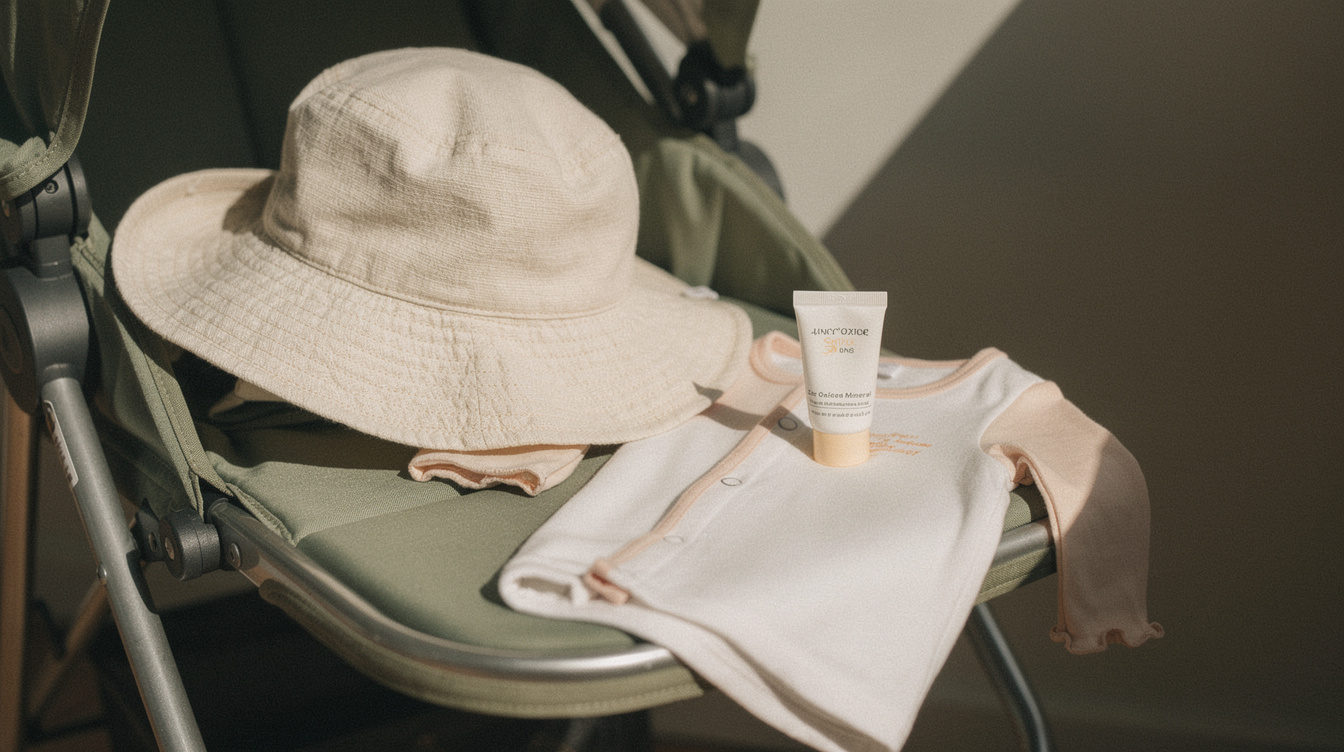
- A lightweight long-sleeved layer. The FDA suggests "dressing infants in lightweight clothing, such as long pants and long-sleeve shirts," and notes that "tight weaves are better than loose ones" — hold it up to a lamp, and the less light you see through it, the more it is blocking.
- A hat with a brim all the way around. The AAP describes "a hat with an all-around 3-inch brim to shield the face, ears, and back of the neck." The FDA is specific about what not to use: a baseball cap, which doesn't "shade the neck or ears."
- Baby sunglasses with UV protection. The AAD says to make sure your baby "always wears a wide-brimmed hat and sunglasses with UV protection" — worth having, even if keeping them on is its own project.
- A stroller canopy, an umbrella, or both. This is the AAD's "create your own" shade. A canopy that extends is worth more on a sunny day than anything in the diaper bag.
- A small tube of mineral sunscreen, for the gaps. Face and the backs of the hands, when shade and clothing have run out. Not the whole body, and not as the first move.
Do not drape a blanket over the stroller
It is the most common improvised sunshade there is, and it backfires. Pediatrician Dr. Katherine Williamson, writing for CHOC Children's, says "a blanket blocks the breeze and traps heat, and it can push the temperature inside the stroller past 100 degrees in just 30 minutes." Her alternative: "Keep the canopy open, point the stroller opening away from the sun, and clip on a portable fan to keep the air moving," and "peek in on your baby every 10 to 15 minutes to make sure they are not getting too warm."
04Heat is the other half of the problem
Sunburn gets the attention, but overheating happens faster and is harder to see. The FDA points out that "younger babies don't sweat like adults do," which means they "can become easily overheated — and have a greater risk of becoming dehydrated."
The fix for a newborn is not water. The FDA's instruction is to "give your child formula or breast milk if you're out in the sun for more than a few minutes," and Dr. Williamson says the same: "Babies younger than 6 months get all the fluids they need from breast milk or formula, so offer it more often on hot days." Signs to watch for, per CHOC: flushed skin, fast breathing, sweaty hair, and extra fussiness.
If you are packing for a day out, our leaving the house guide covers what else belongs in the bag, and our note on newborn dry skin covers the skin questions that come up in every season, not just this one.
05If your baby gets a sunburn
First, watch for the early signal before it becomes a burn. The AAD says that "if your baby is fussy, crying excessively, or developing redness on any exposed skin, take him or her indoors immediately." The FDA lists the same warning signs — fussiness, redness, and excessive crying.
If skin does turn red, the FDA's instruction is to get out of the sun right away, apply cold compresses, and call your baby's pediatrician right away. The AAP is equally direct on this point: if your baby is younger than 1 year old and gets a sunburn, call their doctor right away. A sunburn on an infant is not a wait-and-see situation, and you will not be wasting anyone's time by calling.
This is general information, not medical advice
Every baby's skin is different, and so is every afternoon outside. Anything here about sunscreen, sun exposure, heat, or a burn is worth running past your own pediatrician — they know your baby and can tell you what applies. If your baby gets a sunburn, seems overheated, or is unusually sleepy or hard to rouse after time in the heat, call them. That is exactly what they are there for.
06One myth worth putting down: sun is not how babies get vitamin D
The "give the baby some sun" advice usually comes wrapped in vitamin D. Babies do need it — but the AAP's answer is a supplement, not sunlight. HealthyChildren.org says "breastfed and partially breastfed infants should be supplemented with 400 IU a day of vitamin D beginning in the first few days of life," and that for formula-fed babies, "unless the child is drinking 32 ounces of infant formula per day, a vitamin D supplement is required."
That is the whole reason the shade rule costs a newborn nothing. The drops handle vitamin D; the shade handles the sun. Our guide to vitamin D drops for babies walks through the dose, the timing, and how to give them without a fight.
07The short version you can act on today
Walk early or late, park the stroller in the shade with its canopy up and never a blanket over it, put the baby in a light long-sleeved layer and a brimmed hat, keep a small tube of mineral sunscreen for the face when there is nowhere to hide, and feed more often on hot days. That is the entire protocol, and none of it requires buying much.
The rest of the going-outside learning curve — the car seat, the diaper bag, the first outings — is in our newborn basics guide, each piece sourced the same way this page is. And if you are still pregnant, our free week-by-week planner puts the prep that makes those first outings easier where it belongs: in the weeks before the baby arrives.
Questions parents actually ask
When can babies wear sunscreen?
Generally at 6 months. The Cleveland Clinic says babies shouldn't wear sunscreen until they're 6 months old or older, and the FDA does not usually recommend it for younger infants because they are at greater risk than adults of side effects like a rash. The exception both the AAP and the American Academy of Dermatology allow: if shade and adequate clothing are not available, a small amount of broad-spectrum mineral sunscreen on exposed areas such as the face is reasonable.
Can a newborn be in the sun at all?
Not in direct sunlight. The AAP's guidance is to keep babies younger than 6 months out of direct sunlight. Shade counts — a tree, an umbrella, or the hood of a stroller — and so does timing: the AAP advises limiting sun exposure between 10 a.m. and 4 p.m., when UV rays are strongest, and the FDA singles out 10 a.m. to 2 p.m. as the stretch to avoid.
What kind of sunscreen is safest for a baby?
Mineral. The American Academy of Dermatology says sunscreens containing titanium dioxide or zinc oxide are less likely to irritate a baby's sensitive skin, and the AAP recommends those same ingredients for sensitive areas like the nose, cheeks, tops of the ears, and shoulders. Look for "broad-spectrum" on the label, which the AAP explains means it screens out both UVB and UVA rays. Skip sprays — the Cleveland Clinic calls them the least recommended type because so much gets blown away.
Is it okay to put a blanket over the stroller for shade?
No. Pediatrician Dr. Katherine Williamson, writing for CHOC Children's, says a blanket blocks the breeze and traps heat, and can push the temperature inside the stroller past 100 degrees in just 30 minutes. Use the stroller's canopy instead, point the opening away from the sun, keep air moving, and check on your baby every 10 to 15 minutes.
What should I do if my newborn gets sunburned?
Get out of the sun right away, apply cold compresses, and call your pediatrician. The FDA's guidance is to call your baby's pediatrician right away, and the AAP says to call the doctor right away for any sunburn in a baby younger than 1 year old. Earlier warning signs to act on, per the American Academy of Dermatology, are fussiness, excessive crying, or redness on any exposed skin — take the baby indoors at that point.
Do babies need sunlight for vitamin D?
No — the AAP's answer is a supplement. HealthyChildren.org says breastfed and partially breastfed infants should be supplemented with 400 IU a day of vitamin D beginning in the first few days of life, and that formula-fed babies need a supplement unless they are drinking 32 ounces of formula per day. Keeping a newborn out of direct sun does not put their vitamin D at risk.
Sources
- HealthyChildren.org (AAP) — Sun Safety: Information for Parents About Sunburn & Sunscreen — Keep babies younger than 6 months out of direct sunlight; use sunscreen on small areas such as the face if protective clothing and shade are not available; broad-spectrum sunscreen with SPF of at least 15 (up to SPF 50); broad-spectrum screens out both UVB and UVA; zinc oxide or titanium dioxide for sensitive areas including nose, cheeks, tops of ears and shoulders; reapply every 2 hours and after swimming, sweating or toweling off; limit sun exposure between 10 a.m. and 4 p.m.; a hat with an all-around 3-inch brim; up to 80% of UV rays get through clouds and UV bounces back from water, sand, snow and concrete; call the doctor right away for sunburn in a baby younger than 1.
- U.S. Food and Drug Administration — Should You Put Sunscreen on Infants? Not Usually — Sunscreen is not usually recommended for infants under 6 months; infants are at greater risk than adults of sunscreen side effects such as a rash; keep babies out of the sun especially between 10 a.m. and 2 p.m.; dress infants in lightweight long pants and long-sleeve shirts with tight weaves; a hat with a brim that shades the neck rather than a baseball cap; younger babies don't sweat like adults and can become easily overheated and dehydrated; give formula or breast milk if out in the sun more than a few minutes; warning signs of fussiness, redness and excessive crying; if sunburned, get out of the sun, apply cold compresses, and call the pediatrician right away.
- American Academy of Dermatology — Infant Sun Protection: How Parents Can Keep Their Baby Safe — Keep the baby in the shade as much as possible and create shade with an umbrella, canopy or stroller hood; dress the baby in lightweight long-sleeved shirts and pants plus a wide-brimmed hat and sunglasses with UV protection; minimize sunscreen use under six months but a minimal amount of broad-spectrum, water-resistant SPF 30+ is acceptable when shade and clothing are not available; titanium dioxide or zinc oxide are less likely to irritate a baby's skin; reapply every two hours or after swimming or sweating, and there is no such thing as waterproof sunscreen; take the baby indoors immediately if fussy, crying excessively, or developing redness on exposed skin.
- Cleveland Clinic — What To Know About Sunscreen for Babies — Babies shouldn't wear sunscreen until they're 6 months old or older; chemical sunscreens have to be absorbed into the skin while mineral sunscreens work more like a protective shield; apply about 30 minutes before going outside, reapply every two hours when dry and every 40 minutes when getting wet; sunscreen sprays are the least recommended type because so much gets blown away.
- CHOC Children's — Stroller Safety: Keeping Your Baby Cool on Hot Summer Days (Dr. Katherine Williamson) — A blanket over a stroller blocks the breeze and traps heat and can push the interior temperature past 100 degrees in 30 minutes; keep the canopy open, point the stroller away from the sun and use a portable fan; check on the baby every 10 to 15 minutes; signs of overheating are flushed skin, fast breathing, sweaty hair and extra fussiness; babies under 6 months get all their fluids from breast milk or formula, offered more often on hot days.
- HealthyChildren.org (AAP) — Vitamin D: On the Double — Breastfed and partially breastfed infants should be supplemented with 400 IU a day of vitamin D beginning in the first few days of life; formula-fed infants need a vitamin D supplement unless drinking 32 ounces of infant formula per day.
Newborn Weeks is planning help, not medical advice — always follow your own doctor, midwife, or pediatrician.
From the gear guide
- Munchkin Sparrow Travel Stroller — our pick in travel strollers
- Compact Travel Stroller with Canopy — our pick in travel strollers
- Hiccapop Playard Mattress Pad — our pick in cribs & travel cribs
- BlueSnail Quilted Changing Pad Liners — our pick in diaper bags & changing pads
Keep reading
 Feeding · 13 min read
How to Clean Baby Bottles (and When You Actually Need to Sanitize)
How to clean baby bottles the way the CDC and FDA describe: wash after every feeding, the sink mistake almost everyone makes, and when sanitizing matters.
Read the article Newborn basics · 12 min read
Newborn Breathing Patterns: The Pauses, Fast Breaths, and Grunts That Are Normal (and When to Call)
Newborn breathing patterns can look alarming. Learn which pauses, fast breaths, and noises are normal, and the warning signs that mean call now.
Read the article Newborn basics · 12 min read
Thrush in Babies: How to Tell It From Milk Tongue, and What Actually Helps
Thrush in babies looks like milk but won't wipe off. How to tell the difference, how it's treated, and what to do about bottles and breastfeeding.
Read the article