The journal · Feeding
Vitamin D Drops for Babies: How Much, When to Start, and Why Breast Milk Isn't Enough
In short
If your baby is breastfed or takes less than about 27 ounces of formula a day, the American Academy of Pediatrics wants you to give them 400 IU of vitamin D by mouth every day, starting in the first few days of life. Breast milk is nearly everything a newborn needs — vitamin D is the honest exception. The drops are cheap, concentrated (usually a single drop or 1 mL), and go straight into your baby's mouth or into a bottle. More is not better: infants have a real upper limit, so stick to the 400 IU dose and use an infant product, not an adult one.
Somewhere in the paperwork blur of leaving the hospital, a nurse hands you a tiny amber bottle and says, "give one drop a day." You get home, forget for a week, and then wonder — do I really need to bother with this? Isn't breast milk supposed to be perfect?
It is, with exactly one honest exception. Vitamin D is the nutrient breast milk does not carry enough of, and it is the one thing the American Academy of Pediatrics asks parents to add from the very first days. Here is what the guidance actually says — from the AAP, the NIH, and the big breastfeeding organizations — with nothing invented in between.
01What the AAP actually recommends
The American Academy of Pediatrics puts the number in one line: 400 IU (10 mcg) of vitamin D a day for infants up to age one, and 600 IU a day after that. It applies to "all infants," with one carve-out — formula-fed babies drinking more than 27 ounces daily of vitamin-D-fortified formula are already getting enough.
The timing is not "eventually" — it is "now." As La Leche League International quotes the AAP directly: "A supplement of 400 IU/day of vitamin D should begin within the first few days of life." La Leche League Canada says the same for Canadian babies — 400 IU "starting the first few days after birth," given as drops into the baby's mouth.
That is the whole prescription: 400 IU a day, from day one, forever until they are weaned onto enough fortified milk or formula. Everything else on this page is the why and the how.
02Why breast milk doesn't have enough — and why that is not a failure of breastfeeding
The NIH Office of Dietary Supplements puts it plainly: "Breast milk alone does not provide infants with an adequate amount of vitamin D." That is not a knock on breastfeeding — it is a fact about how the human body was designed to get this particular nutrient.
Vitamin D was meant to come mostly from sunlight on skin, not food. Newborns cannot deliver that safely. The AAP recommends keeping babies under six months out of direct sun altogether, because their skin burns easily and sunscreen is not recommended that young. Breast milk is nearly the whole package a newborn needs; sunlight was meant to close the last gap, and modern life — indoors, latitudes, clothing, sunscreen — doesn't. Drops close it instead.
It is not about your milk supply, your diet, or anything you did wrong. Even a mother taking a normal prenatal vitamin will not pass enough vitamin D through her milk on that dose. There is an alternative that does work — very high-dose maternal supplementation, discussed further down — but for most families, the simpler route is to give the baby the drops directly.
03What vitamin D is actually doing in there
This is what you are protecting against. HealthyChildren.org (AAP) explains that vitamin D "ensures the body absorbs and retains enough calcium and phosphorus, both critical for building strong bones," and adds that it "plays a role in the immune system response and has been linked with mental health."
The classic deficiency disease is rickets, which the AAP describes as "a bone-softening disease that can affect growing children, especially in the first two years of life." It is uncommon in the United States now, and that is largely because most breastfed babies do get their drops. This is not a scare paragraph — it is why the drops exist.
04How to actually give the drops
This is where most of the day-to-day questions live. The good news is that the mechanics are simple, and the AAP has already thought about the dropper problem.
Giving vitamin D drops, step by step
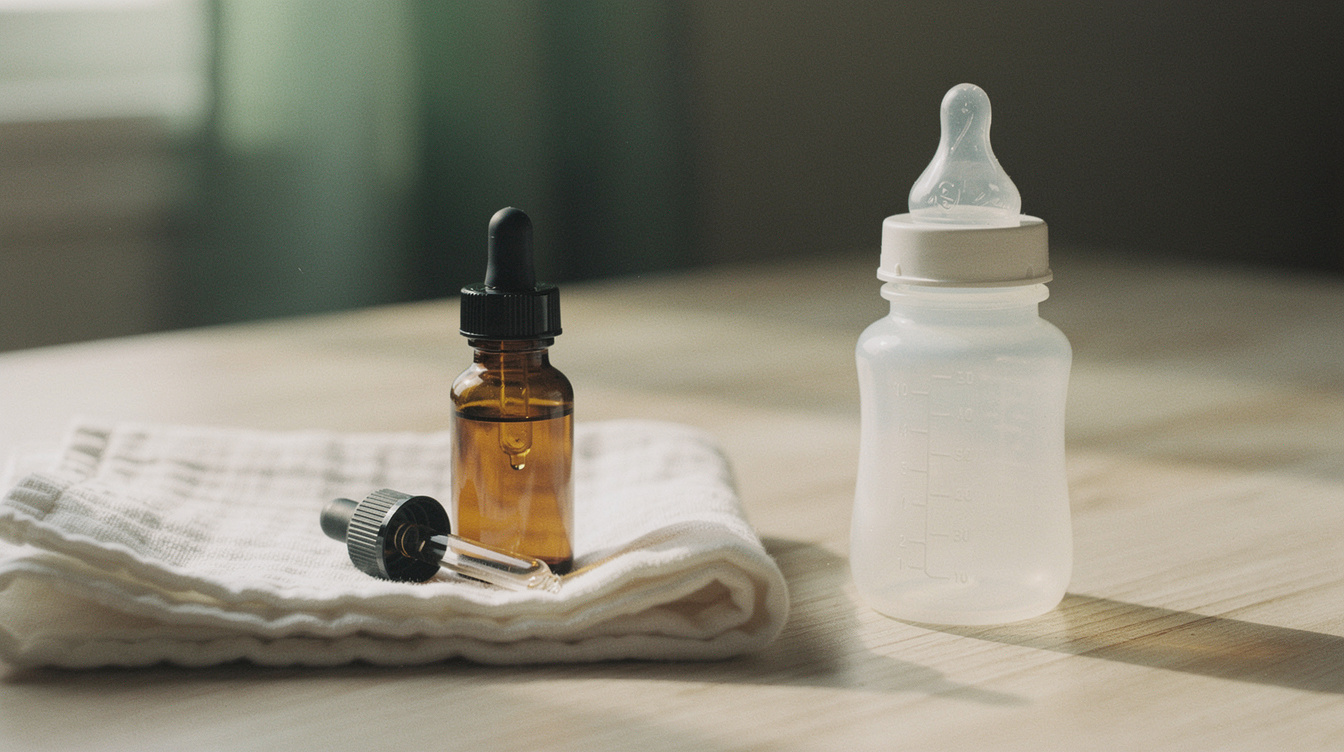
- Buy an INFANT product, not an adult one. The AAP notes that "there are liquid preparations that give the recommended intake of 400 IU in ½ or 1 mL." Infant vitamin D drops are made to deliver 400 IU in a single drop or a tiny fraction of a milliliter — the dose is already measured for you. Adult drops are much more concentrated and are the easiest way to accidentally overdose a baby.
- Give it once a day, at a time you will actually remember. Tie it to a feed you never skip — the first morning feed, or bath time. Consistency matters more than the exact hour.
- Two ways to give it, both are fine. UPMC puts it simply: "You can give your baby vitamin D drops directly in the mouth with a dropper or mix the drops with formula or breast milk." Direct into the cheek, onto the nipple before a feed, into a bottle — pick what your baby tolerates.
- Follow the bottle's own dosing marks. "One drop" and "1 mL" are not the same thing, and the answer is on your specific bottle's label. If the number on the box says 400 IU per drop, one drop is one dose. If it says 400 IU per mL, use the full dropper. Read the label before the first dose.
- Store it where you will see it. On the counter, next to the bottles, not in a drawer. A supplement you cannot see is a supplement you will forget.
Missed a day? Don't double up
If you forget yesterday's dose, give today's dose today and move on. Do not give two doses at once. The daily 400 IU has a lot of margin built in, and one skipped day is not going to hurt your baby — but doubling the dose to make up for it is exactly the wrong instinct with vitamin D, which stores in the body.
05Do formula-fed babies need drops too?
Sometimes yes, sometimes no. Standard American infant formula is fortified with vitamin D, so babies who are drinking enough of it are already covered. The AAP's line is that formula-fed babies do not need extra drops once they are "consuming more than 27 ounces daily" of fortified formula.
In practice, that means a newborn does need drops for the first weeks or months, because a small baby is not yet drinking 27 ounces a day. It also means a combo-fed baby who nurses part of the day and takes some formula the rest of it counts as "partially breastfed" for supplementation purposes and should get the drops, unless the formula share is very large. If you are not sure where your baby falls, ask at the next well-visit — this is exactly the kind of question your pediatrician expects.
06How long to keep going
The AAP wants babies on 400 IU daily until they either "wean" onto enough fortified milk (roughly 32 ounces of vitamin-D-fortified milk or formula a day) or reach a first birthday, whichever comes first. From the first birthday on, the number goes up: 600 IU a day for toddlers and older kids. The Academy of Breastfeeding Medicine actually recommends a full year of drops for breastfeeding infants, "beginning shortly after birth in doses of 10–20 mcg/day (400–800 IU/day)."
Practically, most families give the daily drop until around the baby's first birthday and then switch to fortified whole milk. Your pediatrician will tell you when to stop, based on how much milk your baby is drinking.
07More is not better — the upper limit is real
This is the one part of vitamin D worth taking seriously. It is a fat-soluble vitamin, which means the body stores it — so an overdose is not flushed out the next morning.
The NIH Office of Dietary Supplements lists the tolerable upper limit as 25 mcg (1,000 IU) per day from birth to six months, and 38 mcg (1,500 IU) per day from seven to twelve months — from all sources combined. The recommended 400 IU dose is well inside that. The problem is not the dose you were told to give; it is grabbing the wrong bottle or misreading a dropper.
The two mistakes to avoid
First: never give a baby drops formulated for adults. Adult vitamin D drops can pack 5,000 IU or more per drop — that is more than the daily upper limit in a single squeeze. Second: read the specific bottle you own. "One drop" versus "one dropperful" is the difference between a dose and an overdose. If your baby ever seems suddenly unwilling to feed, is vomiting, has become unusually thirsty, or is very sleepy after starting a new bottle of drops, stop the drops and call your pediatrician right away.
08The alternative some parents ask about: mom takes the vitamin D instead
You may have read that instead of dosing the baby, the mother can take a high dose herself and enrich the milk. That is real, and it works, but it is a much bigger dose than a normal adult multivitamin. La Leche League International summarizes the research this way: "Maternal vitamin D supplementation with 6400 IU/day safely supplies breast milk with adequate vitamin D" to meet the infant's needs — roughly ten times the amount in a typical prenatal vitamin.
This is a real option, but not a DIY one. It requires your own doctor's guidance, ideally blood work to check your starting level, and a specific dose — not just "take extra." For most families, one drop into the baby is easier, cheaper, and comes with no doctor's-visit prerequisite. If you want to go the maternal-dose route, bring it up with your OB and your baby's pediatrician together.
09When to bring it up with your pediatrician
Bring the product you're using to the first well-baby visit and hand it to the pediatrician. They will confirm the dose is 400 IU and that the dropper measurement matches. A few situations deserve a specific conversation, because the standard 400 IU may not be the right number: a premature baby, a baby with darker skin (vitamin D is harder to make from what little sun you get), a baby whose family is largely indoors year-round, and any baby on medications that affect vitamin D absorption.
This is general information, not medical advice
Dose, timing, and product choice are worth confirming with your own pediatrician at your baby's first visit — they know your baby's weight, feeding pattern, and any special situations that change the answer. If your baby is a preemie, has been in the NICU, has a medical condition, or you are considering the high-dose maternal route, please talk to your doctor before starting or stopping any supplement.
10One drop, once a day, that's it
This is one of the small tasks that is easy to forget and then feel guilty about. Don't. Give today's dose today, put the bottle where you will see it, and stop keeping score on missed days. The rest of the newborn learning curve — feeds, sleep, diapers, when to call — is on our newborn basics guide, and if you are still expecting, our free week-by-week planner puts the whole run-up in one place, so tiny things like this bottle of drops don't get lost in the paperwork on the way out the hospital door.
For the surrounding feeding questions — how often, how much, how to store the milk — see our guides to the newborn feeding schedule, paced bottle feeding, and breast milk storage guidelines.
Questions parents actually ask
How much vitamin D does a breastfed baby need?
400 IU (10 mcg) a day, according to the American Academy of Pediatrics. That applies to babies who are fully or partially breastfed, and also to formula-fed babies who are drinking less than about 27 ounces a day of vitamin-D-fortified formula. After a baby's first birthday the recommendation goes up to 600 IU a day.
When should I start giving my baby vitamin D drops?
In the first few days after birth. La Leche League International, quoting the AAP directly, says the 400 IU/day supplement "should begin within the first few days of life." There is no benefit to waiting.
Do formula-fed babies need vitamin D drops too?
Usually only at first. American infant formulas are fortified with vitamin D, and the AAP says babies drinking more than about 27 ounces of fortified formula a day are already getting enough. A brand-new baby who is not yet drinking that much still needs the drops, and so does a combo-fed baby who takes some breast milk and some formula. Ask your pediatrician at the first visit.
Can you give a baby too much vitamin D?
Yes. The NIH's tolerable upper limit is 1,000 IU per day from birth to six months and 1,500 IU per day from seven to twelve months, from all sources combined. Sticking to a product made for infants at the 400 IU dose keeps you well inside that. Most overdoses happen when parents accidentally use adult drops (which can be 10 times more concentrated) or misread "one drop" as "one dropperful." Read your specific bottle's label.
How do you give vitamin D drops to a baby?
Either straight into your baby's mouth with the dropper — cheek or onto the nipple before a feed — or mixed into a bottle of formula or expressed breast milk. UPMC puts it plainly: "You can give your baby vitamin D drops directly in the mouth with a dropper or mix the drops with formula or breast milk." Pick whichever your baby accepts more easily and stick with it.
Do I have to give my baby drops if I take a vitamin D supplement myself?
A normal prenatal vitamin does not get enough vitamin D into your milk to cover your baby. Research has shown that if a breastfeeding mother takes a much higher dose — around 6,400 IU a day — her milk can supply the baby's daily need without direct drops. That is a real option, but it needs your own doctor's guidance and usually a blood test first. For most families, one drop into the baby is the simpler route.
Sources
- HealthyChildren.org (AAP) — Where We Stand: Vitamin D & Iron Supplements for Babies — AAP recommendation of 400 IU (10 mcg) per day for infants up to age one and 600 IU per day for children over one; recommendation applies to all infants; exception for formula-fed babies consuming more than 27 ounces daily of vitamin-D-fortified formula; parents should talk to pediatrician about supplemental drops.
- HealthyChildren.org (AAP) — Vitamin D on the Double — Vitamin D ensures the body absorbs and retains calcium and phosphorus critical for building strong bones; role in immune response and mental health; rickets defined as a bone-softening disease that can affect growing children, especially in the first two years; liquid preparations give 400 IU in ½ or 1 mL; 400 IU for infants under 12 months and 600 IU for older children.
- NIH Office of Dietary Supplements — Vitamin D (Consumer) — Recommended amount for infants birth to 12 months is 10 mcg (400 IU) per day; breast milk alone does not provide infants with an adequate amount of vitamin D; tolerable upper intake limits of 25 mcg (1,000 IU) for infants birth to 6 months and 38 mcg (1,500 IU) for infants 7-12 months; vitamin D helps the body absorb calcium for strong bones and supports muscles, nerves, and immune function.
- La Leche League International — Vitamin D, Your Baby, and You — Direct AAP quote that a supplement of 400 IU/day of vitamin D should begin within the first few days of life; Academy of Breastfeeding Medicine recommends vitamin D supplementation for a year beginning shortly after birth in doses of 400-800 IU/day; research showing maternal vitamin D supplementation with 6400 IU/day safely supplies breast milk with adequate vitamin D.
- La Leche League Canada — Vitamin D and the Breastfed Baby — All breastfed babies should receive 400 IU of vitamin D starting the first few days after birth, given as drops into the baby's mouth; babies under six months should not be in direct sunlight; a mother deficient in vitamin D cannot pass adequate amounts to her baby through milk.
- UPMC HealthBeat — Do Infants Need Vitamin D Drops? — AAP recommends 400 IU of vitamin D daily for babies under 12 months and 600 IU for ages 12-24 months; parents can start giving drops as soon as they come home from the hospital; drops can be given directly in the baby's mouth with a dropper or mixed with formula or breast milk; formula-fed exception for babies consuming more than 27 ounces of vitamin-D-fortified formula daily.
Newborn Weeks is planning help, not medical advice — always follow your own doctor, midwife, or pediatrician.
From the gear guide
- Graco SnugRide SnugFit Infant Car Seat — our pick in infant car seats
- Bugaboo Butterfly 2 — our pick in travel strollers
- TP-Link Tapo C100 Security Camera — our pick in baby monitors
- Skip Hop Moby Smart Sling 3-Stage Tub — our pick in baby bathtubs
Keep reading
 Newborn basics · 12 min read
Newborn Breathing Patterns: The Pauses, Fast Breaths, and Grunts That Are Normal (and When to Call)
Newborn breathing patterns can look alarming. Learn which pauses, fast breaths, and noises are normal, and the warning signs that mean call now.
Read the article Newborn basics · 12 min read
Thrush in Babies: How to Tell It From Milk Tongue, and What Actually Helps
Thrush in babies looks like milk but won't wipe off. How to tell the difference, how it's treated, and what to do about bottles and breastfeeding.
Read the article Pregnancy · 11 min read
When Do You Feel the Baby Move? First Flutters, Kick Counts, and When to Call
When do you feel the baby move? Most people notice first flutters around 16 to 20 weeks. What they feel like, how kick counts work, and when to call.
Read the article