The journal · Newborn basics
RSV in Babies: The Symptoms That Matter and When to Call
In short
RSV is an ordinary respiratory virus that almost every child catches before age two, and in most babies it looks like a bad cold that clears in a week or two. What makes it different in a newborn is the breathing. Call your pediatrician right away for fast or labored breathing, grunting, nostril flaring, tugging between the ribs, pauses in breathing, or fewer than one wet diaper every eight hours. There is no medicine that cures it — saline, suctioning, and frequent feedings are the real treatment — and there are now two ways to prevent the severe version: a vaccine during pregnancy or an antibody shot for the baby.
Your baby has a runny nose. Two days later the cough starts, and by the third night you are lying awake listening to them breathe, counting, trying to decide whether what you are hearing is a stuffy nose or something worse. That is the whole experience of RSV with a newborn — a virus that looks completely ordinary right up until it isn't.
RSV stands for respiratory syncytial virus. It is not exotic and it is not rare: according to HealthyChildren.org, the American Academy of Pediatrics' parent site, "Almost all children get infected with respiratory syncytial virus (RSV) at least once before they are 2 years old." Most of those children get a cold and get over it. The reason RSV gets its own article is that a small share of babies — the youngest ones especially — get something more, and the difference between the two shows up in how they breathe. This page is about learning to tell them apart.
01Why the same virus is worse in a small baby
The virus itself is not stronger in an infant. The airway is just smaller. The AAP explains that in bronchiolitis — the lung infection RSV often causes in babies — the illness "causes the small breathing tubes of the lungs (bronchioles) to swell," and it "occurs most often in infants because their airways are smaller and more easily blocked than in older children" (HealthyChildren.org on bronchiolitis). A millimeter of swelling in a straw-sized tube is a much bigger deal than a millimeter in a garden hose.
That shows up in the numbers. The AAP says "Two to three out of every 100 infants in the U.S. with RSV infection may require a hospital stay," and the CDC puts the same figure specifically on the youngest group: "Two to three out of every 100 infants under 3 months are hospitalized with RSV every year." Before the current immunizations existed, the CDC estimates "58,000–80,000 children younger than 5 years were hospitalized due to RSV each year."
The CDC lists who is at higher risk of a severe case. Plain age is the first item on the list — "the younger the age, the higher the risk" — followed by:
- Babies born prematurely
- Babies with chronic lung disease or congenital heart disease
- Babies with weakened immune systems
- Babies with severe cystic fibrosis
- Babies with neuromuscular disorders that make it hard to swallow or clear mucus
- American Indian and Alaska Native children
If your baby is on that list, say so out loud to your pediatrician at the first runny nose rather than waiting to see how it goes. A plan made on day one is worth a great deal more than a judgment call made at 2 a.m. on day four.
02What RSV looks like at the start
For the first day or two, nothing about RSV announces itself. The AAP's list of the cold-like symptoms is: "Fever (temperature of 100.4 or higher), Cough (dry or wet sounding), Congestion, Runny nose, Sneezing, Fussiness, Poor feeding, Hoarse cry or voice." That is indistinguishable from any other virus going around, which is exactly why parents get caught off guard.
Two details from the CDC are worth holding onto. First, "People infected with RSV usually show symptoms within 4 to 6 days after getting infected" — so the exposure that caused this was probably last week, not yesterday. Second, and more useful at home: "These symptoms usually appear in stages and not all at once" (CDC on RSV symptoms). A baby who seems fine this morning and worse tonight is not a baby who caught something new. That is how this virus moves.
In the very youngest babies, the usual symptoms may barely show up at all. The CDC is direct about this: "In very young infants with RSV, their only symptoms may be irritability, decreased activity, and breathing difficulties." Its infant page adds apnea to the list for babies under six months — "pauses in breathing for more than 10 seconds." So in a newborn, do not wait for a textbook cough. A baby who has gone quiet, floppy, and uninterested in feeding is telling you something, and it counts.
The reassuring half of the picture: "Most RSV infections go away on their own in a week or two," per the CDC. If your baby is feeding, peeing, and breathing comfortably, a week of misery is the likely whole story.
03The breathing signs that change everything
This is the part worth reading twice, because it is the part you can actually observe. When RSV moves from the nose down into the lungs, the work of breathing becomes visible. The AAP's list of bronchiolitis signs is specific:
- Fast breathing
- Flaring of the nostrils and head bobbing with each breath
- Rhythmic grunting during breathing
- Belly breathing, and tugging between the ribs — the skin pulling in below or between the ribs with each breath
Undress your baby's chest and watch it for a full minute in good light. Normal newborn breathing is already irregular and faster than an adult's, so what you are looking for here is effort — a body working hard for air rather than simply breathing fast.
Call your pediatrician right away if you see any of these
HealthyChildren.org says to call right away if your child has "Symptoms of bronchiolitis, Symptoms of dehydration (fewer than 1 wet diaper every 8 hours), Pauses or difficulty breathing." And it names two signs that mean emergency care, not a phone call: "Pale, gray or blue-colored skin, lips or nail beds" and "Significantly less activity and alertness." The AAP's bronchiolitis page says the same thing in plainer words — if it gets very hard for your baby to breathe, "you may notice a bluish tint around their lips and fingertips." A blue or gray baby, or a baby you cannot rouse, is a 911 call.
Dehydration is the quieter of the two dangers, and it sneaks up because a congested baby simply cannot suck and breathe at the same time. The AAP's dehydration signs are "Drinking less than normal, Dry mouth, Crying without tears, Urinating less often than normal." The diaper is your best instrument here: fewer than one wet diaper in eight hours is the threshold to call about. Count them rather than estimating — nobody remembers accurately on three hours of sleep.
The RSV call list, in order
- Any fever in a newborn — call, don't wait. A fever in the first weeks of life is handled differently from a fever in an older baby; our guide to newborn fever and when to call covers the age cutoffs. Call your pediatrician before giving a baby this young any fever medication.
- Fast or labored breathing, grunting, nostril flaring, head bobbing, or tugging between the ribs. Call right away (AAP).
- Any pause in breathing. The CDC counts a pause of more than 10 seconds as apnea in babies under six months. Call right away.
- Fewer than one wet diaper every 8 hours, a dry mouth, or crying without tears (AAP).
- Significantly less activity and alertness, or a baby who has gone unusually floppy and quiet — emergency care (AAP).
- Pale, gray, or blue skin, lips, or nail beds — emergency care (AAP).
- Symptoms that are getting worse rather than better. The CDC's rule is simply to call "if you or your child are having difficulty breathing, not drinking enough fluids, or experiencing worsening symptoms."
04What actually helps at home
Start with the hardest part to accept: there is no medicine that treats this. The AAP states it flatly — "There is no specific treatment for RSV and medications, like steroids and antibiotics, do not help with RSV." Its bronchiolitis page explains why antibiotics come up and why they don't work: "Antibiotics are not helpful because they treat illnesses caused by bacteria, not viruses." If you leave an appointment without a prescription, that is not your pediatrician being dismissive. That is the correct treatment.
What does help is unglamorous and genuinely effective. The AAP's list of home care:
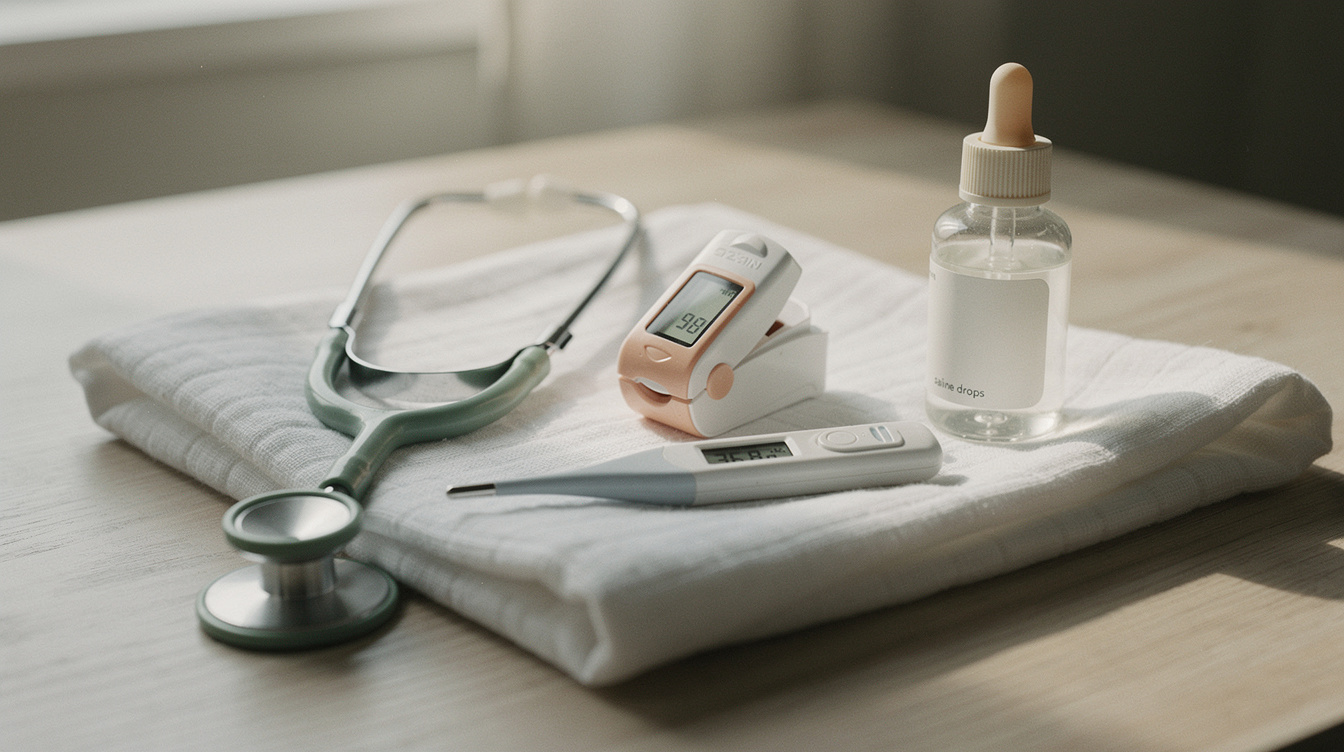
- Nasal saline with gentle suctioning. Saline drops to loosen the mucus, then gentle suction to clear it — ideally right before a feed, so your baby can actually eat. Our guide to newborn congestion walks through the technique.
- A cool-mist humidifier in the room where your baby sleeps.
- Fluids and frequent feedings. The AAP's bronchiolitis advice is to "make sure your baby drinks lots of fluid." Smaller, more frequent feeds usually work better than full ones when a baby is stuffed up — and they are what keeps the diapers wet.
- Fever and comfort medication, which the AAP lists as "Acetaminophen or ibuprofen (if older than 6 months)." Ibuprofen is not for young infants, and dosing in a newborn is a conversation with your pediatrician, not a guess from a box.
Some babies do need more than this, and needing it is not a failure of home care. The AAP notes that "Some children with bronchiolitis need to be treated in a hospital for breathing problems or dehydration." That is what hospitals are for — usually oxygen and fluids for a few days while the virus runs its course.
This is general information, not medical advice
Every baby is different, and a breathing illness in a newborn is exactly the kind of thing that deserves a real set of eyes and a stethoscope. Nothing on this page replaces a call to your own pediatrician, and you never need to justify making that call — if your baby's breathing worries you, that is reason enough. If your baby is struggling to breathe, turning pale, gray, or blue, or cannot be roused, do not call the office. Call 911.
05How it gets into the house
RSV spreads the way colds do. The AAP says "It enters the body through the nose or eyes, usually from contact with infected saliva, mucus or nasal discharge." The CDC adds that it spreads "when a person who has RSV coughs or sneezes near you" or through "direct contact with someone with RSV," and — the detail most people haven't heard — "RSV can survive for many hours on hard surfaces, such as tables and crib rails" (CDC on how RSV spreads).
Two things follow from that. First, the hand-washing and surface-wiping that feel excessive are doing real work. Second, people are contagious for longer than they feel sick: the CDC says "People with RSV are usually contagious for 3 to 8 days," and that "some infants and people with weakened immune systems can continue to spread the virus for 4 weeks or longer." A relative who says their cold is "basically gone" may still be carrying it.
The AAP's own prevention list is short and mostly social: "Stay up to date on vaccines, Limit your baby's exposure to crowds, Wash your hands, Feed your baby breastmilk." This is the honest, medical case for being the unpopular person at the door during the newborn weeks — our guide to newborn visitor rules has the scripts for saying it without a family argument.
06The two ways to prevent the severe version
This is the part of RSV that has genuinely changed, and it is worth knowing before your baby arrives rather than after. The CDC's recommendation is "A maternal RSV vaccine given to the mother during pregnancy or an RSV antibody given to your baby" (CDC, Immunizations to Protect Infants). Most babies need only one of the two, not both.
Route one: a vaccine during pregnancy. The CDC says "The maternal RSV vaccine (Pfizer's Abrysvo) is given during weeks 32-36 of pregnancy," recommended "September through January in most of the U.S.," and that "Maternal antibodies protect the baby against RSV for approximately 6 months after birth." The AAP puts a number on what that buys: it "reduces the risk of RSV hospitalization for babies by 57% in their first 6 months after birth." If you are pregnant in the fall, this belongs on the same list as the other third-trimester shots — one appointment, protection handed to the baby before birth.
Route two: an antibody shot for the baby. Per the CDC, "An infant RSV antibody is recommended for all babies younger than 8 months of age born to mothers who did not receive a maternal RSV vaccine," given "shortly before the RSV season, or within 1 week after birth if born during October through March." Unlike a vaccine, it does not wait for an immune response: "This antibody provides immediate protection against RSV and lasts at least 5 months." The AAP describes this immunization as "about 80-90% effective in preventing infants from being hospitalized with RSV." The CDC also recommends it for a second season for certain high-risk children aged 8 through 19 months.
Which route applies to you depends on the season your baby is born into and whether you had the vaccine in a previous pregnancy, so this is a question for your OB or midwife during the third trimester and for your pediatrician at the first newborn visit. Ask it specifically and early — the infant dose has a window, and the window is narrow.
07One minute, one bare chest, one diaper count
If you remember nothing else from this page, remember the three things you can check yourself without any equipment: watch a bare chest for a full minute and look for effort rather than speed, count the wet diapers, and trust a baby who has gone quiet and limp over a baby who is simply loud and congested. Those three observations are what a pediatrician will ask you about on the phone anyway.
The rest of the newborn learning curve — fevers, breathing, feeding, and the long list of when-to-call thresholds — is on our newborn basics guide, each page sourced the same way this one is. And if you are still pregnant and reading ahead, that is the best possible time to ask about the RSV vaccine: our free week-by-week planner puts questions like that in the weeks where there is still time to act on them.
Questions parents actually ask
How do I know if my baby has RSV or just a cold?
At the start, you often can't — the AAP's list of early RSV symptoms (fever, cough, congestion, runny nose, sneezing, fussiness, poor feeding, a hoarse cry) looks like any cold. The difference shows up in the breathing. Fast or labored breathing, nostril flaring, head bobbing, rhythmic grunting, or skin tugging in between the ribs are the AAP's signs of bronchiolitis, and they mean call your pediatrician right away. A test can confirm RSV, but the decision to call is based on how your baby is breathing and feeding, not the name of the virus.
How long does RSV last in a baby?
The CDC says most RSV infections go away on their own in a week or two. Symptoms usually appear in stages rather than all at once, which is why a baby can seem fine in the morning and worse that night. The CDC also notes that people with RSV are usually contagious for 3 to 8 days, and that some infants can keep spreading the virus for 4 weeks or longer.
When should I take my baby to the hospital for RSV?
HealthyChildren.org lists two sets of signs that mean emergency care rather than a phone call: pale, gray, or blue-colored skin, lips, or nail beds, and significantly less activity and alertness. Call your pediatrician right away — not later — for any sign of bronchiolitis, any pause or difficulty in breathing, or dehydration, which the AAP defines as fewer than one wet diaper every 8 hours. If your baby is struggling to breathe or cannot be roused, call 911.
Is there a medicine that treats RSV in babies?
No. The AAP states that there is no specific treatment for RSV, and that medications like steroids and antibiotics do not help. Antibiotics treat bacterial illnesses, not viruses. What does help is supportive care: nasal saline with gentle suctioning, a cool-mist humidifier, and fluids with frequent feedings. Some babies need a hospital stay for breathing problems or dehydration, which is treated with oxygen and fluids while the virus passes.
Can RSV be prevented in a newborn?
The severe version largely can. The CDC recommends either a maternal RSV vaccine during pregnancy or an RSV antibody given to the baby — most infants need only one. The maternal vaccine (Abrysvo) is given at 32 through 36 weeks of pregnancy, September through January in most of the U.S., and the AAP says it cuts the risk of RSV hospitalization by 57% in the baby's first 6 months. The infant antibody is recommended for all babies younger than 8 months whose mothers did not get the vaccine, gives immediate protection lasting at least 5 months, and the AAP describes it as about 80-90% effective at preventing RSV hospitalization.
Can my baby get RSV from someone who seems better?
Yes. The CDC says people with RSV are usually contagious for 3 to 8 days, which can outlast how sick they feel, and that RSV can survive for many hours on hard surfaces such as tables and crib rails. The AAP's prevention list for babies is to stay up to date on vaccines, limit your baby's exposure to crowds, wash your hands, and feed your baby breastmilk.
Sources
- HealthyChildren.org (AAP) — RSV: When It's More Than Just a Cold — Almost all children are infected with RSV at least once before age 2; RSV spreads like a cold and enters through the nose or eyes from infected saliva, mucus, or nasal discharge; two to three of every 100 infants with RSV may need a hospital stay; the cold-symptom list (fever 100.4 or higher, cough, congestion, runny nose, sneezing, fussiness, poor feeding, hoarse cry); bronchiolitis signs (fast breathing, nostril flaring and head bobbing, rhythmic grunting, belly breathing, tugging between the ribs); call right away for bronchiolitis symptoms, dehydration of fewer than 1 wet diaper every 8 hours, or pauses/difficulty breathing; emergency signs of pale, gray or blue skin, lips or nail beds and significantly less activity and alertness; no specific treatment and steroids/antibiotics do not help; home care of nasal saline with gentle suctioning, cool-mist humidifier, fluids and frequent feedings, acetaminophen or ibuprofen if older than 6 months; prevention list of staying up to date on vaccines, limiting exposure to crowds, hand-washing, and breastmilk; maternal RSV vaccine at 32 through 36 weeks reduces RSV hospitalization risk by 57% in the first 6 months; infant RSV immunization is about 80-90% effective at preventing RSV hospitalization.
- HealthyChildren.org (AAP) — Bronchiolitis — Bronchiolitis causes the small breathing tubes of the lungs (bronchioles) to swell; it is caused by respiratory viruses including influenza, RSV, parainfluenza, and human metapneumovirus; it occurs most often in infants because their airways are smaller and more easily blocked; it often starts with cold signs such as runny nose, mild cough, and fever; a bluish tint around the lips and fingertips when breathing becomes very hard; dehydration signs of drinking less than normal, dry mouth, crying without tears, and urinating less often; antibiotics are not helpful because they treat bacterial illnesses, not viruses; some children need hospital treatment for breathing problems or dehydration; make sure your baby drinks lots of fluid.
- CDC — RSV in Infants and Young Children — Two to three of every 100 infants under 3 months are hospitalized with RSV every year; an estimated 58,000-80,000 children younger than 5 were hospitalized due to RSV each year before immunizations were introduced; the younger the age, the higher the risk; risk factors of premature birth, chronic lung disease, congenital heart disease, weakened immune systems, severe cystic fibrosis, neuromuscular disorders affecting swallowing or mucus clearance, and American Indian and Alaska Native children; symptoms in infants under 6 months of irritability, decreased activity, eating or drinking less, and apnea (pauses in breathing for more than 10 seconds); seek medical attention for difficulty breathing, not drinking enough fluids, or worsening symptoms; prevention via a maternal vaccine in pregnancy or an RSV antibody for the infant.
- CDC — RSV Symptoms and Care — Symptom list of runny nose, congestion, decrease in appetite, coughing, sneezing, fever, and wheezing; symptoms usually appear in stages and not all at once; most RSV infections go away on their own in a week or two; in very young infants the only symptoms may be irritability, decreased activity, and breathing difficulties; people usually show symptoms within 4 to 6 days after getting infected; call a healthcare professional for difficulty breathing, not drinking enough fluids, or worsening symptoms.
- CDC — How RSV Spreads — RSV spreads when a person with RSV coughs or sneezes near you, or through direct contact with someone with RSV; people with RSV are usually contagious for 3 to 8 days; some infants and people with weakened immune systems can continue to spread the virus for 4 weeks or longer; RSV can survive for many hours on hard surfaces such as tables and crib rails.
- CDC — Immunizations to Protect Infants from RSV — A maternal RSV vaccine given during pregnancy or an RSV antibody given to the baby, with most infants needing only one; the maternal vaccine (Abrysvo) is given during weeks 32 through 36 of pregnancy, recommended September through January in most of the U.S.; maternal antibodies protect the baby for approximately 6 months after birth; an infant RSV antibody is recommended for all babies younger than 8 months born to mothers who did not receive the maternal vaccine; the infant dose is given shortly before RSV season or within 1 week after birth if born during October through March; the antibody provides immediate protection lasting at least 5 months; nirsevimab is also recommended for certain high-risk children aged 8 through 19 months.
Newborn Weeks is planning help, not medical advice — always follow your own doctor, midwife, or pediatrician.
From the gear guide
- Munchkin Sparrow Travel Stroller — our pick in travel strollers
- Compact Travel Stroller with Canopy — our pick in travel strollers
- Munchkin Fold Drying Rack — our pick in sterilizers & drying racks
- oogiebear Nose & Ear Cleaner — our pick in nasal aspirators
Keep reading
 Pregnancy · 14 min read
Cord Blood Banking: What It Costs, What It Treats, and What the AAP Recommends
Cord blood banking, explained: what it treats, what private banks charge, and why the AAP recommends donating to a public bank unless a sibling needs it.
Read the article Postpartum · 13 min read
Diastasis Recti After Pregnancy: How to Check for It and What Actually Helps
Diastasis recti affects 6 in 10 women after childbirth. How to check for the gap at home, which exercises help, which to skip, and when to call a provider.
Read the article Pregnancy · 13 min read
Heartburn During Pregnancy: Why It Happens and What Actually Helps
Heartburn during pregnancy hits up to 80% of pregnant people. Why it happens, what actually helps at night, and when it's worth calling your provider.
Read the article