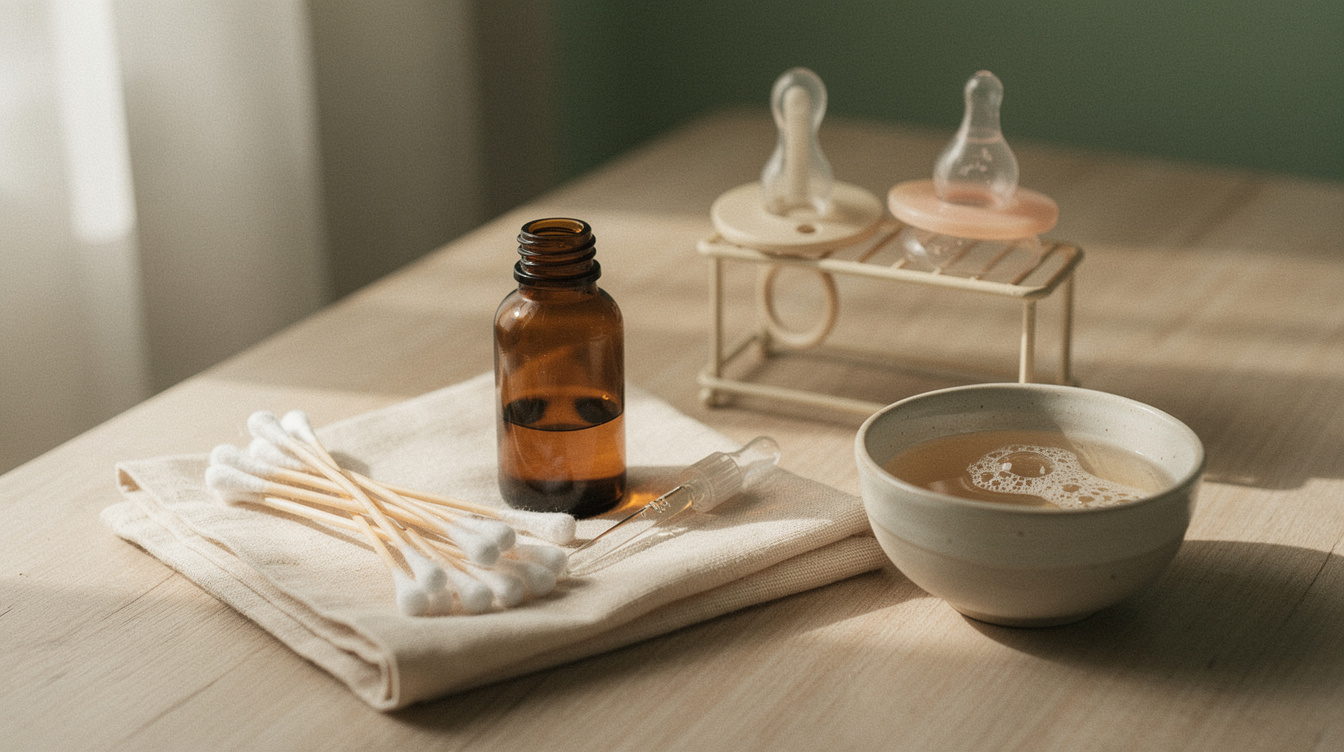
The journal · Newborn basics
Thrush in Babies: How to Tell It From Milk Tongue, and What Actually Helps
In short
Thrush is a yeast infection of the mouth that is common in young babies. A white coating on the tongue alone is usually just milk; thrush shows up as white patches on the tongue, lips, gums, roof of the mouth, or inner cheeks that stick and don't wipe away easily. It usually needs a prescription antifungal from your pediatrician, and with treatment it typically clears in about 4 to 5 days to two weeks. You can keep breastfeeding, and thrush doesn't spread through ordinary contact, but call sooner for a baby under 1 month who seems off, a baby who is drinking less, or signs of dehydration.
Your baby opens wide mid-cry, and there it is: white on the tongue. Maybe on the cheeks, too. You've seen enough late-night search results to know the word thrush, and now you can't stop looking at it.
Most of the time, a white tongue on a milk-fed baby is just milk. Sometimes it's thrush, which is common, very treatable, and not an emergency on its own. Below: how to tell the two apart, what treatment actually involves, what to do about bottles and pacifiers, and what it means if you're breastfeeding. Every claim is sourced, and where the sources disagree (they do, on a couple of points), we say so instead of picking the one that sounds most confident.
01What thrush is, and why babies get it
Thrush is a yeast infection of the mouth. Nemours KidsHealth explains that it's caused by an "overgrowth of a yeast (a type of fungus) called Candida albicans," and that it's "most common in babies younger than 6 months old and in older adults." The AAP's HealthyChildren.org calls oral thrush "common in infants and toddlers," and the Cleveland Clinic lists babies under 1 month old among the groups at higher risk.
Why babies in particular? A few reasons show up across the sources:
- A young immune system. KidsHealth says the overgrowth happens when the immune system is weakened or not yet fully developed.
- Birth itself. HealthyChildren.org notes that newborns can pick up Candida from their mothers during passage through the vagina at birth.
- Antibiotics. KidsHealth explains that antibiotics can kill off the beneficial bacteria that normally keep yeast in check, and MedlinePlus says thrush often happens "when mother or baby has taken antibiotics."
None of that means you did something wrong. Thrush is one of the most ordinary things a young baby can pick up.
02Milk tongue or thrush? How to tell
This is the question almost every parent is really asking, and the HealthyChildren.org thrush guide answers it plainly: "A milk diet often causes a white coated tongue. This is normal." Thrush is different. It shows up as patches that "stick to the mouth. It can't be washed away or wiped off easily like milk curds."
Milk coating vs. thrush, side by side
- Where it is. A milk coating usually sits on the tongue. Thrush patches can appear on the tongue, lips, gums, roof of the mouth, and inner cheeks (HealthyChildren.org). White on the inside of the cheeks or lips is the bigger clue.
- What it looks like. KidsHealth describes thrush as white patches that "look a little like cottage cheese"; MedlinePlus calls them "white, velvety sores." HealthyChildren.org says they can also be yellow.
- Whether it wipes off. Milk comes off with a light wipe. Thrush doesn't wipe away easily, and MedlinePlus notes that thrush sores "may bleed when wiped." So a gentle touch with a clean, damp cloth is enough. If it doesn't come off, stop there. Scrubbing won't answer the question any better, and it can hurt.
- The corners of the mouth. KidsHealth lists "cracked skin in the corners of the mouth" as another sign.
- Redness. MedlinePlus includes redness in the mouth among the symptoms.
03Other signs worth noticing
Some babies with thrush act completely normal. KidsHealth says "some babies may not feed well or are uncomfortable when sucking because their mouth feels sore, but many babies don't feel any pain or discomfort." MedlinePlus lists mood changes, "such as being very fussy," and "refusing to nurse because of soreness."
The other place yeast likes to turn up is the diaper area. MedlinePlus lists diaper rash as a symptom of thrush in newborns, and HealthyChildren.org says Candida "can make a diaper rash worse, producing redness and sensitivity in the affected area." For a yeast-related diaper rash, the HealthyChildren.org guide mentions an over-the-counter anti-yeast cream. It's worth telling your pediatrician about the rash at the same visit. Our guide to diaper rash in newborns covers how a yeast rash looks different from an ordinary one.
04When to call the pediatrician
Thrush on its own is an office-hours call, not a middle-of-the-night one. HealthyChildren.org puts "thrush, but none of the symptoms above" in its call-during-office-hours group, and the reason it gives is practical: your baby "may need a prescription medicine to treat it." But a few things move it up the list.
When to call sooner (from HealthyChildren.org)
- Call or seek care now if dehydration is possible: "No urine in more than 8 hours, dark urine, very dry mouth and no tears."
- Call or seek care now if your baby is under 1 month old and "looks or acts abnormal in any way."
- Call or seek care now if your baby looks or acts very sick.
- Call within 24 hours for a fever, bleeding in the mouth, or drinking less than normal. For how fever works in the first months, see newborn fever: when to call.
- Call within 24 hours if you're breastfeeding and your nipples are red and sore.
This is general information, not medical advice
A white mouth, a fussy feed, or a stubborn rash can have more than one cause, and your pediatrician is the one who can look and tell you which it is. If your baby is under a month old, was born early, or has other health conditions, lean toward calling sooner. Nobody at a pediatric office thinks a thrush question is a waste of their time.
05How thrush is treated
Thrush is usually treated with a prescription antifungal. The Cleveland Clinic names "antifungals (like nystatin)" as the typical treatment and says they "can clear up thrush in one to two weeks." For babies it usually comes as a liquid you put inside the mouth. KidsHealth describes it as "usually applied several times a day by 'painting' it on the inside of the mouth and tongue with a sponge applicator."
Giving the medicine (HealthyChildren.org's instructions)
- Use the amount your pediatrician prescribes. The dose depends on your baby's age, so follow the label rather than a website.
- Put it where the yeast is. "Place in the front of the mouth on each side. Also, put it wherever you see the thrush."
- Four times a day. "Do this 4 times per day."
- Hold the next feed. "Don't feed your baby anything for 30 minutes after the medicine."
- Don't stop when it looks better. "Keep this up for at least 7 days. Also, continue it until all thrush has been gone for 3 days."
How long it takes: HealthyChildren.org says "with treatment, thrush usually clears up in 4 to 5 days. Without treatment, it clears up in 2-8 weeks." Its longer article notes that "once treatment starts, most candidiasis infections get better within about 2 weeks." If the patches aren't fading, or they come back after you finish, call the pediatrician again rather than restarting leftover medicine on your own.
HealthyChildren.org also suggests going easier on the pacifier while the mouth is sore, since a lot of extra sucking can irritate it. That's a short-term adjustment, not a reason to give the pacifier up. Our guide to pacifiers for newborns covers the rest.
06Bottles, pacifiers, and pump parts: the sources disagree
This is the part where you'll find conflicting advice, so here is exactly what each source says:
- HealthyChildren.org's thrush guide: "Pacifiers and bottle nipples can be washed the usual way with soap and water. They do not need to be boiled or sterilized. They do not need to be thrown out."
- HealthyChildren.org's longer article on Candida: "Long-lasting thrush is sometimes related to pacifiers or bottles that have not been properly boiled to remove the fungus."
- KidsHealth: "Thoroughly clean the nipples and pacifiers in hot water or a dishwasher after each use."
- MedlinePlus: clean and sterilize all equipment, including nipples, pacifiers, and other toys that go in your baby's mouth.
- La Leche League GB (a breastfeeding support organization): "Pump parts, infant toys, and other household items do not need to be sterilized."
A middle path covers all of them. Wash everything that goes in your baby's mouth thoroughly after every use, in hot soapy water or the dishwasher. That's the everyday baseline all five agree on. If thrush keeps coming back even with treatment, that's when HealthyChildren.org's point about boiling matters, so ask your pediatrician whether boiling nipples and pacifiers is worth adding. You don't need to throw anything away.
07If you're breastfeeding
You can keep nursing. La Leche League GB says that if your baby is diagnosed with thrush, you can keep breastfeeding as normal, and that there is "no evidence that her stored expressed milk needs to be discarded." The freezer stash stays.
Do you need treatment too? This is the second place the sources differ. MedlinePlus says: "If both you and your baby have the infection, you both need to be treated at the same time. Otherwise, you can pass the infection back and forth." KidsHealth notes that a breastfeeding mother with red, sore nipples may have a yeast infection she can pass to her baby. La Leche League GB takes the other view: "When infants undergo thrush treatment, mothers do not need to undergo antifungal treatment themselves."
In practice, the two positions meet in the middle. If your nipples feel fine, you don't need to treat yourself just because your baby has thrush. If your nipples are red and sore, HealthyChildren.org says to contact your doctor within 24 hours, and if you both turn out to have it, MedlinePlus's advice to treat you both at once applies.
One more thing: nipple pain isn't automatically yeast. La Leche League GB points to research, including a 2021 study titled "It's Not Yeast," suggesting thrush is an unlikely cause of persistent nipple pain. If nursing hurts, have someone look at the latch and the nipple rather than assuming it's thrush. Our guides to getting a good latch and mastitis cover the other usual suspects.
08Is thrush contagious?
Not through ordinary contact. HealthyChildren.org says: "Thrush cannot be spread to others, since it does not invade normal skin. Your child can go to child care with thrush." Siblings can still kiss the baby, grandparents can still hold them, and nobody needs to be kept away. Nursing is the one close-contact situation the sources treat separately, covered above.
09Can you prevent it?
Not completely, and it's worth being honest about that. A young baby's immune system is still developing, which is part of why thrush is so common in the first months. What you can do is small: wash bottle nipples and pacifiers well after each use, and if you or your baby is on antibiotics, keep an eye out for white patches, since MedlinePlus notes that's when thrush often shows up. If it keeps coming back, KidsHealth suggests talking to your doctor, especially once a baby is older than 9 months.
10One less thing to worry about at 3 a.m.
Thrush is one of those newborn things that looks alarming, turns out to be common, and usually clears within a couple of weeks. Check the cheeks, not just the tongue, and try a gentle wipe. If it sticks, call during office hours. The rest of the newborn learning curve lives on our newborn basics guide: feeding, diapers, sleep, and when to call, all sourced the same way this page is. And if you're still pregnant, our free week-by-week planner puts the prep that makes those first weeks easier where it belongs, in the weeks before the baby arrives.
Questions parents actually ask
How can I tell if it's thrush or just milk on my baby's tongue?
Look at where the white is, and try a gentle wipe. HealthyChildren.org says a milk diet often causes a white coated tongue, which is normal. Thrush shows up as white or yellow patches that can also appear on the lips, gums, roof of the mouth, and inner cheeks. Those patches stick and can't be wiped off easily like milk curds. Don't scrub: MedlinePlus notes thrush sores may bleed when wiped.
Does thrush in babies go away on its own?
It can, but slowly. HealthyChildren.org says that without treatment, thrush clears up in 2 to 8 weeks, and with treatment it usually clears in 4 to 5 days. Because it can make feeding uncomfortable for some babies, and because a prescription antifungal is the usual treatment, it's worth calling your pediatrician during office hours if you think your baby has it.
Can I keep breastfeeding if my baby has thrush?
Yes. La Leche League GB says you can keep breastfeeding as normal after a thrush diagnosis, and there is no evidence that stored expressed milk needs to be thrown out. If your nipples become red and sore, HealthyChildren.org says to contact your doctor within 24 hours, and MedlinePlus advises that if you both have the infection, you should both be treated at the same time.
Do I need to sterilize bottles and pacifiers if my baby has thrush?
The sources disagree. HealthyChildren.org's thrush guide says pacifiers and bottle nipples can be washed the usual way with soap and water and don't need to be boiled, while MedlinePlus recommends sterilizing them and KidsHealth recommends hot water or a dishwasher after each use. A thorough wash after every use satisfies all of them. If thrush keeps coming back, ask your pediatrician about boiling, since HealthyChildren.org notes long-lasting thrush is sometimes related to pacifiers or bottles that haven't been properly boiled.
Is thrush contagious to other kids or adults?
Not through ordinary contact. HealthyChildren.org says thrush cannot be spread to others because it does not invade normal skin, and a child with thrush can go to child care. Breastfeeding is the one close-contact case the sources treat separately.
When should I call the doctor about thrush?
For thrush alone, call during office hours, since your baby may need a prescription. Call within 24 hours for a fever, bleeding in the mouth, or drinking less than normal. Call or seek care right away for signs of dehydration (no urine in more than 8 hours, dark urine, very dry mouth, no tears), for a baby under 1 month old who looks or acts abnormal in any way, or for a baby who looks very sick. That guidance comes from HealthyChildren.org.
Sources
- HealthyChildren.org (AAP) — Thrush (Symptom Checker) — Milk diet often causes a normal white coated tongue; thrush patches stick and can't be wiped off easily like milk curds; when to seek care now, within 24 hours, and during office hours; anti-yeast medicine placement, 4 times per day, no feeding for 30 minutes after, at least 7 days and until thrush gone for 3 days; pacifiers and bottle nipples can be washed with soap and water and don't need boiling; limit pacifier use; call within 24 hours for red, sore nipples; OTC anti-yeast cream for yeast diaper rash; clears in 4-5 days with treatment and 2-8 weeks without; not spread to others, child can attend child care.
- HealthyChildren.org (AAP) — Thrush and Other Candida Infections — Oral thrush is common in infants and toddlers; white or yellow patches on the tongue, lips, gums, palate, and inner cheeks; newborns can acquire Candida during vaginal birth; Candida can make diaper rash worse; most infections improve within about 2 weeks of starting treatment; long-lasting thrush is sometimes related to pacifiers or bottles not properly boiled.
- Nemours KidsHealth — Oral Thrush — Caused by overgrowth of Candida albicans; most common in babies under 6 months; white cottage-cheese-like patches that can't be wiped away; cracked skin at the corners of the mouth; some babies feed poorly while many feel no discomfort; weakened or immature immune system and antibiotics killing beneficial bacteria as causes; antifungal painted on with a sponge applicator several times a day; clean nipples and pacifiers in hot water or a dishwasher after each use; sore nipples in breastfeeding mothers may be yeast; see a doctor for recurring thrush after 9 months.
- MedlinePlus (NIH) — Thrush in Newborns — White, velvety sores that may bleed when wiped; redness in the mouth; diaper rash; fussiness and refusing to nurse; often follows antibiotics taken by mother or baby; antifungal medicine painted on the mouth and tongue; if both mother and baby have the infection, treat both at the same time; clean and sterilize nipples, pacifiers, and toys.
- Cleveland Clinic — Thrush — Babies under 1 month old are at higher risk; antifungals like nystatin are typical treatment; antifungals can clear thrush in one to two weeks.
- La Leche League GB — Thrush and Breastfeeding — Continue breastfeeding after a thrush diagnosis; no evidence stored expressed milk must be discarded; mothers do not need antifungal treatment when infants are treated; pump parts, toys, and household items do not need sterilizing; research including Betts et al. (2021), "It's Not Yeast," suggests thrush is an unlikely cause of persistent nipple pain.
Newborn Weeks is planning help, not medical advice — always follow your own doctor, midwife, or pediatrician.
From the gear guide
- Compact Travel Stroller with Canopy — our pick in travel strollers
- Mamazing Ultra Air Stroller — our pick in travel strollers
- Acrabros Baby Wrap Carrier — our pick in baby carriers
- Luvs Platinum Protection Diapers — our pick in diapers & wipes
Keep reading
 Postpartum · 12 min read
Perineal Care After Birth: How to Soothe Stitches and Soreness
Perineal care after birth, step by step: ice in the first day, a peri bottle, sitz baths, stitches that dissolve on their own, and when to call.
Read the article Pregnancy · 14 min read
Morning Sickness: When It Starts, What Actually Helps, and When to Call
Morning sickness usually starts around weeks 4 to 9 and eases by 12 to 16. What actually helps, what to skip, and the signs worth calling your provider about.
Read the article Newborn basics · 11 min read
How to Take a Baby's Temperature (and Which Number Actually Counts)
How to take a baby's temperature step by step: why rectal is the number doctors act on, what the armpit and forehead are good for, and the 100.4 rule.
Read the article